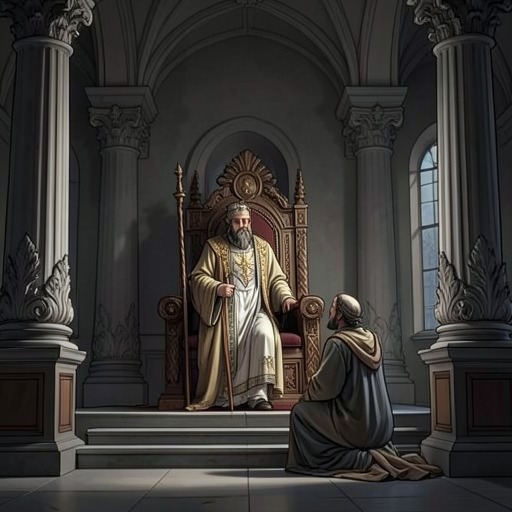
Zhou Guo
I ChingZhou was a western principality of the Shang kingdom, associated with a lineage of capable and virtuous rulers and, above all, with King Wen. Its political position made it a counterweight to the Shang court, while its name became attached to the Changes of Zhou, the surviving text of the I Ching. The account also connects Zhou with the text’s formation: during his imprisonment at Youli, King Wen is said to have worked with the hexagram figures and given them interpretive names and judgments.
Territory and Political Position
Zhou lay in the western portion of the kingdom, in what is now Shaanxi. By King Wen’s time, its ruler was not merely a local lord: King Wen had become a kind of viceroy over a large part of the kingdom. The principality’s standing rested on a reputation for ability and virtue, and its chief was portrayed as distinguished in both peace and war. Yet the political contrast between Zhou and Shang was not simply a contest of power. Although princes and people would have welcomed an attack on the tyrant, King Wen hesitated to expose himself to the charge of disloyalty.
That restraint became more difficult as Shang’s King Shou grew suspicious of him. King Wen was imprisoned in 1143 BC, with the order for his death potentially imminent. The narrative thus presents Zhou as possessing both the capacity to challenge the ruling power and a ruler cautious about acting before the political grounds for rebellion could be made clear.
Zhou and the Early Text of the I Ching
The Official Book of the Zhou dynasty records the office of the Grand Diviner as having charge of three systems of Changes: Lien-shan, Kwei-zhang, and the Changes of Zhou. Each system is said to have had eight primary figures, multiplied to produce sixty-four. The date of the Official Book is uncertain, and the passage is difficult to reconcile with the view that the book was composed by the Duke of Zhou. The account nevertheless argues that the record rests on an early foundation: the Changes of Zhou already existed among the kingdom’s archives under the care of a high officer.
The other two named systems leave no surviving trace, whereas the Changes of Zhou survives as the text distinguished from its later Appendixes. This documentary reference gives Zhou a place in the institutional history of divination as well as in the political history of the western kingdom: the principality’s name identifies one of the three recorded systems, but only its text remained available for later study.
King Wen, Imprisonment, and Interpretation
Divination by figures was already an established practice, and the use of stalks and tortoise shell is described in early traditions. King Wen would therefore have known divination as a feature of his country’s institutions. The account speculates that studying the figures might also have seemed innocuous to his captors, who could have dismissed the lines and attached sentences as harmless occupation. It then offers a deliberately personal reconstruction of King Wen in prison at Youli, with the sixty-four figures arranged before him.
In this reconstruction, King Wen connected each hexagram with qualities of nature, principles of society, or the actual and possible condition of the kingdom. He named the figures for the ideas he associated with them and added either exhortation or warning. The interpretation is presented as an effort to bring divination’s uncertainties within the bounds of reason. The book’s account distinguishes this proposed work on the figures from the later Appendixes, including the Sequence of the Diagrams, which discusses the hexagram names and their order in an explanatory rather than critical manner.
Zhou in the Transmission of the Classic
The account assigns the text to King Wen in 1143 BC and to the Duke of Zhou, his son, roughly thirty to forty years later. It emphasizes that the older Text and the Appendixes should not be treated as a single work: even if some Appendixes were composed in the Confucian period, they would be centuries later than the material attributed to King Wen and the Duke of Zhou. Their separation matters because the later writings can shape how readers interpret the earlier text and its figures.
The classic’s subsequent transmission further demonstrates how Zhou’s textual legacy was preserved and rearranged. The I Ching escaped the book burning of 213 BC because it was classified as a work of divination, a category exempted from the order to burn old books. By the beginning of the Common Era, Liú Xin’s catalogue listed works on the I Ching and its Appendixes from thirteen authors or schools, in 294 portions. The imperial edition published in 1715 quoted 218 commentators, while the Khang-hsî editors printed Text and Appendixes separately. Common editions, by contrast, had interspersed five Appendixes with the Text, a layout the account criticizes for confusing the interpretation of the older material. Zhou’s significance therefore persists not only in the name of the surviving text, but in the later disputes over its authorship, arrangement, and meaning.