“A little lost lamb”
Impure Blood“A little lost lamb” is the recurring image that turns a mother’s affectionate recollection into a clue to Corinne Delage’s past. In the investigation, the phrase suggests that Corinne was not the Groismonts’ biological child and supports the theory that she was Olivie, separated from her family during the wartime deportations.
The phrase in the family record
In a photograph dated summer 1949, a young Corinne appears with the Groismont family. A note on its reverse calls it a picture of the whole family: Mama, Papa, Antoine, and the child who would become Corinne Delage. The scene offers no proof of what the family’s life was like beyond the photograph, but it gives the investigators a visual record of Corinne as a child already incorporated into the household.
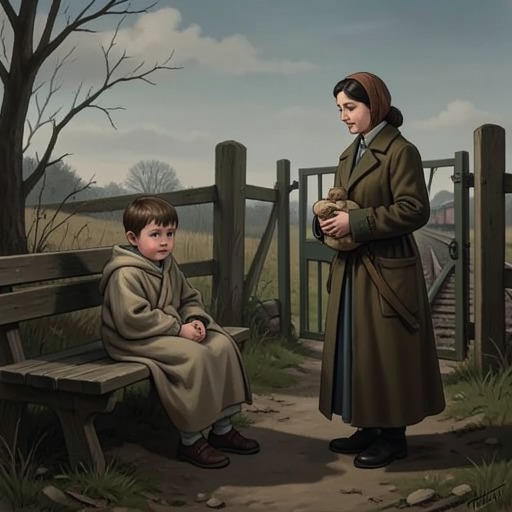
A more unsettling clue appears in a letter Corinne received from her mother in 1987, a month before her mother died. She wrote that she would never forget the day Corinne became part of their lives, “wandering in like a little lost lamb.” The words are tender on their surface, but their unusual account of the child’s arrival catches Paul Darac’s attention. He cannot settle on what they mean, yet senses that one of his possible explanations may contain the key to the case.
From metaphor to hypothesis
When Paul Darac and Bonbon reconsider the letter, the image becomes more than a family endearment. Bonbon emphasizes its wording: Corinne is described as “lost” and “wandering,” not as having arrived with someone who brought her to the farm. The distinction suggests that she came alone. Because Madame Groismont was not Jewish, and Corinne’s original birth certificate had been lost, the investigators suspect that the registered family history conceals a different beginning.
The setting gives that suspicion a possible route. Grandeville was a small rural community, but the Groismont farm lay beside the main railway line from Paris to the southeast, used to transport Jews from Nice to the Drancy internment camp. Paul Darac proposes that Corinne may have been on one of those trains and escaped when it slowed or stopped near the farm. Accounts of prisoners cutting holes in train carriages or forcing apart planking make it conceivable that a child could have been passed through an opening. The letter does not establish that this happened; it gives the investigators a phrase whose implications can be tested against the wartime records.
The lost lamb and Olivie
The image returns when the team considers Olivie, a girl who went missing somewhere between Nice and Drancy. Armani insists that the lost-lamb scenario at the Grandeville farmhouse must not be forgotten, while acknowledging that the resemblance remains suggestive rather than certain. Paul Darac then points to the dates: the Djourescus were deported to Drancy on 10 October 1943, and the Groismonts’ re-registered certificate gives Corinne’s birth date as 10 October 1940.
For Paul Darac, the shared date indicates that the certificate preserves not the child’s actual birth but the beginning of her new life with the Groismonts. Read alongside the mother’s letter, the date supports the identification of Corinne as Olivie, the child who disappeared during the deportation journey. The lost lamb image thus links an intimate family memory to a historical rupture: a child’s arrival at a farm may have been the aftermath of her separation from her family on a train to Drancy.
Narrative significance
The phrase matters because it is both emotionally soft and evidentially sharp. The letter remembers Corinne’s arrival as a moment of belonging, yet its language of wandering and loss leaves open the possibility that belonging began with abandonment, flight, or rescue. The investigators do not treat the metaphor alone as proof; its force comes from its conjunction with the lost birth record, the railway’s route, the missing girl, and the date preserved on the re-registered certificate.
As the inquiry advances, “lost lamb” recurs as shorthand for the hypothesis connecting Corinne’s childhood to Olivie’s disappearance. Its movement from private letter to investigative argument shows how a seemingly affectionate phrase can carry historical evidence: the family’s account of when Corinne became one of them also hints at what had happened to her before that moment.