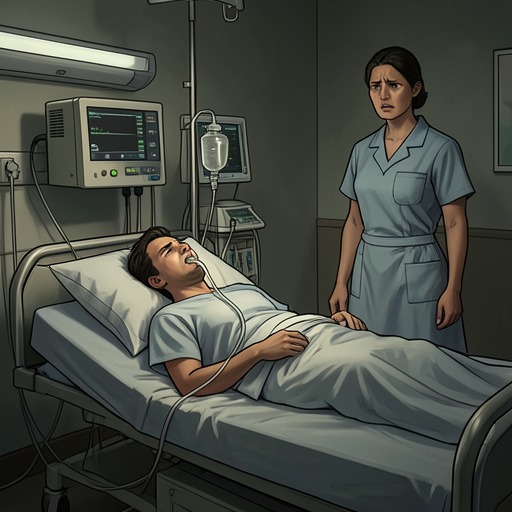
Conscious paralysis of the ICU patient
Impure BloodThe ICU patient’s paralysis is presented not as an absence of mind but as a severe mismatch between awareness and the ability to act. Unable to speak or move freely, he depends on blinking to answer questions and express what he wants. That restricted channel turns ordinary care into a question of interpretation: those around him may ask, but they must also understand what his response means. The recurring contrast between his vivid inner life and the body that cannot carry it into speech gives the condition its decisive significance in the novel.
Awareness and the Hospital Routine
He measures the hospital through details available to him, including the two displays on the climate-control unit. One shows the room’s intended temperature and the other its actual temperature; both read 21.2 degrees. At first the matching numbers reassure him. When he wakes again and sees the same reading, however, he wonders whether the figures are accurate or merely frozen on the display. His suspicion exposes how little he can verify from the bed: even the apparent certainty of a number depends on equipment and information he cannot test for himself.
The distinction between ordinary inpatient life and intensive care sharpens that confinement. In a general ward, he recalls a day divided into breakfast, washing, medication rounds, clinic or MRI visits, the periodicals and drinks trolleys, lunch, a nap, dinner, visitors, and perhaps television before sleep. These routines may be tiring, but their sequence gives the day shape. In intensive care he has no meals to anticipate and no dependable distinction between day and night. The drip-fed patient experiences a sameness that he describes as a prelude to death, a condition in which time itself loses its ordinary landmarks.
His perception is nevertheless active and discriminating. He listens to voices arriving with a shift change and distinguishes between a nurse who is energetic but too occupied to consider his wish for a television and another voice that might belong to the nurse he hopes will ask. He recognizes that not all staff approach him in the same way, even while he is unable to identify everyone by sight or make himself heard. His account therefore separates physical dependence from mental passivity: he observes, compares, anticipates, and judges what happens around him.
Blinking as Communication
Blinking is his principal means of answering the staff. When a nurse asks whether he feels all right and whether he is comfortable, he blinks once to answer each question. The exchange establishes a workable convention, but it does not make communication effortless. A signal has to be solicited, recognized, and interpreted correctly; a small movement carries more weight because he has so few ways to clarify it.
The television question makes that vulnerability unmistakable. The patient has been told that he can have a set, but earlier he became overexcited at the prospect of watching the Tour de France and blinked repeatedly. The nurse took that response as a reason to withdraw the offer. He understands his own mistake as a failure to keep to the agreed code: one blink for yes, two for no. His wish was clear to him, yet the excess of movement obscured it to the person deciding what he wanted. A communication barrier thus becomes a material consequence, not an abstract limitation: the television he hoped for is taken away.
When another nurse asks whether he is sure he does not want the set, he tries to reason through the grammar of the question before responding. One blink could be read as agreement that he does not want it; two might mean that he is unsure. He chooses two blinks, hoping the nurse will infer that he does want the television after all. Her face remains blank, and he anxiously urges her, in his thoughts, to understand. The scene shows that a response is not self-interpreting: even a deliberate signal can fail when the question is negatively phrased and the listener does not share the patient’s intended meaning.
Care, Assumption, and Vulnerability
The staff’s attention to his body is both necessary and intimate. One nurse notices that the flange of his endotracheal tube is making his mouth sore and asks whether it can be loosened. Another answers that it must remain secure and adds that she does not think he will feel it. The scene does not establish whether the tube is adjusted; it does show a clinical decision being discussed over the patient, whose ability to report discomfort is severely limited. A gentle hand on his forehead, the touch of the tube, and the smell of soap reach him as concrete sensations, while the assumption that he may not feel pain risks substituting a caregiver’s judgment for his experience.
This tension does not make care simply hostile. A nurse’s gentle touch and concern about the sore mouth coexist with the requirements of securing the tube and with assumptions about what the patient can feel. The same dependence that makes attentive care indispensable also leaves him exposed to decisions made without an ordinary spoken exchange. His interior account restores distinctions that the clinical setting can flatten: he can be reassured, suspicious, disappointed, eager, or uncomfortable even when outward evidence of those states is slight.
The Television and a World Reopened
The television becomes a test of whether his preference can be heard, but it also promises a structure missing from intensive care. He imagines the Tour de France giving three weeks a beginning, a middle, and an end: a prologue, time trials, road stages, breakaways, sprints, and climbs, with the contests for the yellow, green, and polka-dot jerseys unfolding day by day. His interest is intensely personal. The race is not merely something to watch; it is part of a world to which he feels he belongs and a sequence he needs to follow.
The set arrives as a large black screen, its first flickering images showing trains and then a woman reading the news. Once turned on, it seems to him more vivid than the thermometer: its face brings the world to life. He sees it as a life-support machine of another kind, not because it replaces medical equipment, but because it can restore orientation, anticipation, and engagement to days otherwise rendered homogeneous. The screen’s importance lies in what it lets him follow, not in its physical appearance.
The Tour’s opening spectacle makes that return to the outside world specific. The introductions and interviews are over, experts have spoken, and the promotional procession has scattered trinkets to the crowds. Giant soft-green foam hands are prized by spectators, while riders passing at fifty kilometres per hour face the danger of a foam finger tearing an arm like glass. The patient’s attention encompasses both the fun for the roadside crowd and the pain behind the spectacle. Through the broadcast he can again watch a world that is not organized solely around drips, tubes, and nursing rounds.
Family, Agency, and the Limits of the Ending
The television is also an act of attention from his son. The patient remembers that his son said he had persuaded the hospital to allow the set and would arrange for his father to see him. When the screen is finally in place, the patient thinks with gratitude that his son bought it and had it specially adapted so he could watch while lying flat on his back. His thanks carries a note of self-reproach: he recognizes the generosity despite believing that he has done much to hurt his son. The set therefore connects bodily accommodation to a family relationship, allowing a gift to answer a need that the patient could not meet by himself.
The story does not turn the television into a cure for paralysis or suggest that the patient’s communication problems have been solved. He remains dependent on staff, equipment, and others’ interpretations; even blinking twice can leave him uncertain whether his meaning has reached its audience. What changes is that his wishes and pleasures become legible as specific and consequential. The Tour gives him something to anticipate, his son’s effort gives that anticipation a familial meaning, and the repeated attention to blinking insists that a person with limited outward movement still has preferences that deserve to be asked about and understood.