Corinne Delage
Impure BloodCorinne Delage first appears as a familiar name in a police file: a 69-year-old widow with a long record of petty theft, shoplifting, and one earlier poisoning. Yet the investigation into her connection to Emil Florian’s death and the kidnapping of Agnès and Vincent Dantier uncovers a much older identity. Delage was born Olivie Djourescu, a Jewish child separated from her family during the occupation and brought up by the non-Jewish Groismonts. Her story joins criminal opportunism to the unresolved consequences of wartime persecution: the woman investigators first read through her record is also someone whose beginnings were obscured by a second birth.
Identity and Background
A neighbour identifies the woman seen with a shopping trolley as Corinne Delage, a widow living near the Stade du Ray. Her record is extensive, though most of it concerns small-scale theft. The striking exception dates to 1998, when she poisoned a neighbour’s dog with warfarin mixed into food. Delage admitted administering it but claimed that she had intended to kill rats and that the dog had eaten the poisoned food by mistake. Although the amount was far beyond a normal vermin dose, her explanation was accepted. The old case gives investigators reason to take her history seriously, but it does not, by itself, establish what she knows about Florian or the later crimes.
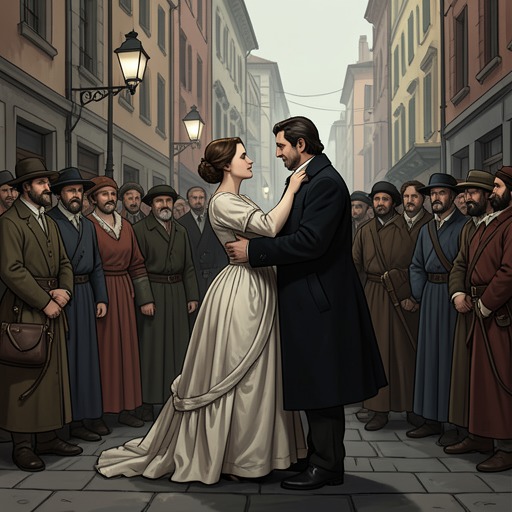
The investigation subsequently identifies Delage as née Groismont, born in Grandeville, in the Île-de-France region. Her birth had been re-registered as 10 October 1940, while her original birth certificate was lost. A family photograph dated to summer 1949 shows a young girl identified as Corinne among Mama, Papa, and Antoine; the resemblance persuades Paul Darac and Alejo Busquet that it is Delage as a child. The photograph offers an image of an apparently settled family, but the records and later discoveries show that this identity was not her birth identity.
The Groismonts were not Delage’s natural parents. In a letter, Madame Groismont described the day the child entered their lives as her arrival “wandering in like a little lost lamb.” That phrasing suggests that the child was unaccompanied, but investigators initially lack enough evidence to identify her securely with Olivie Djourescu. The dates provide the decisive link: the Djourescus were deported to Drancy on 10 October 1943, and the Groismonts later used 10 October 1940 as Delage’s re-registered date of birth. Darac interprets the shared date as marking the child’s arrival with the Groismonts—a second beginning memorialized as a birthday.
The Investigation and the Trolley Assault
When police question Delage about Florian, she presents herself as an innocent older woman being unfairly accused. She says that she had never seen him before and had hardly touched him. Investigators understand that, in the particular incident under discussion, she did not leave the mark they were examining. Yvonne Flaco challenges her with the older dog-poisoning case. Delage’s reaction when Florian’s name is raised appears genuine to Agnès Dantier, who considers that this may mean Delage did not know about him in advance and therefore could not have killed him as an act of revenge. Agnès keeps questioning her, however, because the available evidence does not yet establish when or how Florian received the drug suspected of killing him.
A financial clue shifts the inquiry from Delage’s personal means to the possibility that she was acting for someone else. On 17 January, €9,500 was deposited in her savings account; the following week she bought a van for the same sum. Investigators find no corresponding withdrawal from any of her other accounts. The timing and matching amounts lead Darac and Busquet to conclude that Delage was a front for another person, rather than the independent source of the money.
Busquet develops a possible account of Delage’s involvement in Florian’s poisoning and the subsequent trolley incident. In his reconstruction, she was present when a bearded man injected Florian, followed him in the hope of seeing him collapse, and later returned with a shopping trolley. When she found Florian still alive at a prayer meeting, she rammed him, perhaps hoping to obscure the puncture mark or perhaps acting out of hostility. This remains a theory rather than a confirmed account of every step. Darac adds a consequential inference: the bearded man had previously hurried away from Delage, apparently anxious not to be seen with her. If he was preparing the kidnappings, keeping her out of sight would have mattered because the van was in her name; instead, her conduct brought her into the open.
Hidden Origins and Jewish Identity
A mezuzah found in connection with Delage gives the investigators another kind of evidence: the marks left by repeated use. Matching screws had been taped to it, and the turning surfaces in their slots were worn. Several pairs of corresponding holes appeared in both the front and rear doorframes. Darac concludes that Delage had attached, removed, and reattached the object more than once. He takes this on-and-off display as significant to the question of her Jewish identity, while acknowledging that possession alone would not prove that she was Jewish; a non-Jewish person could own a mezuzah, though displaying it in the prescribed manner would be less likely.
The evidence of her origins changes how the lost-lamb letter reads. The Groismonts’ account, the missing original birth certificate, the re-registered date, and the date of the Djourescus’ deportation converge on a child whose identity was recast after separation from her family. Delage later confirms that she knew where she came from, though not who she came from, until David Jarret visited her. The distinction is central: knowledge of an origin did not amount to knowledge of her surviving relatives or the family from which she had been taken.
Captivity, Revelation, and Final Confrontation
Agnès and Vincent recognize Delage’s voice during their captivity. Agnès cannot see a clear grudge against either of them and notes that Delage had been released, but the van’s back door later opens to reveal Delage alongside a much taller, slimmer man. Vincent recognizes the newcomer with relief. The scene confirms that Delage has returned to the captives and is involved in the events around their imprisonment, though her precise relationship to the other man has yet to be explained.
That explanation emerges through Jarret. He tells the captives that Delage is going to meet his father and that he has kept from him the fact that his big sister survived, because he was too ill to be told. Delage then says that she knew where she had come from but had not known who she had come from until Jarret came to see her. Her discovery of her living family is thus entangled with the criminal operation: the man who brings her the truth about her parentage is also the accomplice controlling the captives. Vincent attempts to welcome the prospect of a family reunion, but Jarret postpones it and tells him and Agnès they are going to a pleasure park first.
During the final confrontation in the van, Delage orders Jarret to reattach a pipe. When he tells her that there is no point because the captives are already dead, she keeps her gun trained on him. Darac seizes the opening, dives at her, and knocks the weapon away; a shot passes him, and Delage falls. With the gun secured, he begins the rescue, finding Agnès barely breathing and calling for medical teams. Delage’s momentary opposition to Jarret does not undo her participation in the plan, but it breaks his immediate control of the scene and allows the rescue to begin.
Narrative Significance
Delage’s story is built around the gap between a legible public identity and a concealed past. At first, her long record encourages the police to read her as a repeat offender, while her claim that she scarcely touched Florian is tested against the history of the poisoned dog. Later, the financial deposit makes her appear less like a self-sufficient culprit than a front for another actor. Finally, the family photograph, the Groismont letter, the dates, and the mezuzah complicate any single account of who she is: criminal conduct and a history shaped by persecution coexist without canceling one another.
The recurring lost-lamb image gives the concealed identity a precise narrative form. The child’s arrival at the Groismont farm is described not as a routine transfer but as wandering in, and the date later assigned to Delage’s birth echoes the deportation date of the family from which she was separated. The motif does not make her subsequent crimes an effect of her past; rather, it makes the question of origin inseparable from the plot’s questions of trust, concealment, and responsibility. Her late discovery of a surviving family offers the prospect of reunion, but the story leaves that future beyond the immediate rescue and places the revelation beside the consequences of her choices.