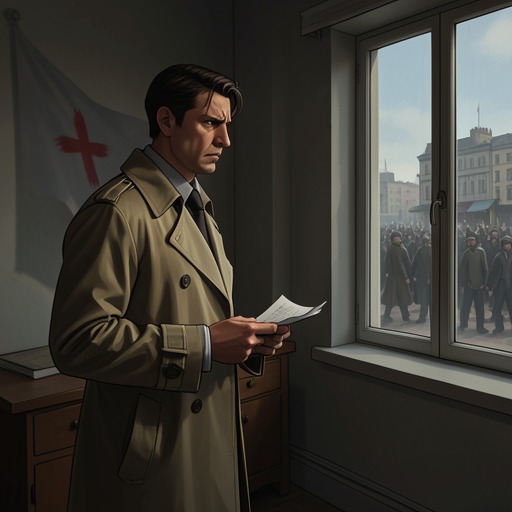
Emil Florian
Impure BloodEmil Florian is a teacher at Lycée Mossette whose murder turns an initially puzzling crime scene into the opening of an investigation into drug-facilitated abuse. The contrast between his respectable occupation and the conduct uncovered after his death defines his role: he is both a murder victim and a perpetrator whose concealed crimes draw several other characters into the case.
Identity and Public Appearance
The police identify Florian as a teacher at Lycée Mossette in Riquier. He is found dead in a white suit, barefoot, with his face against an opened, unused pizza box; another opened box lies beneath his knees. The peculiar arrangement prompts investigators to consider the scene and the objects around the body rather than treat it as an ordinary death. At this early point, the circumstances of his killing remain unexplained.
The investigation also questions the identity Florian presented to others. Paul Darac tells Professor Deanna Bianchi that, although the police have not yet confirmed it, Florian does not appear to have converted to Islam. Bianchi’s immediate question—why he had been pretending—points to a disguise or false public identity, but the available evidence does not explain its full purpose. The apparent conversion is therefore an investigative lead, not proof of his beliefs or motive.
The Drug Evidence and Its Intended Use
A forensic clue first connects Florian to γ-hydroxybutyric acid (GHB): Professor Bianchi isolates a GHB-related substance from sugar residue between his toes, and droplets in his Evian bottle contain a matching substance. The added sugar would mask the liquid’s salty taste. Investigators infer that Florian had not taken the drug himself and that the prepared bottle was intended for somebody else. The discovery shifts the question from what killed Florian to what he meant to do with the drug.
That evidence initially leaves open whether Florian was acting alone or supplying someone else. When Erica Lamarthe suggests that he may have been a date rapist, Darac allows the alternative that he might have supplied one. This uncertainty matters: the chemical trace establishes preparation and intended use more securely than it establishes the full extent of his actions. Later testimony supplies the context the laboratory evidence alone cannot.
Encounters at La Masarella
Statements gathered from residents of La Masarella place Florian in the orbit of Manou Esquebel before the murder. Madame Griet, who watched the neighborhood’s informal football games from her window, recalls that Manou often joined matches attended by local teenagers. Florian appeared on the sidelines on one Saturday, looking out of place, and seemed to know Manou. The observation does not by itself establish what passed between them, but it gives the investigation a setting and a connection to pursue.
A week later, around ten in the morning, Griet saw Florian hanging around again while Manou did not appear to be playing. She remembered him because a plastic bottle caught in his pocket and he struggled to pull it free. The bottle is a distinctive detail that acquires significance beside the later discovery of the drugged Evian bottle. Griet then left to go shopping with a friend and witnessed nothing further; her account is useful precisely as a limited, ordinary observation rather than a complete explanation of Florian’s activities.
Manou’s Account and Florian’s Crimes
During questioning, Manou describes Florian as having become fixated on young boys and wanting access to real victims after consuming videos. Manou says Florian learned about GHB and knew that Manou used the drug. According to Manou, Florian expected him to participate; when Manou refused, Florian nevertheless stole some of his supply and mixed up his containers when Manou was not watching. Manou insists that he never helped Florian and says he warned him to stop or their relationship would end.
This account gives a possible source for the drug and explains why evidence of GHB led investigators to Manou. It also distinguishes Manou’s alleged refusal from Florian’s actions: Manou says he would neither join in nor provide the substance, while accusing Florian of taking it without permission. His statement is testimony from an interrogated suspect, not an independently established account in every detail, but it converges with the forensic evidence that Florian had access to GHB and with the earlier observations linking the two men.
The investigation later establishes that Florian was involved in a pattern of drug-facilitated assaults. One account describes an eighteen-month operation in which victims were drugged and taken to a room. Imanol Esquebel, according to testimony attributed to André Volpini, transported drugged victims to the room—often after receiving a call for a cab home—and drove them away afterward, but did not take part in the assaults themselves. The account says Esquebel was truthful about that limited role. This expands the significance of Florian’s death: he was not merely preparing a drugged drink for an unknown individual, but connected to a sustained practice involving other participants.
Family Background and Conflicting Judgments
A recollection about the Florian family complicates the image of Emil as simply an indulged child. His mother, Louise Florian, eventually bore a son who survived; Emil was born seven or eight years later, after an interval she remembers as marked by heartache. Emil was indulged and spoiled, while the older boy, Jean Florian, had been cheerful, helpful, and much loved. After Emil’s birth, she says, Jean might as well have ceased to exist in his parents’ eyes, despite being their biological child.
The same recollection describes Emil as clever and capable of appearing loving and sweet, but also as cowardly and inclined to cruelty when he thought he was unobserved. His mother blames the parents’ treatment of him for the person he became. Her account is a retrospective judgment, not an objective diagnosis, and it sits alongside rather than erases Manou’s description of Emil’s deliberate conduct as an adult. Together, the accounts present his character through sharply different forms of testimony: one locates damage in family favoritism, while the other emphasizes choices that harmed others.
Death, Investigation, and Narrative Significance
Florian’s murder remains a separate question from the crimes the investigation uncovers. His death prompts the inquiry into his conduct, and a later police account notes that a print of Florian has been found at a location under investigation. At the time Florian was killed, André Volpini says, he was waiting there for Florian; the two had planned to go “hunting,” Volpini’s term. The timing and phrasing connect Florian’s murder to the world of abuse, but the evidence here does not settle who killed him or establish that this meeting was the immediate cause.
The possibility of a private motive enters the story when Agnès Dantier tells David Jarret that he killed Florian and adds that Florian was a rapist. Jarret and Corinne Delage exchange a look, but an old woman disputes Agnès’s description, calling Florian rotten while beginning to qualify the accusation. That interruption keeps judgment unsettled even as the investigation has assembled serious evidence against him. Florian’s narrative role rests on this deliberate tension: his death calls for an explanation, while the truth about his conduct changes the moral context in which that explanation must be sought. His public standing as a teacher, the concealed use of GHB, and the conflicting accounts of his past make him neither an uncomplicated victim nor a mystery reduced to a single motive.