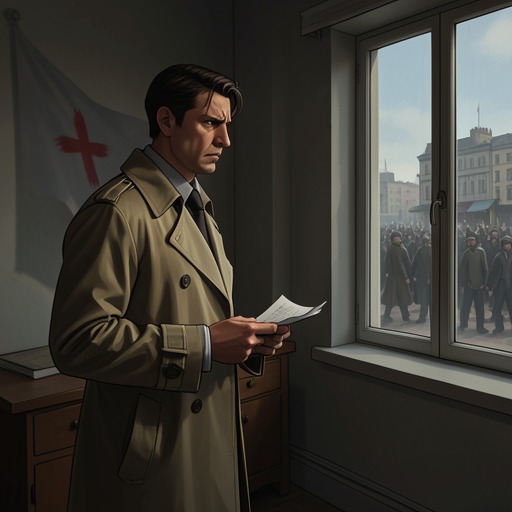
Florian’s water bottle containing GHB
Impure BloodFlorian’s water bottle containing GHB is a seemingly ordinary container whose contents connect Florian to Manou’s scheme of drugging boys. The bottle matters not only because laboratory analysis can identify its contents, but because the investigation reconstructs how it was carried, used, concealed, and finally emptied in public. It is a portable tool for the crime and, through the evidence gathered around it, a material trace that helps expose the partnership behind it.
Contents and Connection to Manou
The investigation identifies the substance in the bottle as GHB and treats it as the same drug found in Manou’s possession. Agnès tells Manou that laboratory testing will prove that his GHB and the substance Florian carries in his water bottle are identical. The comparison turns two separate pieces of evidence into a link between the men: the drug in Manou’s possession is not merely similar to Florian’s, but, according to the proposed laboratory result, the same substance.
The bottle also unsettles the ordinary explanation suggested by Florian’s circumstances. He is not a bodybuilder, Agnès observes, so the contents cannot readily be explained as a sports supplement. Earlier, Bonbon challenges Manou’s claim that a marked container holds protein powder: its contents are too salty for that account. The label and the everyday category of sports nutrition offer a cover, but the investigation reads the substance itself against that cover. The bottle is made suspicious by the mismatch between what it is said to contain and the role the evidence assigns it.
How the Bottle Was Used
Darac reconstructs a method in which Manou befriends young people while they are playing games such as football or skateboarding. As the players become hot, he waits for a particular boy to leave the game. Florian then arrives with the GHB water, allowing Manou to avoid carrying it himself. In Darac’s account, the bottle’s transfer is embedded in an apparently casual interaction: Manou approaches the boy and Florian, presents the older man as someone from whom they might obtain money, and then takes the water on the pretext of being hot.
Darac describes Manou pouring some of the water over his own head, perhaps pretending to drink, before passing it to the boy. The sequence gives the bottle a double function. Its presence can appear natural in a game played in the heat, while its contents enable the drugging that Darac alleges. The performance of thirst and shared water disguises the bottle’s purpose within an ordinary social exchange.
An eyewitness account supports the reconstruction of this method in a specific instance. A witness saw Florian outside La Masarella watching a football game. Darac says the routine did not go smoothly that time because Florian got the bottle caught in his jacket, though he eventually retrieved it. The witness later saw a boy crossing the lobby looking sick and drowsy; the witness had initially attributed his condition to exertion in the sun, but, in the statement presented by Darac, understood that he had been drugged. The bottle’s temporary snag is a small practical failure in the supposed routine, while the boy’s later condition supplies the consequence that the misleading appearance of exertion had concealed.
Concealment and the Prayer Meeting
Florian’s handling of the bottle later places it within a public religious gathering. Bonbon concludes that Florian took cover in the prayer meeting and poured away the incriminating GHB water in a manner that would look natural for a Muslim about to pray. The act is presented as an attempt to dispose of evidence without attracting notice. Florian, Bonbon adds, did not know that he had little time left, making the apparently deliberate concealment an action taken under a mistaken sense of how much time remained.
The setting gives the disposal its camouflage. In the Friday prayer described elsewhere in the book, worshippers fill the prayer room and those without space form ranks in the street, using mats, towels, or flattened packing materials. The gathering takes place amid the city’s ordinary bustle and scrutiny. Against that background, Florian’s act could be read as part of the movements of prayer rather than as the destruction of evidence. What makes the bottle incriminating is also what makes its disposal appear, for a moment, unremarkable: it is carried into a place where religious practice provides a plausible explanation for handling water.
The Bottle as a Clue and Narrative Hinge
The bottle’s significance depends on the accumulation of observations rather than on a single discovery. Armani was in Rue Verbier around the time Florian arrived there, although he was off duty and could not give an exact time. The investigation later considers the account of Florian jogging past the street prayer gathering and colliding with a bearded young man carrying a rucksack. Bonbon connects that encounter to the bottle’s disposal at the prayer meeting, proposing that Florian’s entry into the gathering was a way to escape notice and empty the container.
The container therefore links separate strands of the case: the laboratory comparison with Manou’s GHB, the alleged method of approaching boys during games, the eyewitness account outside La Masarella, and Florian’s attempt to discard the contents at prayer. Each strand changes the meaning of an ordinary bottle. At first it can pass as water for someone engaged in physical activity; in the reconstructed scheme, it is a means of delivering a drug; at the prayer meeting, it becomes evidence Florian tries to remove. Its shifting uses make it a compact record of both the crime’s practical organization and the investigation’s route toward exposing it.