Grandeville
Impure BloodGrandeville is a small rural community in Île-de-France, about fifty kilometres south-east of Paris. In the investigation into Corinne Delage’s origins, its significance rests not only on the Groismont family’s farm but on the farm’s position beside a railway used during the wartime deportation of Jews from Nice to Drancy. That setting gives the account of Corinne’s childhood a possible point of connection between a rural household and a history of persecution.
Location and Recorded Identity
The first investigative account of Grandeville comes from Roland Granot, who reads from Perand’s case notes while examining Corinne’s family history. The notes identify her as Delage, née Groismont, and record her birth as re-registered in Grandeville on 10 October 1940. The re-registration matters because Corinne’s original birth certificate has been lost, leaving the circumstances of her earliest identity uncertain.
When Roland Granot asks where Grandeville is, Bonbon reads Perand’s description: it lies fifty kilometres south-east of Paris. Perand’s notes also make a joke about the place as a one-horse town, which Bonbon finds opaque and unhelpful. The exchange gives the location a modest, rural character, but the investigation soon turns from its size to its position on a major route.
The Groismont Farm and Family
The official account associates Corinne’s childhood with Jeanne and Albert Groismont, tenant farmers in Grandeville. They were thirty-nine and forty-four at the time of her birth, and Corinne had an older brother, Antoine, fifteen years her senior. The case notes state that her parents and brother are all dead, so the family’s role in her life must be reconstructed through records and a surviving letter rather than through their testimony.
A family photograph marked summer 1949 shows the Groismonts with Corinne and Antoine. The scene appears serene, but its appearance cannot establish what family life was like beyond the moment captured. The picture does, however, sit alongside the investigators’ growing suspicion that the family’s registered account of Corinne’s birth did not tell the whole story.
Corinne’s adult life is also partly traced through the case notes: she married Yves Delage in Paris on 2 June 1970, had no children, and divorced in 1978. Yves died in 2001. She lived in Nice from 1979, worked mainly as a florist, and retired seven years before the investigation because of rheumatoid arthritis. These later details establish the long span of a life whose earliest circumstances remain the central mystery; they do not resolve why the Groismonts took her in.
Railway and Wartime Reconstruction
The investigation identifies the farm’s location beside the principal railway line from Paris to the south-east. In the 1940s, the line was used to transport Jews from Nice to the holding camp at Drancy. Its proximity to the farm changes Grandeville from a mere place name in a registration record into a plausible site in a wartime escape account.
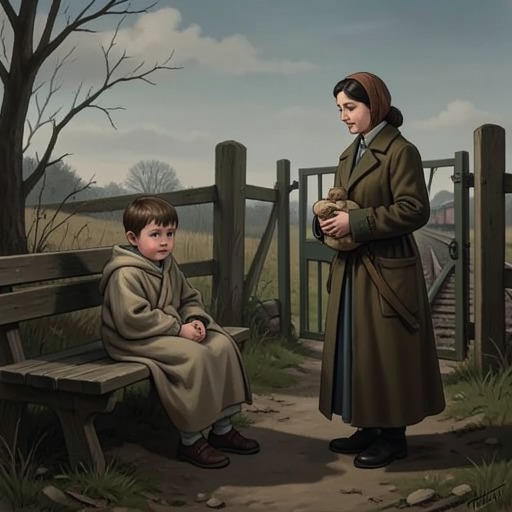
Roland Darac and Bonbon had already concluded that the Groismonts were probably not Corinne’s natural parents. At a later briefing, Perand presents the theory that Corinne may have been on one of the trains passing the farm. He describes a possible chain of events rather than a verified record: a train slowed or stopped near the property; someone, perhaps her parents, pushed the very young child through an opening in a carriage or freight van; and she crossed the fields to the Groismont cottage. The evidence supplies a setting and a proposed explanation, but no direct confirmation of the escape or of who placed her outside the farmhouse.
The theory draws on accounts of captive passengers cutting openings with concealed tools or forcing apart planking despite guards. In Perand’s reconstruction, a pause in the train’s movement offered a brief chance to get a toddler out. The route from railway to cottage is essential to the hypothesis: Grandeville’s farm stood close enough to the line for the escape and the child’s arrival to be imagined as part of one connected episode.
The “Lost Lamb” and Corinne’s Origins
A letter from Madame Groismont, who was not Jewish, supplies the most suggestive clue to how Corinne entered the family. She describes the day the young girl came into their lives as the day she came “wandering in like a little lost lamb.” Perand stresses the wording: it describes a child arriving alone, not being brought from a vehicle. The phrase supports the possibility that Corinne reached the farm by herself, but it remains an inference drawn from a letter, not an eyewitness account of the journey.
Perand reasons that the Groismonts must have known where the child came from, given the regular passage of deportation trains beside their land. He further suggests that, perhaps late in their lives, they told Corinne about her heritage. The timing and content of that disclosure are not established; the account presents them as possibilities suggested by the surviving evidence.
The uncertainty of Corinne’s origin also affects how her later religious identity is understood. Perand points to a mezuzah that Corinne had repeatedly attached, removed, and reattached, reading this pattern as evidence of uncertainty about her Jewishness. The case notes and the letter therefore leave Grandeville with a double significance: it is both the place entered into Corinne’s official birth history and the proposed refuge where a displaced child may have been received by the family who raised her.