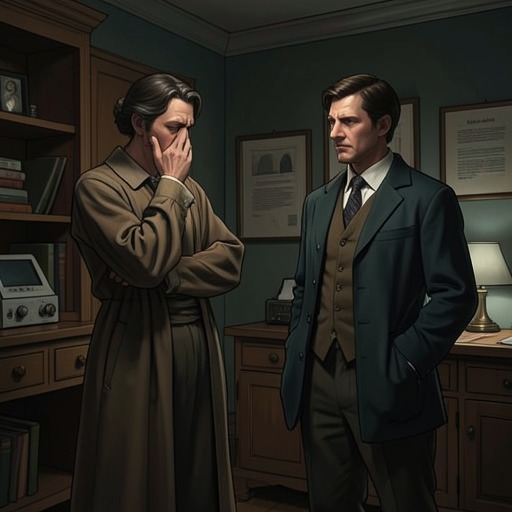
La Masarella
Impure BloodLa Masarella, in L’Ariane, is a low-rent apartment block whose shabby common spaces and neighborhood routines place it at the intersection of social marginality and police investigation. The building is introduced as the home of Emil Florian’s lover Imanol Esquebel, and later becomes the site where a neighbor’s memories of football games and a stuck water bottle help Paul Darac establish that Florian had been drugged. Its significance lies not in a single dramatic set piece but in the way ordinary, closely observed life inside the block makes a concealed crime legible.
Setting and Social Position
When Paul Darac reads Imanol Esquebel’s address aloud, it is apartment 7 at La Masarella. The block stands in L’Ariane, described as one of the low-rent housing developments and, in Darac’s assessment, the roughest of them. Against Florian’s comparatively higher social position, Imanol’s home is presented as almost outside the social ladder altogether. This contrast gives the address more weight than a mere location: it marks the unequal circumstances of the two men whose relationship brings the investigation to the building.
The block’s condition is described with qualification rather than romanticization. Someone remarks that it looks worse than it is, although even that reassurance concedes that its appearance is not attractive. Darac has a practical reason to watch the roof when he arrives: on a recent visit, a full-sized fridge fell onto the pavement beside him. The danger is recalled as the product of children being children, an offhand explanation that does not make the building feel safer. Instead, the falling appliance establishes the hazards of its surroundings before the detectives enter.
The Building in Everyday Use
Darac and Bonbon reach the building without being hit by anything and enter at 7:22 p.m. The lobby is shabby and cheerless, with muffled thuds from competing sound systems carrying through it. Against that noisy, worn setting, a woman in a vivid orange bubu and head wrap stands reading notices on a board headed Your La Masarella. She hums to a child on her hip; the girl’s rolling eyes, contorted lips, and sudden cry prompt the woman to kiss her ear and reassure her that her mother is there. Darac offers the woman a warm greeting as he and Bonbon pass behind her, but she looks them over and turns back to the notices.
The brief encounter gives the entrance a human presence independent of the investigation. The board, the music, and the mother soothing her child suggest a shared residential space in use, not an empty backdrop. Yet the detectives remain visitors: the woman’s glance registers their presence without inviting them into her attention. The building’s everyday life continues around their inquiry, and its residents are not reduced to a welcoming audience for the police.
Football, Neighbors, and Florian’s Visits
The investigation later reconstructs La Masarella’s weekend football games through the account of Madame Griet, a widow who lives on the ground floor opposite Manou’s apartment. She considers the games breeding grounds for trouble, so she keeps occasional watch from her window. Her account describes matches that may involve as many as thirty players and continue for hours, usually teenagers. Manou, admired by the younger residents for his physique and madcap stunts, often joins them.
Madame Griet remembers Florian watching a game from the sidelines two Saturdays before her interview. He seemed out of place, though Manou appeared to know him. The next Saturday, at about ten in the morning, she saw Florian at the block again. This time Manou did not appear to be playing. What fixed the scene in her memory was a plastic water bottle caught in Florian’s pocket: he turned red while trying comically to pull it free. A friend arrived at Madame Griet’s door, and she left to go shopping with her. Her testimony therefore preserves a precise but incomplete view: she witnessed the awkward struggle with the bottle, then departed before she could see what happened afterward.
The Bottle and the Investigation
Darac uses the witness statement to connect that everyday incident to the suspicion that Florian had been drugged. He tells Manou that police had shown Florian’s photograph to many people and asked whether they had ever seen him; Madame Griet’s signed and dated account is among the identifications. Darac places the time at about ten o’clock on the previous Saturday and reminds Manou that Florian had been outside La Masarella watching a football game. The address and the neighbor’s recollection thus become an evidentiary link between Florian and Manou’s residential world.
The bottle, first remembered as a comic nuisance, changes meaning under questioning. Darac says that Florian eventually got the water bottle out of his jacket, but Madame Griet could not say what happened next. He then reads from the statement her later recollection of seeing a boy cross the lobby looking sick and drowsy, which she had initially attributed to exertion in the sun. In retrospect, she concluded that he had been drugged. Darac points to the signed account as something Manou cannot simply dispute. The sequence makes the lobby and the bottle crucial not because either proves the entire case on its own, but because a neighbor’s ordinary observations preserve details that the police can reinterpret and assemble into a chronology.
Narrative Significance
La Masarella is rendered through contrasts between precarious surroundings and active communal life: the dangerous roof and shabby lobby stand alongside the children’s football, the resident reading notices, and the mother comforting her daughter. The same everyday closeness that makes Madame Griet’s watchfulness feel intrusive to her also gives her a vantage point from which she notices Florian. The block’s social margins do not make its residents invisible; they make their remembered routines consequential to the investigation.
The account also changes the meaning of small details without changing what was observed. A plastic bottle lodged in a pocket first produces an almost comic image of Florian turning red; the later report of a sick, drowsy boy crossing the lobby recasts the episode as evidence of drugging. La Masarella therefore functions as more than an address or a crime scene. It is a lived environment where scraps of attention—a glance from a ground-floor window, a visitor standing at a football game, a moment in the lobby—can expose what happened beyond any one witness’s view.