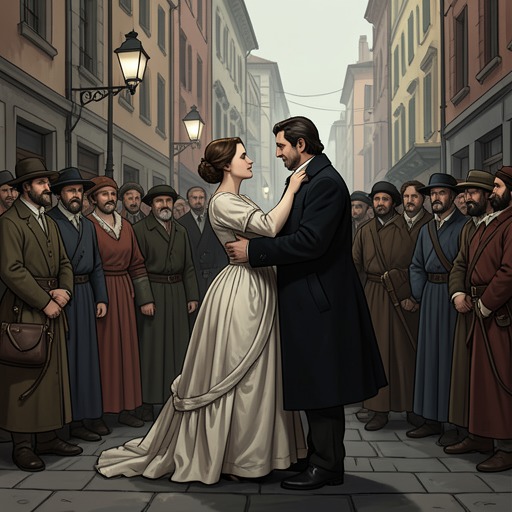
Paul Darac
Impure BloodPaul Darac is a captain of the Brigade Criminelle, a working detective and jazz guitarist whose ability to improvise serves both music and investigation. The novel places him between those roles: he is drawn to uncertainty as a musician, follows evidence through competing explanations as a police officer, and must confront the costs of a life in which neither calling can simply be set aside. His decisive choices in the Florian investigation reveal a detective willing to revise his theory and, when time runs out, to act before the formal chain of command can catch up.
Identity and Introduction
Darac enters the story returning from a late night at the Blue Devil jazz club. He has played until four in the morning, and the previous performance mattered because he had avoided familiar runs and chord progressions, finding himself in unfamiliar musical territory and having to discover his way back to the band. The audience’s appreciative shouts, including the club owner Ridge Clay’s rarer cries of approval, reward precisely the risk of that improvisation. The scene establishes a pattern that also describes Darac’s investigative work: he can tolerate not knowing the way through, provided he keeps listening and finds a route back.
The morning-after details make the musician a working person rather than a separate, romantic identity. Darac queues at Fantin for warm pastries, threads past the trinket sellers in Place Garibaldi, and heads home for what will be a late breakfast. Later, he is back on the road in his unmarked Peugeot, responding to the police cordon at Rue Verbier. His professional world interrupts the rhythm of the night’s performance; the novel does not treat music as an escape from police work, but as one part of the same life.
Investigation and Method
At Rue Verbier, Darac arrives to find not one or two barriers but a slalom of staggered police signs, followed by cones directing him to officers at the kerb. The elaborate perimeter is the first sign that the case will demand coordination and judgment rather than a routine response. Although prosecutor Jules Frènes is already speaking with others about the investigation’s leadership, Darac asserts his place in the work. Addressing the detained men at the prayer room, he identifies himself as the captain charged with leading the inquiry into the death of the man who had briefly joined their congregation. He thanks them for their patience and acknowledges the approaching Asr prayer, trying to organize the next interviews around a deadline that matters to the people being questioned.
Darac’s investigative voice is direct, but his conclusions are not presented as certainty before the evidence warrants it. When considering Emil Florian’s death, he reasons from the absence of visible distress: Florian had knelt and prostrated with the congregation, yet did not rise with the others. The scene had looked peaceful, as if he had fallen asleep, but Darac’s reconstruction is that the apparent stillness concealed an agonizing death that could not be heard. The contradiction between the quiet appearance and the concealed process becomes a central investigative problem.
The medical evidence sharpens the hypothesis without making it final. Deanna Bianchi explains that the degree of paralysis points toward a powerful muscle relaxant and that a poison causing death by asphyxiation could leave the victim apparently peaceful. Because ingestion or inhalation would more commonly produce other visible signs, injection seems more likely; however, the suspected substance may already be undetectable. A minute sample of straw-coloured liquid recovered by wringing Florian’s cut-up underwear may provide a lead. Darac and his partner Roland Granot have to proceed with that uncertainty in view: the medical explanation is a working theory, not a solved case.
Darac’s manner with people is similarly attentive to circumstance. When Agnès Dantier watches him interview Mansoor Narooq, Darac first asks whether Narooq is in pain and offers to postpone the questioning. Narooq says the injury troubles him only when he moves in a certain way, and the interview proceeds. Later, when Darac gathers the team, he sets out two linked lines of inquiry: Florian’s murder and the likelihood that Florian had been involved in drug-assisted rapes. Reporting that he and Granot found at Manou Esquebel’s workplace a key like the one Florian had tried to discard, he also notes that Esquebel had been particularly anxious that the police not search for it. The key gives the investigation a concrete connection to a person and a place, while the meeting shows Darac sharing developments with the team rather than treating the case as a private puzzle.
Reasoning and Changing Theory
Darac is skeptical of institutional ceremony when it seems to promise less than it claims. At a meeting in the Salle Prince Pierre, Granot observes that the gathering appears designed to define where each force’s role ends and another’s begins. The official answer is that coordination among disparate police groups is essential, because without it their work can fall apart. The exchange frames a tension that follows Darac through the case: coordination can prevent confusion, but it can also slow action when the danger is immediate.
As the investigation widens to include the kidnapping of Agnès and the former commissaire Vincent Dantier, Darac changes his interpretation of the apparent threat. At first the Sons and Daughters of the Just Cause appear to provide a political explanation. But Darac comes to believe that the group is not a terrorist organization in the sense the threat implies, and that the kidnapping is itself the underlying crime. He argues to Frènes that the notes are a smokescreen: taking both the current and a previous commissaire points toward a personal motive, most plausibly revenge by someone they had imprisoned or an associate of that person. The argument is a hypothesis, but it reorganizes the inquiry around the victims’ shared professional past instead of the public political claim.
Darac’s theory-building depends on testing how evidence was produced, not only on reading what it appears to show. Reviewing the surveillance problem, he rejects elaborate explanations for a missing interval and proposes a simpler method: the van driver photographed the view from Camera One, then later placed the image in front of the camera’s lens. The camera’s autofocus and the slight difference in framing explain why the resulting image is blurred and why the apparent gap does not require interference with the camera’s timestamp. The reasoning shows Darac treating a technical anomaly as a physical act that can be reconstructed, then checking the explanation against the details visible in the footage.
His later case presentation draws together evidence that had seemed separate. Darac points out that Corinne Delage was present when poison was injected into Florian and later when he died; that the seventy-year-old, frugal Delage had recently bought a van for €9,500 with money supplied by another person, apparently concealing the actual purchaser; and that the van was almost certainly used in the kidnapping of Agnès and Vincent. He introduces a further fact about Delage that Frankie Lejeune is best placed to explain. The assembled clues make the case against Delage cumulative rather than dependent on a single dramatic discovery, while leaving room for the investigation to trace the relationships and history behind her actions.
Relationships and Private Life
Darac’s partnership with Roland Granot supplies a practical counterweight to solitary intuition. The two work together on the Florian inquiry, and Darac gives Granot what he knows about Florian while they are travelling. Granot responds that they will find corroborating evidence somewhere, then asks about Mansoor Narooq and the hospital update. Their exchanges move between evidence and immediate operational concerns: Narooq has chipped a bone in his shoulder, and the detectives must keep the wider investigation in view while attending to individual consequences.
Darac’s relationship with Angeline exposes a vulnerability his police manner cannot resolve. After a quiet conversation on the apartment terrace, he recognizes that they have at last acknowledged a major problem. The discussion has not ended in a shouting match or a decisive rupture; instead, a few restrained sentences leave him with sadness and uncertainty about whether there is a way back. He loves Angeline and cannot take comfort in the fact that nothing terminal has been said. The contrast with his earlier relationships, which ended in more explosive arguments and sometimes briefly rekindled, makes the calmness of this disagreement more troubling, not less.
The conflict is not reducible to money or a simple choice between careers. Darac once asks Angeline whether she would prefer him to give up the police and become exclusively a jazz musician, joking that his salary would fall by about ninety-five per cent. Angeline answers that money is irrelevant: he could no more be only a musician than only a policeman. She calls him a poète policier, a phrase Darac recognizes from press accounts of the French figure who combines artistic ability with service and the risk of fighting crime. Her formulation names an identity he cannot divide into two clean alternatives, even as that integrated life strains their relationship.
Darac’s response to Frankie also reveals how personal knowledge can alter his understanding of a colleague. After Frankie speaks at the team meeting, he realizes that her inability to have children is a source of pain, rather than a matter of simple preference as he had assumed. He feels sympathy but has to return his attention to Madame Laseige’s account. The shift matters because the investigation’s old family history is not merely an evidentiary mechanism: it intersects with private grief, including grief Darac had failed to recognize in someone close to the case.
Crisis, Action, and Significance
The investigation’s historical thread reaches Darac through Madame Laseige’s memory. She recalls that Louise Florian’s baby was stillborn, while Elena Djourescu gave birth to a healthy boy only hours later. This conflicts with the report Frankie had read, which attributed the premature birth and death to Elena’s baby. Laseige also remembers Adam Djourescu running back from the Florians’ apartment and shouting, “Thank you, Vincent.” Because Louise’s husband was Marcel, the name points instead toward Vincent Dantier, Adam’s friend. Laseige wonders whether Vincent was present and whether the exchange of a living child for a dead one had been his idea. Darac has to treat this as a remembered clue and a question, not as an established fact; nevertheless, it offers a possible connection between old concealment and the present kidnapping.
When Darac considers the suspected perpetrator, he follows the institutional trail as well as the personal one. If Jarret is responsible, Darac reasons, the officer could have accessed the files and assembled the same story the investigators have reconstructed. Access should have left a record, since personnel had to sign for archive files. The line of thought makes the archive’s mundane paperwork a potential test of the theory, though Darac does not simply wait for confirmation when the hostages’ lives are in immediate danger.
At the lock-up, Darac sees water seeping beneath the roller door and remembers Astrid’s warning that there are only thirty seconds. Regulations require him to call for backup and wait, but he judges that delay intolerable. He drives the Peugeot through the door, using the broken section as cover as he gets out and moves to stop the vehicle exhaust from entering the van. Gunfire follows, and he returns fire before opening the rear doors. The action is not a victory without cost: the kidnappers tell him the occupants are already dead, and Darac has no time to establish their condition before facing the armed threat.
With Corinne Delage’s weapon dislodged and secured, Darac begins the rescue. He goes directly to Agnès, whose wrists are bound and whose breathing is weak and erratic, calls in medical teams, and works to get her out of the van and into the air. He understands the limits of what he can do: he can attempt basic mouth-to-mouth if she stops breathing, but her restraints would prevent him from laying her on her back for CPR if her heart stopped. The sequence brings the novel’s competing demands into a single decision. Darac’s professional world has procedures and chains of command; his musicianship has taught him to move through uncertainty; in the lock-up, neither deliberation nor improvisation can guarantee a safe outcome. What defines him is that he acts on the evidence and the time available, accepting responsibility for the choice.