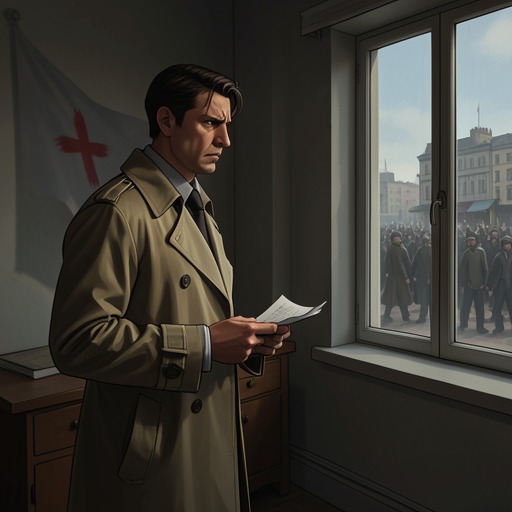
Rue Monteverdi secret room
Impure BloodThe Rue Monteverdi secret room is a hidden room within a small industrial unit on Rue Monteverdi, near the Peerless Taxis office and the prayer room on Rue Verbier. Its importance lies in the contrast between its unremarkable setting and the crimes linked to it: a concealed destination for victims brought by taxi, a place accessed with Emil Florian’s key, and a site where investigators uncover evidence connecting Manou Esquebel and André Volpini to an eighteen-month pattern of sexual assaults.
Setting and Approach
Rue Monteverdi is described as little more than an alley behind Rue Durante. Though unimpressive in appearance, it lies a short walk from two important locations: the Peerless Taxis office and the Rue Verbier prayer room. Manou Esquebel is tracked about halfway along the street, where he turns into the yard of a small industrial unit. The approach is constrained: the yard is enclosed by a head-high wall topped with spikes, with a gate wide enough for a car or small van. From the street, the gate is the only apparent way in or out.
The unit has an unfrequented, almost disused appearance. Its yard is paved, lit by a single lamp, and bounded on three sides by blank walls. The one-storey building is L-shaped; a roller door on its short side would have been audible if opened, so the investigators rule it out as Esquebel’s entrance. This examination of walls, gate, and access points makes the location part of the case’s spatial reasoning, not merely its backdrop.
The Search and Entry
Frankie Lejeune’s team moves toward the yard as quietly and quickly as possible. Serge Paulin reaches the gate first and looks inside; the yard appears empty, and Esquebel is nowhere in sight. The team finds no padlock on the gate, but the absence of an obvious obstacle does not resolve whether their target is inside. The space’s closed boundaries and lack of visible activity sustain that uncertainty until the team locates the relevant door.
The team members carry copies of Emil Florian’s key. At the door, Arnaud tests it, and the lock opens. The key therefore gives the investigators access to a room whose connection to Florian is material and direct, rather than merely suggested by its address. Inside, the room is unlit and shabby. Its only furniture is a group of four battered waiting-room-style benches pushed into a corner; one has no seat. A second door stands in the far wall, with light showing beneath it. Muffled voices beyond include Esquebel’s, as well as another voice Frankie recognizes. After listening long enough to identify the conversation as significant, she signals to Arnaud, steps back, and the team forces the inner door and enters.
Use and Criminal Connections
The room’s role emerges through the investigation that follows. André Volpini confesses to raping Anne-Marie Sosa and an unspecified number of other girls, and identifies five other key holders to the room. The room is thus not represented as a one-off hiding place: the keys and the number of people who held them indicate shared access. Volpini’s confession also establishes the room as a venue tied to repeated crimes, while leaving the total number of victims unspecified.
Esquebel’s part is distinct from Volpini’s. According to Volpini, Esquebel transported drugged victims to the room, often after they had called for a taxi home, and drove them away afterward; Volpini says Esquebel did not participate in the rapes themselves. The account is striking because Esquebel had been suspected of lying about his involvement, yet this part of his account is said to be accurate. The room’s proximity to the taxi office and Esquebel’s work as a driver connect ordinary transport routines to the concealed operation, without making the room itself visible from the street.
Investigation and Significance
Investigators learn that the crimes had continued for eighteen months without detection, and that the investigation reached the room only after Emil Florian was murdered. A print of Florian is found there. Volpini says he was waiting in the room for Florian on the day of the murder; they had planned to go hunting. The room therefore links the assault investigation to the murder inquiry, joining a long-hidden pattern of crimes to the event that brought the police to the site.
The room also belongs to a wider chain of surveillance and concealed access in the story. At Rue Verbier, investigators reason from witnesses, balconies, windows, and CCTV to reconstruct a street killing and the movement of people through the scene. In a separate CCTV investigation, Darac infers that a photograph was placed in front of a camera lens to conceal a five-minute period and facilitate Agnès Dantier’s abduction. At Rue Monteverdi, by contrast, the relevant evidence is the physical route through the gate and the lock opened by Florian’s key. Across these investigations, the narrative treats streets and buildings as systems of visibility and concealment: what can be seen, what can be entered, and what can be hidden determine how the crimes are reconstructed.
The room’s significance extends beyond the Rue Monteverdi investigation. Later, Darac notices water seeping from beneath the roller door of a lock-up and acts immediately, breaking through the door to reach the people inside. That rescue occurs at a different lock-up, not at the Rue Monteverdi secret room, but it echoes the book’s recurring problem of hidden interiors and delayed access. The Rue Monteverdi room remains a particularly consequential example: an obscure space whose keys, occupants, and connection to a taxi route expose the human system concealed behind an otherwise ordinary street.