Rue Verbier prayer room
Impure BloodThe Rue Verbier prayer room is a modest former bistro at the end of Rue Verbier, close to a small marketplace and apart from the street’s basilica. It becomes the focal point of a fatal interruption to a Muslim prayer gathering and a recurring anchor in the investigation: its interior offers a carefully ordered setting for worship, while the surrounding street presents investigators with abundant potential witnesses but crucial gaps in direct observation.
Setting and Layout
Rue Verbier lies among the crowded streets around Nice’s main railway station. The prayer room occupies a converted former bistro near the end of the street furthest from the Basilique Saint Eustache, just before Rue Verbier opens onto a small marketplace. The contrast between the religious sites is practical as well as visual: the basilica and its car park dominate the south side of the street, while the prayer room is tucked into premises that once served an everyday commercial purpose.
Inside, the room is small, clean-lined, and decorated in cream and sky-blue tones. Its light, calm atmosphere differs from the guilty shadows and images of death that Paul Darac associates with Catholic churches. That contrast belongs to Darac’s perspective, but it shapes his first impression of the space and the people assembled there for further questioning.
The room’s furnishings also make its religious function legible. Wall-mounted clocks specify prayer times to the minute, and parallel lines woven into the carpet point toward a niche in the eastern wall, indicating the direction of Mecca. These details establish an environment structured around the timing and orientation of prayer, rather than a generic meeting room.
The Killing and Its Witnesses
A man joins the congregation temporarily and is killed during the gathering. The initial emergency call comes from an unidentified woman using the public phone box outside a pharmacy on Rue Verbier. She reports that a Muslim has been killed during a prayer service, but supplies no further account of how he died. Because the number 17 call is free and requires no card, Darac cannot trace the caller unless she is identified or comes forward.
The people in and around the prayer room offer different, limited vantage points. Hamid Toulé leads the outdoor congregation, standing in front of those gathered, while another man remains inside throughout the service. Neither sees what happened. The distinction between the outdoor gathering and the interior matters to the inquiry: being present at the prayer does not mean that a witness had a view of the killing.
The wider streetscape seems, at first, to promise abundant evidence. At least fifty apartment balconies and many more windows overlook the scene, and cameras in the car park may record parts of the area. Darac considers whether a shooter might have used a window overlooking the stationary congregation. Yet the volume of possible witnesses is also a logistical burden: investigators must sort useful accounts from a large pool, and Darac’s second-in-command, Roland Granot, is on leave that day.
Investigation and Reconstruction
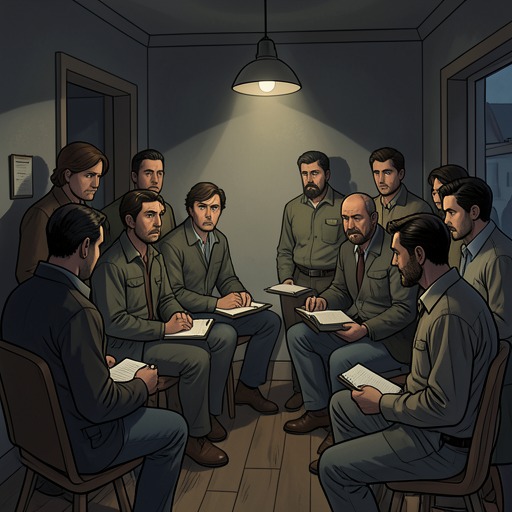
The prayer room serves as a place to gather and re-interview members of the congregation. When Darac addresses them, he identifies himself as captain of the Brigade Criminelle and explains that he is leading the investigation into the death of the man who joined them. He thanks those present for their patience and cooperation, while acknowledging the approaching Asr prayer and arranging for other members of the gathering to be accommodated in a separate cordoned-off area outside.
Surveillance helps investigators reconstruct the events near the room, but does not provide an uninterrupted view of the decisive area. Lartigue explains that the available west-facing camera watches the marketplace; there is no coverage of the space directly outside the prayer room itself. The footage gives investigators an initial view of an elderly woman with a trolley, but the camera’s position and coverage mean that its images must be interpreted alongside witness testimony.
Marie Lacroix, calling from a third-floor balcony opposite the basilica, supplies that crucial human perspective. She saw Emil Florian join the prayer meeting, saw Corinne Delage strike him with her shopping trolley, and watched him bend forward as though praying and then fail to rise. Her account also places Florian on the street before the CCTV footage begins. Investigators use this timing to reconstruct his earlier movements: he noticed Armani Tardelli on Jean Médecin, concealed himself behind a Colonne Morris, and set off when Tardelli entered a Rue Verbier boutique, using a nearby crowd watching a living-statue performer as cover.
The prayer-room case also turns on what the cameras fail to show. During the investigation into Agnès Dantier’s disappearance, Darac asks Lartigue to mark the precise times when the image from Camera One blips. He infers that those moments mark the interval in which Agnès was taken, although no people are visible in the footage. Rather than supposing that a sophisticated jammer altered the time tags, he proposes a simpler deception: a man photographed the camera’s view in advance, then placed that photograph in front of the lens later. The camera’s autofocus produced a slightly blurred image, and the changed framing offered a telltale discrepancy. The surveillance problem associated with the prayer-room investigation thus becomes part of a broader account of how the offenders exploited visual coverage.
A Recurring Point in the Wider Case
The room remains a geographic reference as the inquiry expands. Rue Monteverdi, an alley behind Rue Durante, lies within a short walk of both the Peerless Taxis office and Rue Verbier, home of the prayer room. When investigators trace Manou Esquebel to a yard on Rue Monteverdi, the proximity helps link locations that might otherwise appear separate: the site of the fatal gathering, a transport office, and a place associated with the suspected operation.
Witness recollections continue to revise the account of what happened on Rue Verbier. Astrid Pireque, a street performer asked to prepare likenesses, remembers that after a bearded man collided with a man in a white suit and walked away, a woman hurried after him. She had not been watching the performance and had only just arrived. The detail complicates the earlier reconstruction by identifying another person whose presence and actions may matter, rather than allowing the investigation to settle too quickly on the visible figures in the CCTV and witness accounts.
The room’s importance therefore exceeds its role as the location of a single death. It is at once a functioning prayer space, a scene whose congregation must be treated as witnesses rather than a single undifferentiated group, and a fixed point in an investigation built from partial sightlines, camera limitations, and corrected recollections. Its quiet order stands against the uncertainty outside: the street is crowded with possible observers, yet the decisive events must be assembled from what no single observer could see in full.