Artesia's clearance and redevelopment as Channel View Estates
Inherent ViceArtesia's clearance and redevelopment as Channel View Estates is presented as more than the replacement of one neighborhood by new housing: it is a racialized transfer of land whose polished sales pitch conceals a history of removal. When Tariq Khalil returns from prison, the street and turf he remembers are gone; a sign advertises homes and a shopping mall, and Doc Sportello recognizes the site as Channel View Estates. The redevelopment makes Los Angeles’s recurring struggle over who may occupy land visible in bulldozed ground, unfinished streets, and the uneasy fit between new property values and displaced residents.
A neighborhood erased
Tariq tells Doc that after leaving Chino he went looking for members of his old street gang, the Artesia Crips, only to find that not just the gang but its territory had disappeared. The place had been ground into little pieces. At first Tariq thinks he may be hallucinating; he drives around and comes back, but the absence remains. A sign announcing that homes and a shopping mall are coming soon is all that marks the transformation, and Tariq identifies Mickey Wolfmann as the builder.
The return makes redevelopment register as a breach in lived memory, not simply a change in a city map. Tariq remembers a neighborhood as a place where people and everyday life belonged; instead he encounters a ghost town and a promise of new construction. The blunt material fact of its removal unsettles the distinction between a community’s disappearance and the disappearance of its physical ground: both have been cleared away, while the sign speaks as though the site were newly available.
The history beneath the site
Tariq places the clearance within a longer history of racial displacement. He recalls that before the Second World War much of South Central was still a Japanese neighborhood; Japanese Americans were sent to camps, and Black residents moved into the vacated area. He describes his own community’s removal as the next turn in the same sequence. The novel does not make these histories identical, but puts them in contact: one population’s forced absence becomes part of the conditions under which another community settles, and that community is in turn displaced.
Tariq also links the redevelopment to the 1965 Watts uprising, calling it an insurrection rather than accepting the more dismissive language of riots. In his account, the powerful wait for their moment, and the freeway near the airport has already been one instrument of upheaval. Doc’s recognition of the site extends that argument beyond Tariq’s account: the clearance of Chavez Ravine for Dodger Stadium and the removal of American Indians from Bunker Hill for the Music Center join Artesia’s destruction in a long record of Los Angeles land use. Aunt Reet’s detailed knowledge of property gives this history a local counterpart: land has stories, relations, and consequences that deeds and contracts seldom contain.
From cleared ground to model homes
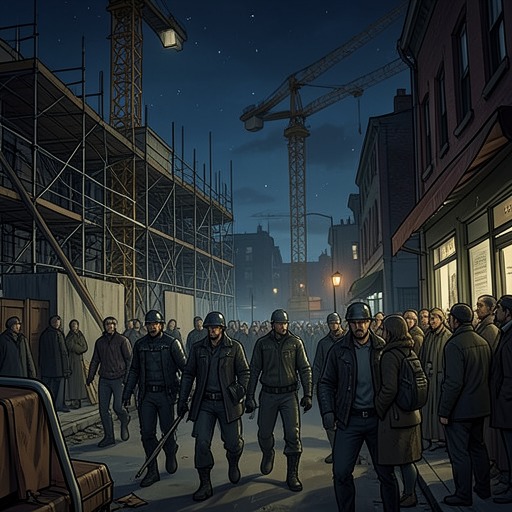
Following the signs from Artesia Boulevard, Doc reaches Channel View Estates, advertised as “A Michael Wolfmann Concept.” At the edges of his drive he sees Black pedestrians who may, like Tariq, be looking for the old neighborhood. The development extends into the haze: model units stand near the road, finished homes farther in, and the skeletons of new construction continue beyond them into unincorporated land. Doc passes the gate and parks on empty contractor hardpan at the future corner of Kaufman and Broad, where street signs already stand although the streets have not yet been paved.
The unfinished landscape shows development as a process still being made, rather than a settled community. The homes promise a version of Spanish Colonial architecture, with red-tile roofs and small balconies, and are meant to suggest pricier places such as San Clemente or Santa Barbara. They command filtered views of a neglected branch of the Dominguez Flood Control Channel, cut off by fill, regrading, and industrial debris; the promised scenery is already shaped by earlier interventions. There is not yet a shade tree in sight. On this exposed ground, the new neighborhood’s image of desirable domestic life stands beside the environmental alteration that made it possible.
Property, belonging, and power
The name on the sales signs makes Wolfmann’s development a particular project, but the novel sets it against a wider contest between developers and established property owners. Crocker Fenway describes residential owners resisting Wolfmann’s Channel View development as a struggle to preserve the environment and prevent high-density housing. Doc rejects that public rationale as a defense of property values. Crocker answers by asserting that his group is already in place: real estate, water rights, oil, and cheap labor have long belonged to those with power, while other people are treated as a transient supply that can be bought off and replaced.
That exchange sharpens the event’s central contradiction. The displaced Artesia residents are rendered as people who have lost a place, while the opposition to Wolfmann’s project speaks the language of preserving a place already possessed. Neither the developer’s promise of new homes nor the homeowners’ claim to environmental stewardship by itself resolves who is entitled to remain. The dispute exposes how apparently competing interests can share a deeper assumption: that the land and its inhabitants may be rearranged to protect ownership, investment, and existing advantage.
Racialized space and the afterlife of removal
The novel places the clearance alongside the racial hostility that shapes who is considered out of place in nearby Gordita Beach. A Black visitor there once prompted calls for police backup and roadblocks on the Pacific Coast Highway. That reflex reaches back to the postwar attempt by a Black family to move into town: aided by the Ku Klux Klan, residents burned the family’s house down, and the lot remained empty until the town confiscated it and made it a park. The young people later used the park to drink, take drugs, and have sex, to their parents’ dismay but with little effect on property values. The neighborhood’s treatment of Black presence thus connects exclusion from one place to the forces that clear and remake another.
That spatial politics also reappears in the armed response around Channel View. Art Tweedle boasts that his group’s maneuvers chased bikers through the development after the occasion on which Wolfmann disappeared. His racist description of defending the property turns the new estate into a guarded landscape, where the threat of Black intrusion is invoked even as an earlier Black community has already been cleared from the site. Displacement is therefore not an isolated past act: its effects persist in the property boundary, the language of threat, and the armed forces assembled to police who belongs.
By linking Tariq’s return to the physical construction of Channel View Estates, the novel makes development legible as a history written onto land. A vanished street gang’s territory becomes advertised real estate; a landscape of channel, fill, hardpan, and half-built homes carries the marks of previous alterations and anticipated profit. The sequence from wartime removal to later displacement and redevelopment does not promise a clean break with the past. It shows the new neighborhood rising on ground whose history remains visible to those who remember what stood there.