Arthur Tweedle
Inherent ViceArthur Tweedle is a civilian machinist, a self-described standby helper for the police, and a member of the vigilante group Vigilant California. His ordinary suburban household conceals a large arsenal and a role in the group’s counterguerrilla activity. When Doc investigates him under a false sales pitch, Tweedle’s disclosures connect Vigilant California to the Channel View Estates raid and Mickey Wolfmann’s disappearance.
Identity and Background
Tweedle works a regular day shift as a civilian machinist at the naval weapons station. On weekends, and sometimes on weeknights, he puts on a fatigue-style uniform bought at D’Jack Frost, a Santa Monica surplus store associated with the Manson family, and attends Vigilant California meetings with his neighbor Prescott. Prescott, like Tweedle, is described as a countersubversive hobbyist whose name appears on a list Fritz prepared for Doc.
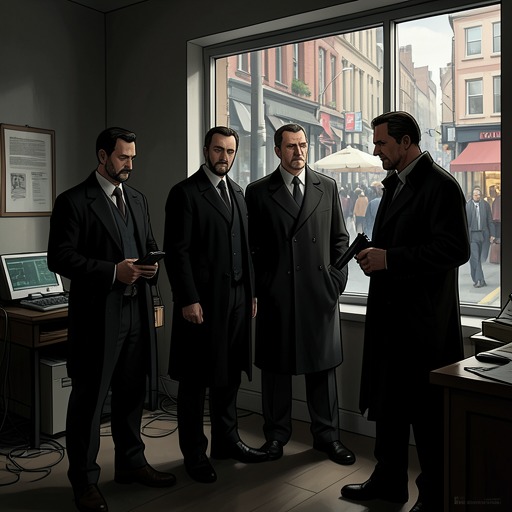
Tweedle’s appearance is unremarkable: he wears pale horn-rimmed glasses and has a high forehead. His face seems composed for company, though it carries a slightly fixed expression. That outwardly conventional presentation matters to the encounter: Doc approaches an ordinary-looking homeowner whose domestic setting and practiced claims of civic-minded readiness gradually expose a much more militarized private life.
Doc’s Approach and Tweedle’s Household
Doc arrives posing as a representative of Hairy Rope Home Security, a company he hopes does not actually exist. The sales pitch borrows from a California folk belief Aunt Reet once told him: a homeowner can keep snakes away by laying a hairy rope around the property line. Doc claims his company applies the same principle with electric eyes and speakers that trigger subsonic pulses intended to make intruders retreat. The system, he says, can be disabled remotely for ordinary access or yard work.
Tweedle is not persuaded. He calls the proposed system complicated and points instead to himself as a proven security arrangement. He says he is not technically a Los Angeles resident, but is on standby, with his car ready and the ability to reach wherever he is needed in under an hour. Doc encourages his account by praising the police for needing all the help they can get in a dangerous situation. The exchange gives Tweedle room to describe his role as practical assistance to law enforcement, even as the conversation reveals the scale and character of his preparedness.
Arsenal and Vigilant California Activities
As the visit continues, with the Tweedles encouraging one another and drinks arriving, Tweedle displays an extensive collection of home-defense weapons. It ranges from small pearl-handled .22 pistols and .357 Magnums to surplus grenade launchers. He then leads Doc out the back door, across the lot, and into a small barn-like outbuilding holding assault rifles and light machine guns.
The collection’s centerpiece is a Gleichschaltung Model 33 Automatic Bazooka, which Tweedle describes as illegal. It requires two people to operate: one to aim its 75-millimeter launch tube, the other to drive a modified electric golf cart carrying a magazine that can hold up to a hundred rounds. The technical specificity of the apparatus makes Tweedle’s idea of household defense inseparable from organized military force.
Tweedle describes Vigilant California’s activities as weekend maneuvers and urban counterguerrilla training. Sometimes, he says, the group is asked to deal with an individual when the authorities cannot commit the necessary manpower. Those assignments may involve stakeouts or throwing a rock through a window with a warning note. He characterizes such work as unexciting but says it brings cash on the spot, enough to keep the Pizza Man happy. His account therefore complicates his presentation as a volunteer auxiliary: the group’s work can be paid, targeted, and carried out beyond ordinary police deployment.
The Mask and the Channel View Raid
As Doc and Tweedle leave the workshop, Doc notices a Nordic-themed ski mask hanging on a hook. It resembles the masks in footage Farley Branch took during the assault on Chick Planet Massage. Doc casually claims to have received a similar novelty mask for Christmas, using the remark to see how Tweedle responds. Tweedle answers that the mask is standard issue for the group’s maneuvers. The exchange gives Doc a concrete connection between the vigilantes’ equipment and the masked assailants in the footage.
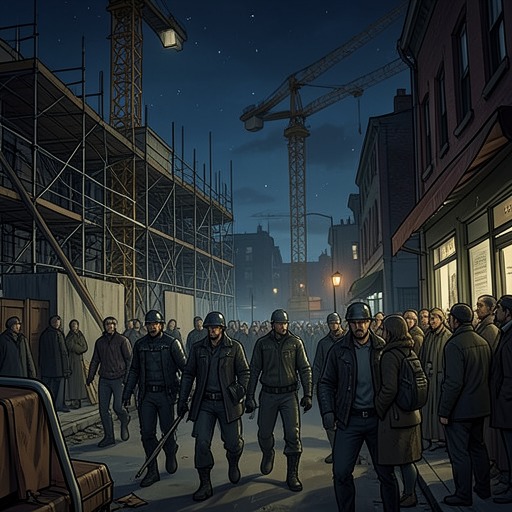
Doc then asks whether Tweedle’s group was present at the gathering where Mickey Wolfmann disappeared. Tweedle confirms that it was. He says the group chased a gang of bikers around Channel View Estates and dismisses them as no more troublesome than Black people. His prejudiced comparison reveals the racial hostility underpinning his supposed neighborhood defense, while his admission places Vigilant California at the scene of the raid.
Tweedle does not explain the group’s full purpose in the operation, and his account does not establish that he personally caused Mickey’s disappearance. What he does confirm is that his unit took part in the Channel View Estates action. He also recognizes the detective in the development’s commercials as Bigfoot Bjornsen, whom he calls Bigfoot. The reference brings the vigilante’s account back into Doc’s wider investigation, where police, private power, and armed anti-subversive groups intersect.
Narrative Role
Tweedle’s importance lies in the gap between his respectable civilian identity and the force he has assembled behind it. The machinist, neighbor, and standby helper presents his activities as security and civic service; the arsenal, paid assignments, standard-issue mask, and participation in the Channel View raid show how that language can cover organized violence. Doc’s false home-security demonstration becomes an improvised interview: by letting Tweedle explain his own system, he learns that the household’s defenses are only the visible edge of a larger political network.
The encounter advances the investigation through Tweedle’s own disclosures rather than a full account of the raid. He supplies evidence of Vigilant California’s methods and presence, but leaves the group’s precise responsibility and the circumstances of Mickey’s disappearance unresolved. His scene thus turns a suspicious resemblance—the ski mask—into a confirmed connection, while preserving the uncertainty that continues to surround the operation.