Bigfoot Bjornsen
Inherent ViceBigfoot Bjornsen is an LAPD lieutenant whose relationship with Doc Sportello shifts between arrest, recruitment, investigation, and wary cooperation. A hard-edged representative of the department’s authority, he is also marked by concealed grief for his former partner Vincent Indelicato. Their exchanges make him both an obstacle to Doc and a guide through the police institution’s informant networks, unsolved histories, and incentives to declare cases closed.
Identity and place in the department
Bigfoot’s public face is that of a forceful, media-ready cop: he appears in television commercials for Channel View Estates, an advertisement bearing the line “A Michael Wolfmann Concept.” Doc’s reaction to seeing him pitch a property development sharpens the connection between law enforcement and the real-estate world, though the advertisement by itself does not establish the nature of Bigfoot’s involvement in the development.
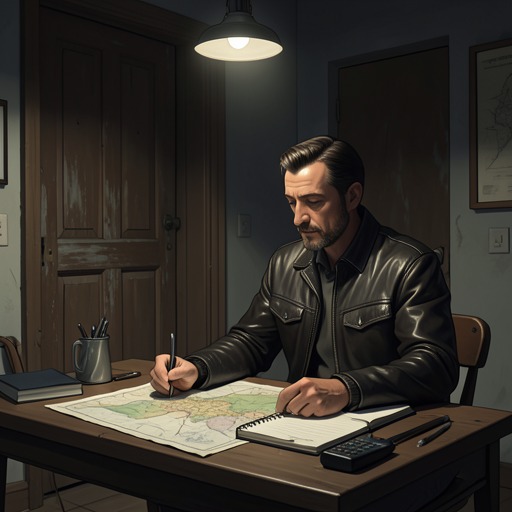
His actual working environment is the LAPD’s Homicide division at Parker Center. When Doc visits, the detectives share an overcrowded room rather than private offices, with long tables, telephones, paper cups, and missed wastebasket shots. Bigfoot belongs to this noisy, insular world of department traditions and loyalties. The narrative describes the Glass House as an institution protected by secret codes and histories, and identifies that world as Bigfoot’s element.
From arrest to informant recruitment
Bigfoot first appears in Doc’s investigation as a threat Doc expects to face. When advised to contact his former police acquaintance about the trouble surrounding him, Doc decides against calling: he fears Bigfoot will arrest him for the whole affair. That suspicion is confirmed when Doc, after blacking out at Chick Planet, wakes on a cement floor to find Bigfoot watching him. Bigfoot welcomes him into a situation he calls too real to escape through hallucination, establishing both his command of the encounter and his contemptuous manner toward Doc’s countercultural identity.
Bigfoot then lays out the case against Doc. During Doc’s alleged midday nap, gunfire occurred near Channel View Estates; Glen Charlock was found dead, and Michael Z. Wolfmann had disappeared. With less than twenty-four hours before federal authorities might treat the disappearance as a kidnapping and intervene, Bigfoot presses Doc to name the other supposed members of his group. He frames the request as a possible way to help law enforcement and improve Doc’s position before trial, while treating the idea of a lone perpetrator as implausible and suspecting a wider conspiracy.
The pursuit of Doc also becomes an attempt to enlist him. Bigfoot drives him to a secluded spot near Canoga Park and describes the large federal funds then available to local law enforcement under the Nixon administration. He points out that members of Doc’s community have accepted special-employee payments, and Doc recognizes the proposal as an invitation to inform. Later, Doc tells Penny Kimball that Bigfoot offered him a job. The offer draws on the same distrust that governs their dealings: Bigfoot regards Doc as potentially useful precisely because he can move among people the police want to penetrate, while Doc understands the position as betrayal of those he knows.
Coy Harlingen and the concealed case
Bigfoot initially treats the apparent death of Coy Harlingen as outside Homicide’s concern. When Doc brings him information about Coy’s alleged overdose, a suspicious deposit in Hope Harlingen’s account, and Coy’s appearance as an agitator at a Nixon rally, Bigfoot calls it another apparent resurrection rather than an obvious homicide. He nevertheless allows the question of who handles such cases to remain open. Later, after Doc sends him toward the matter, Bigfoot asks Doc to come to Parker Center to discuss what he calls the fool’s errand of investigating Coy.
That investigation exposes an unusual institutional history. Bigfoot meets Doc away from the office, brings out a disordered collection of papers from a grocery bag, and explains that Coy used multiple aliases and was handled by several offices at once. Some of those interests, Bigfoot says, would not have minded if Coy had actually died. The suspected overdose had not been designated a homicide, so no progress reports were required; administratively, it could remain one more overdose and one more case marked cleared. The gap between Coy’s possible survival and the official status of his death makes the case a test of how bureaucratic classifications can conceal conflict among agencies and people with power.
Bigfoot also gives Doc restricted information about Dr. Rudy Blatnoyd’s death. Though the official classification is fatal neck injury, the coroner found puncture wounds consistent with the teeth of a midsize wild animal. Bigfoot asks Doc to keep the information confidential. When Doc connects Blatnoyd to Golden Fang Enterprises and asks about testing the wounds for gold, Bigfoot dismisses the prospect of finding a trace because gold is chemically inactive. Later, Bigfoot reports that investigators raised the possibility of testing for copper-gold dental alloys, but a laboratory’s interest in bringing in a dog ended the inquiry without a useful result. His disclosures help Doc connect separate mysteries, while their limits show that Bigfoot does not give him unrestricted access to the department’s findings.
Indelicato, grief, and suspicion
Doc’s reading of the record concerning Adrian Prussia’s history with the California criminal code reveals that Detective Vincent Indelicato was the officer killed in one of Prussia’s cases. The arresting officer who identified the body was Indelicato’s longtime partner, Lieutenant Christian F. Bjornsen. Doc recognizes this as Bigfoot’s history: the partner he no longer rides with or mentions. The file turns Bigfoot’s previously unexplained melancholy into mourning.
Bigfoot eventually speaks about Indelicato while driving with Doc on the San Diego Freeway. Indelicato had come from New York; Bigfoot recalls first struggling with his partner’s pace and then beginning to speak like him. On the day Indelicato died, the two went to Gummo Marx Way on a tip. Indelicato entered the house before Bigfoot had stopped the unit. Bigfoot knew what was likely to happen and called for backup, but heard gunshots first. He recalls yelling for Indelicato and describes the dead partner as both difficult and the person who had made him feel safest. His account gives personal weight to a case that department paperwork had reduced to a justification for a shooting.
Doc tells Bigfoot that he had suspected him of killing Indelicato. Bigfoot rejects the accusation with anger, while Doc explains that distrust follows from the opacity of the police department’s internal dealings. The exchange does not resolve every uncertainty surrounding the case, but it changes the terms of their conversation: Bigfoot’s grief is now explicit, and Doc must reckon with a specific loss behind the institutional secrecy he had treated as evidence of guilt.
Uses and limits of cooperation
Their uneasy partnership becomes most visible when Bigfoot sends Doc into danger while avoiding direct action himself. Doc confronts him with the suspicion that Bigfoot wants to reach Puck Beaverton but cannot openly do so without provoking unnamed powers. Bigfoot acknowledges only that the situation is sensitive. After Doc survives a confrontation with armed men, he finds Bigfoot in a garage unloading a twenty-kilogram parcel from a Lincoln Continental. Doc accuses him of setting him up; Bigfoot apologizes, citing his own trouble with the captain and having seen Doc at the shooting range. The episode confirms that Bigfoot has used Doc as an intermediary while exposing the personal and departmental risks he claims to be managing.
On the drive afterward, Doc tells Bigfoot that Puck claimed to have fired the shots that killed Indelicato, while Adrian Prussia was paid to take the blame and then released. Doc asks whether Bigfoot knows who in the LAPD paid Adrian. Bigfoot refuses to provide a name, saying either that he knows but will not tell or that Doc will never discover it independently. He later offers a narrower explanation: Adrian had become too ambitious, and department officials were glad to be rid of both him and Puck. With both men dead, the LAPD could identify Vinnie’s murderer, claim that justice had been served, improve its clearance rate, and obtain more federal money. Bigfoot’s account makes the case’s official resolution less a simple finding of truth than an institutional opportunity to close a file and reward the department.
Change and narrative significance
Bigfoot is not reduced to either a simple antagonist or a reliable ally. He arrests and pressures Doc, proposes recruiting him as an informant, supplies information selectively, and puts him at risk as a go-between. Yet he also revisits matters that the department had left buried, shares details of Coy’s tangled handling, and finally speaks openly about Indelicato. Each disclosure enlarges the picture of the police world without removing its barriers: Bigfoot can explain how a case becomes administratively useful while still withholding who authorized a killing.
His grief and his professional conduct remain in tension. The man who remembers Indelicato as the partner who made his back feel safe also participates in an institution willing to call a violent death a solved case when doing so improves its funding position. The novel’s portrait of Bigfoot holds these facts together rather than making one cancel the other. Through him, Doc encounters a police system where personal loyalty, informant work, secrecy, and institutional self-interest occupy the same cramped room—and where cooperation can be genuine without ever becoming transparent.