Channel View Estates raid
Inherent ViceThe Channel View Estates raid is a masked assault on the new development that leaves Glen Charlock dead and Mickey Wolfmann missing. Its significance emerges in fragments: first through a federal file and competing accounts, then in Farley Branch’s 16-mm footage, which lets Doc Sportello watch an attack he experienced while unconscious. The film makes the raid visible without making every part of it knowable; even a stark record of Glen’s killing does not settle what happened to Mickey or explain the operation’s full purpose.
Causes and Setting
Channel View Estates, a tract of half-built ranch-style homes and construction ground, is the setting for a raid that reaches its temporary miniplaza and Chick Planet Massage. The assault’s abrupt violence contrasts with the development’s sunny, unfinished appearance. Farley Branch, a Vietnam veteran with an interest in documenting environmental damage, had filmed the area before; according to Spike, he was there on the day of the raid and had taken the footage to a lab for processing.
Mickey Wolfmann’s connection to the location helps explain why the attack becomes entangled with his disappearance. In a later account, someone says Mickey liked Channel View and especially Chick Planet Massage, and describes the raid as arriving amid an ordinary visit to the massage business. The account conveys the shock of the assault, but it does not establish who ordered it, what the raiders intended, or how Mickey left the scene.
The Assault
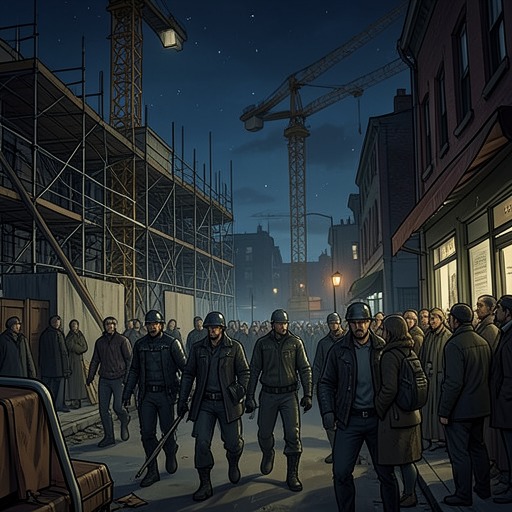
Farley’s footage shows men in matching camouflage fatigues and knitted ski masks entering the unfinished development with an extensive assortment of firearms. They cross a flood-control channel, secure the street and footbridges, and form a perimeter around the miniplaza, whose flagship tenant is Chick Planet Massage. Doc recognizes his car in the filmed scene; the motorcycles that had been present when he arrived are gone. The camera then catches a group of bikers riding through the tract, apparently either fleeing deeper into it or circling without a clear sense of what to do.
The recording is incomplete in ways that expose the limits of its medium. Farley’s Bell & Howell camera captures only a hundred feet of film before a reel change, so the sequence jumps; its turret lenses can also be rotated while filming. The footage has no soundtrack, yet Doc experiences it as an account of the assault he is watching. Because he had been unconscious inside the site, the film produces the disquieting reversal of seeing himself from outside, somewhere in the same place where he had lain helpless.
The clearest and most consequential image is Glen Charlock’s death. The film shows Glen unarmed as a masked gunman shoots him in several controlled bursts. The footage makes the difference between spectacle and evidence painfully plain: the camera records no movie-like protection, only the exposed circumstances of a man who does not survive. It fixes the fact of Glen’s killing, but does not identify the shooter or explain the decision to shoot him.
Accounts, Evidence, and Disappearance
The raid is reconstructed through sources that do not fully agree or answer the same questions. A federal file on Doc contains a blurred telephoto photograph of him in a parking lot, with a cheeseburger; the passage suggests that federal agents have been surveilling him, but the photograph is not identified as a record of the raid itself. Farley’s film, by contrast, supplies direct visual evidence of the armed party’s movements and Glen’s death. These different records place Doc under observation while leaving the larger operation obscure.
A later participant acknowledges being at Channel View after first suggesting he was elsewhere, saying he had stopped briefly to pick up a product. The account then describes a sudden assault and the site filling with armed teams. Another recollection identifies the speaker as having joined a group that chased bikers around the development on the night Mickey disappeared, though the recollection offers no further explanation of Mickey’s fate. Together, these partial testimonies establish the raid’s connection to the disappearance without resolving whether Mickey was abducted, escaped, or was taken by a particular group.
Aftermath and Narrative Significance
The delayed screening changes the raid from an episode Doc could not consciously witness into evidence he can inspect. Yet the film’s vividness does not amount to a complete explanation: it shows movements, vehicles, and Glen’s death, while the missing soundtrack, interrupted reels, and uncertain identification of participants preserve gaps. The reader encounters the event in the same uneven way—as an image assembled beside testimony and investigation, rather than as an account that closes every question.
The raid also sits within a story of expanding surveillance. Federal agents have a photograph of Doc, Farley’s camera preserves a record of the assault, and later discussion of the ARPAnet describes information gathering as increasingly fast and difficult to evade. These technologies are not equivalent: Farley’s film is bounded by its reel length and camera position, while the network is described as changing rapidly and widening the reach of observation. The raid’s record therefore carries a double consequence. It preserves a fact the official or personal accounts might otherwise leave uncertain—Glen was killed—while demonstrating how even an unusually revealing image cannot make the entire event transparent.