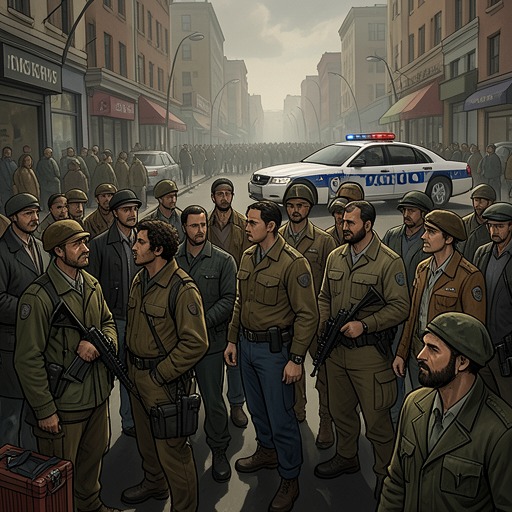
Coy Harlingen's protest at a Nixon rally
Inherent ViceCoy Harlingen's protest at a Nixon rally turns a public spectacle of dissent into a revelation about surveillance: the man hauled away for denouncing the president is not simply a hippie protester but Coy, whom Penny identifies as a police informant. The event brings the machinery of political policing into view through a televised image, while its surrounding history of racial exclusion and displacement makes clear that control over public space extends well beyond the rally.
The Rally and the Protest
The rally takes place at Century Plaza, where Richard Nixon has arrived to address activists belonging to Vigilant California. The television coverage presents the gathering as a scene of political excitement, but the audience is not uniform. Some attendees seem uncontrolled; others are more disturbing to Doc because they stand strategically among the crowd in matching suits and ties, appearing less interested in Nixon than in watching for something to happen. Penny suspects they are private operatives rather than Secret Service.
Their attention converges on a longhaired man in a psychedelic Nehru shirt and bell-bottoms. He shouts insults at Nixon, Vice President Spiro Agnew, the First Family, and even the presidential dog, then laughs as the suited men seize and drag him through the crowd. The audience responds with visible anger, while Nixon makes a joke about sending the protester to a hippie drug clinic. The broadcast turns an act of political defiance into entertainment and an occasion for official ridicule even as the man is forcibly removed.
Coy’s Identity and Informant Role
Penny recognizes the protester in the close-up as Chucky; Doc realizes with a jolt that he is also Coy Harlingen. Doc does not immediately tell Penny that he knows Coy, instead asking whether the man is a friend of hers. The recognition changes the scene’s meaning: what looks like an impulsive countercultural outburst is being performed by someone already connected to police intelligence work.
Penny says Coy is known around the Hall of Justice and the Glass House, and corrects Doc when he calls him a snitch: Coy is an informant, working mostly for the Red Squad and the Public Disorder Intelligence Division. His appearance on television gives him immediate, widespread credibility, Penny explains, making it possible for police to place him inside groups they want to infiltrate. The rally therefore functions not only as a confrontation between a protester and the president, but as a public credentialing of a man whose usefulness lies in entering dissenting circles.
Doc resists Penny’s interpretation, arguing that the demonstrators’ coordinated appearance does not prove there is a setup. Penny regards his skepticism as naïve, and her explanation connects the visible protest to a less visible method of policing: an informant can gain access because the televised incident makes him appear to be a genuine opponent of the authorities. The scene leaves the protest’s precise orchestration unstated, but makes Coy’s informant work—and the opportunity the event creates for infiltration—explicit.
Racialized Space and Displacement
The rally’s surveillance story sits within a wider landscape of racialized exclusion. Earlier, Tariq Khalil arrives at Doc’s office as an unusual Black visitor in Gordita Beach. The town’s response to Black presence has a violent history: after a Black family tried to move there shortly after the Second World War, residents, aided by the Ku Klux Klan, burned the house to the ground. The site remained empty until the town took it over and made it a park, where local youths later gathered to drink, use drugs, and have sex. The transformation does not erase the violence that produced the vacant lot; it converts its aftermath into ordinary civic space.
Tariq describes another history of forced movement. During World War II, Japanese Americans were sent to camps, and Black residents moved into South Central neighborhoods vacated by them. Now, he says, Black residents are in turn being pushed out. The text places this sequence alongside the bulldozing of Tariq’s neighborhood for Channel View Estates, and recalls Mexican families displaced from Chavez Ravine for Dodger Stadium and American Indians removed from Bunker Hill for the Music Center. The named developments and institutions mark displacement not as an isolated disturbance but as a recurring way the city remakes land and decides who may inhabit it.
Channel View’s sales signs call it “A Michael Wolfmann Concept.” Doc sees Black pedestrians near the new development, people who may be looking for the neighborhood and the rooms they once knew, now taken away amid construction and ruin. The contrast between the polished promise of real-estate development and the disorientation of the displaced makes the rally’s controlled crowd more than a separate political tableau: both scenes concern who is observed, moved along, or permitted to occupy a place.
Surveillance, Security, and the Uses of Force
The novel repeatedly connects political order to organized watching and armed protection. Penny’s account of Coy’s work names the Red Squad and the Public Disorder Intelligence Division as institutions for monitoring and infiltrating groups. In another episode, a radio audience sees matching suits pivot together and converge on the protester; in Penny’s explanation, that public image can help an informant pass as a credible dissenter. The spectacle and the covert work reinforce one another: visibility itself can become a credential for surveillance.
The same political culture appears in a different register at Art Tweedle’s home. Art shows Doc an arsenal that includes firearms and Vietnam-surplus grenade launchers, as well as a highly illegal automatic bazooka mounted on a modified electric golf cart. He boasts that Black people will not be sneaking onto his property. When Doc asks about an armed gathering near the place where Mickey Wolfmann disappeared, Art confirms that his group took part, describing a chase through Channel View Estates and comparing the bikers they pursued to Black people. His language makes explicit the racial threat imagined by white armed men and links private security to the contested development landscape.
These episodes do not establish that Art’s group organized Coy’s protest. They do place the televised rally within a broader system in which political surveillance, private force, racial hostility, and land control coexist. The novel’s contrast is sharp: the protester’s noisy denunciation becomes a public show, while the quieter work of identifying and infiltrating groups is described as routine police practice.
Significance
Coy’s protest matters because recognition overturns the apparent meaning of the broadcast. Doc initially sees an angry hippie being dragged away; Penny identifies a man whose informant status allows the police to use precisely that image to gain access to other groups. The scene offers no simple confirmation that every detail of the rally is staged, but it discloses how a public confrontation can serve purposes beyond the protest itself.
Set against the removal of Black residents for Channel View and the older histories of Japanese American incarceration, anti-Black violence, and neighborhood clearance, the rally also expands the meaning of surveillance. Political dissent is watched and infiltrated, while racialized communities face the more material power to be expelled from their homes and land. The television frame contains Coy’s dramatic removal; the wider city supplies the slower, repeated displacement that such a moment cannot contain on its own.