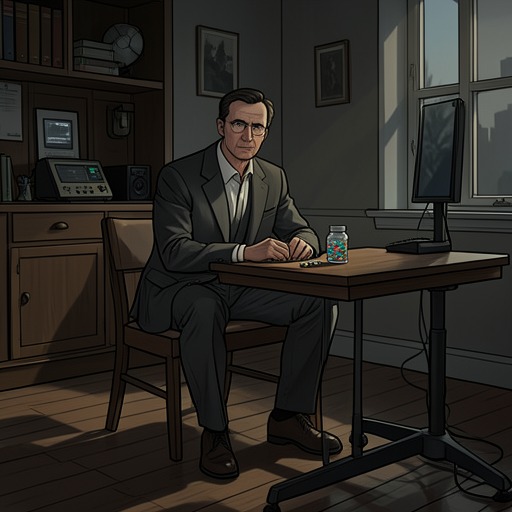
Coy Harlingen’s recovery from heroin addiction
Inherent ViceCoy Harlingen’s recovery from heroin addiction frees him from active dependence but does not free him from the forces that have organized his life around it. After entering the Chryskylodon program, he becomes clean; yet his sobriety is tied to Vigilant California’s recruitment and undercover assignments, and the new life requires him to abandon Hope and Amethyst. The recovery is therefore both a hard-won change and the condition through which another institution gains leverage over him.
Dependence, Family, and Recruitment
Coy and Hope’s heroin use had become inseparable from their family’s hardship. Hope recalls that they began injecting together before reaching San Diego, married soon afterward because they believed two people could obtain drugs more cheaply than one, and then had their daughter, Amethyst. They and the people around them saw the baby’s condition worsening, but the couple’s attempts to imagine a way out repeatedly gave way to waiting until their next supply. The account places their addiction in a context of poverty and diminished choices, rather than treating it as an isolated personal failing.
Hope describes how others warned that heroin was passing through her breast milk, while the couple could not afford formula. They understood their drug use as an escape from an exhausting middle-class round of choices that seemed no real choices at all, and compared it to the older generation’s dinner-hour drinking. That understanding made dependence feel, at the time, like freedom. Their belief that they could stop and make a plan after the next score kept postponing the decision that might have changed their circumstances.
The recruitment offer arrived when Coy believed he and Hope could no longer help one another by staying together. He says that their baby was doing worse, and that both parents could recognize they were dragging each other down without managing to act. Vigilant California appeared different from the religious zealots he had expected: its representatives had money and said they genuinely wanted to help. That appeal matters to Coy’s recovery because the organization offered not only a way out of heroin use but also a structured alternative at a moment when the family had little money or practical support.
Treatment and the New Discipline
The terms of the offer made recovery part of a larger bargain. Coy would have to leave Hope and Amethyst, take on one or more new identities, and let the old identity of Coy Harlingen cease to exist. Vigilant California promised Hope a one-time anonymous payment that could be presented as money Coy had left her in a will. Coy understood that faking his death was a grave step, but the recruitment was framed as a way to end a household situation in which neither parent saw a workable path forward.
Vigilant California presented sobriety as a demanding practice it called the Higher Discipline. Coy was told stories about people who had gained control of their addictions and met former users whose energy, vitality, and quickness impressed him. The promise of an annual Percodan dose served as an additional incentive. This combination of recovery, exemplary role models, and reward makes the program’s appeal concrete; it also shows that sobriety is being cultivated inside a recruitment system, rather than as a neutral medical intervention.
Coy eventually spends time at the Chryskylodon program kicking heroin. The account says the withdrawal period brings discomfort, while visits to Rudy Blatnoyd’s Smile Maintenance Workshop seem almost like vacations by comparison. Coy’s new teeth require him to adjust his embouchure, another practical change in the bodily routine of recovery. Afterward, he begins assignments for Vigilant California, including passing compromising notes to a state legislator and undertaking increasingly demanding preparation that involves political reading, martial-arts workouts, dialect coaching, and evasive-driving lessons.
Sobriety in the Service of Surveillance
As Coy’s work expands, he recognizes that the people running him are themselves answerable to a more powerful level. Vigilant California’s handlers classify him as an addictive personality and reason that informing for his country may become as difficult to quit as heroin. The comparison turns his recovery into a method of control: the organization has helped him stop using one dependency while anticipating that the new role will reproduce the old dependency’s hold.
Coy is sent to infiltrate antiwar, antidraft, and anticapitalist groups at universities, community colleges, and high schools. During those first months, he is so busy that he has little time to think about what he has done or what future the work might leave him. His sobriety enables this demanding new life, but the work also channels his time and attention away from the family he left behind. Recovery, in this phase, has not restored his former life; it has made him useful to an organization with its own political purposes.
Recognition and the Unfinished Return
A glimpse of a young girl looking excitedly at a bookstore window makes Coy think of Amethyst, who would be about the same age. The moment interrupts his work and brings the family he has tried not to think about back into focus. He recognizes the error in faking his death, understands that people he is helping to target may face genuine danger, and realizes how desperately he misses Hope and Amethyst. He wants his old life back, but by then he has no resources, sympathy, or support to help him reclaim it.
Later, Doc reports that Coy is clean, directly confirming the outcome of the recovery rather than merely a period of attempted abstinence. Yet Coy remains caught in work he does not want: he is operating as an informant for the Los Angeles Police Department and has also appeared at a Fascism for Freedom rally pretending to protest Nixon while working undercover for Vigilant California. His sobriety is thus a genuine achievement with an unresolved consequence. The account refuses to equate being clean with being free: Coy has left heroin behind, but has not yet escaped the institution that recruited him through the promise of a new life.