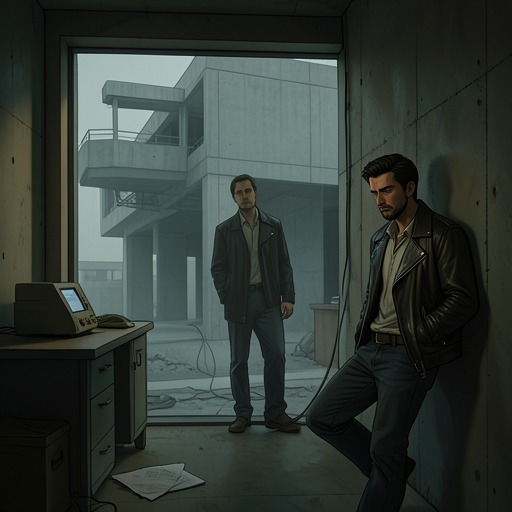
Coy Harlingen's presumed death
Inherent ViceCoy Harlingen’s presumed death begins as an apparent overdose and a closed routine case, but the investigation’s paperwork and scattered connections make that official explanation difficult to accept. Through Doc Sportello’s account and Bigfoot Bjornsen’s covert review, the supposed death becomes a bureaucratic anomaly: Coy may have been treated as dead while still alive, and the people and institutions around the case had reasons not to clarify the distinction.
The reported overdose and signs of survival
Doc recounts to Bigfoot what he has learned about Coy: the allegedly fatal overdose, an unexplained addition to Hope Harlingen’s bank account, and Coy’s appearance pretending to be an agitator at a Nixon rally. Doc does not disclose that he has spoken to Coy in person, so his account offers Bigfoot signs of possible survival without revealing the strongest confirmation he possesses. Bigfoot calls it another apparent resurrection and initially remarks that such a matter would not ordinarily belong to Homicide.
The gap between the official account and the clues grows sharper when Bigfoot reviews the case. Coy’s overdose, or whatever occurred, was never formally classified as a homicide. Without that designation, the department did not require progress reports; on its face, the incident could be treated as one more overdose, one fewer addict, and a case cleared. The absence of homicide paperwork thus did not mean the matter had received little attention. It meant the usual reporting obligation could be bypassed.
A case circulating through agencies
Bigfoot retrieves a mass of papers from a Ralph’s bag and explains that the case had attracted an unusual range of official interest. Coy used multiple aliases, and multiple offices had run him, often simultaneously. Bigfoot adds that some of the involved elements would not have minded if Coy had actually died and been buried under his final assumed name. The investigation therefore points beyond a simple dispute over whether an overdose was fatal: Coy’s identity and the agencies’ competing involvement made his fate politically and institutionally sensitive.
The paperwork itself becomes evidence. Bigfoot observes that dead people do not usually receive such documentary attention and suggests that the files make Coy seem as though he is alive somewhere. He has chosen to discuss the matter away from the Homicide office and stresses that, technically, he is not even aware the case exists. His caution frames the inquiry as an unofficial examination of a case whose records reveal more than the formal classification permits.
Puck Beaverton and the dealer’s address
Among the documents, Bigfoot draws attention to a field interview report concerning Puck Beaverton, whom he identifies as one of Mickey Wolfmann’s jailbird praetorians. Sheriff’s personnel had encountered Puck at the Venice home of the dealer who sold Coy the heroin associated with his supposed fatal overdose. Puck claimed he had come to play pool with Leonard Jermain Loosemeat, also known as El Drano; the report noted that he seemed unusually nervous in Puck’s company. The report does not explain why Puck was there, and Bigfoot offers buying drugs only as a possibility.
The encounter links Coy’s presumed death to people around Wolfmann and to the drug source named in the overdose account, but it stops short of proving that Puck caused Coy’s overdose or knew that Coy survived. Its value is as a concrete, unresolved lead: the case officially dismissed as routine contains a suspicious meeting at the dealer’s home, alongside extensive files on Coy’s aliases and handlers.
Significance of the unresolved death
The episode makes presumed death less a settled fact than an administrative status. Coy’s case can be called cleared because it was not called homicide, even while unexplained money, his apparent presence at the Nixon rally, multiple agencies’ interest, and the Puck report complicate the claim that he died. Bigfoot’s unofficial inquiry and Doc’s carefully limited disclosure expose the difference between what the records authorize investigators to say and what the accumulating clues invite them to suspect. The available evidence leaves the overdose’s exact circumstances unresolved, but makes the official closure look conspicuously inadequate.