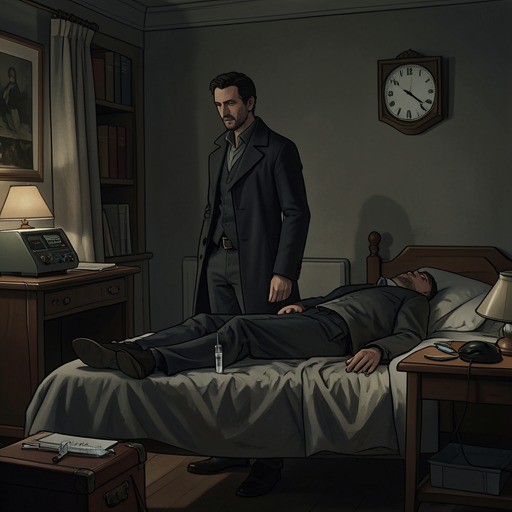
Coy's suspected heroin overdose
Inherent ViceHope Harlingen’s account of Coy Harlingen’s suspected heroin overdose anchors a mystery that begins as a reported death and becomes a challenge to whether that death occurred at all. She believes Coy was given a deliberately substituted supply of heroin, questions the identification of the body, and finds an unexplained credit in her bank account. Later, Doc Sportello encounters Coy alive near the waterfront, where Coy confirms that he is supposed to be dead. The episode’s decisive significance lies in that reversal: the alleged overdose is not simply a loss to be investigated, but the apparent cover for a concealed survival.
The reported overdose
Hope tells Doc that Coy, her husband, had overdosed on heroin a few months earlier. Coy had played saxophone with the Boards, a surf band whose work had developed into what its members called surfadelic. He contributed a saxophone harmony alongside his melody, a distinctive role within the group’s sound. That musical identity makes Hope’s account of his death more than a report about an anonymous victim: the supposed loss concerns a musician with a history and a place in a band.
Hope distinguishes the suspected fatal supply from the heroin Coy would have expected. She says it was not California heroin and that Coy would not have used his usual amount without checking an unfamiliar batch. From those circumstances she concludes that someone must have switched the bags deliberately, knowing the substitution would kill him. This is Hope’s allegation, not a conclusion established by the investigation in the supplied account; the uncertainty is central to why she approaches Doc.
She identifies the dealer as El Drano, whose actual name was Leonard. Coy had known him for years. Hope says Leonard had assured Coy that the heroin was local and ordinary, while also explaining that overdoses could attract customers who interpreted a death as evidence of unusually potent product. The detail supplies a possible context for the alleged switch, but it does not establish that Leonard caused the overdose or knew what was in the supply.
Doubts about the death record
Hope does not present her suspicion as grief alone. When Doc asks whether she identified the body, she says she did not: someone had called to say a band member had already done it. Doc observes that identification would ordinarily be the next of kin’s responsibility. Hope’s diary preserves the name of the caller, Lieutenant Dubonnet, giving her account a specific point Doc can follow up by speaking to Pat Dubonnet. The body’s identification is therefore not confirmed by Hope’s own recognition; it rests on what she was told and on an unexplained delegation of the task.
The identification’s uncertainty is reinforced by the resemblance of the description read to Hope over the phone to one that could have fit a thousand people. That indistinct account leaves open the possibility of mistaken identity, without proving it. What begins as a seemingly settled death certificate is instead surrounded by gaps in firsthand knowledge: Hope did not see the body identified, and the information provided to her was too general to establish that it was Coy.
A second anomaly appears in Hope’s bank records. She shows Doc an old Bank of America statement from shortly after Coy’s alleged overdose, pointing to a credit in her account. When she queried the deposit, bank staff and vice presidents repeatedly insisted it was correct, offering explanations such as a lost deposit slip or a mistake in her arithmetic. The credit’s origin remains unexplained in the account, but its timing and the bank’s repeated, identical reassurances make it part of Hope’s case that the official story does not add up.
From suspicion to encounter
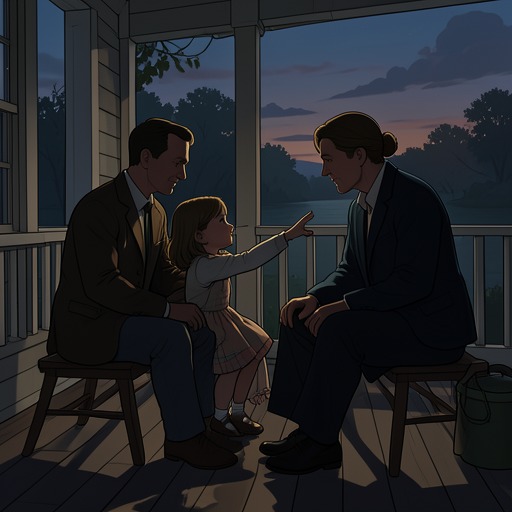
Hope tells Doc that she does not think Coy is really dead. Doc initially recognizes that bereaved people may invent explanations to avoid accepting a death, but judges Hope’s presentation not to be that kind of denial. Her suspicion is connected to concrete irregularities—the unverified identification and the unexplained bank credit—rather than resting solely on refusal to accept a loss. Her daughter Amethyst is present during the conversation, though she leaves for another room as the discussion turns to the case.
The suspicion receives its decisive confirmation when Doc later recognizes Coy from a Polaroid Hope had given him. Coy emerges through waterfront mist dressed in painter’s overalls, a pink shirt from the 1950s, a narrow black tie, and old pointed cowboy boots. He has returned from the world of the supposedly dead, and Doc greets him by name. Coy explains that he avoided Doc’s office because he feared unfriendly eyes and speaks quietly, making clear that secrecy still shapes the encounter.
Coy tells Doc that he is supposed to be dead. The statement confirms that the reported death and his actual survival coexist as opposed public and private identities. It does not, by itself, explain who arranged the apparent overdose, how the body was identified, or what the bank credit means. The evidence establishes the reversal, while leaving its full mechanism and responsibility unresolved.
Consequence and narrative significance
The alleged overdose changes from a suspected drug-death case into a question about concealment. Hope’s details prompt Doc to examine the official account; the later meeting with Coy vindicates her central suspicion without answering every question she raised. Her belief that someone switched the heroin is plausible within her account, but the surviving evidence here does not name a proven perpetrator or establish that the overdose itself happened as described.
The episode also turns on the difference between a record of death and recognition of a living person. The unverified identification, the generic description, and the unexplained deposit all make the official account feel settled without making it reliable. When Coy appears, the supposed death proves to be an imposed status rather than a confirmed ending. His words that he is supposed to be dead preserve the mystery even as they overturn its most important assumption: Coy is alive, and the circumstances that made him a reported overdose victim remain concealed.