Denis
Inherent ViceDenis is Doc Sportello’s friend and habitual companion: a drifting, cannabis-smoking presence whose baffled interpretations of everyday life provide some of the story’s most comic scenes, but whose companionship also becomes practical support when Doc’s investigations turn dangerous. He moves between the ordinary and the bewildering without drawing a firm boundary between them. A drugstore sign becomes a revelation, a kitchen raid becomes an emergency supply run, and a television carton full of heroin becomes a slow educational program. Through Denis, confusion is not an exception to the story’s reality but one of the forms in which that reality is lived.
Identity and Character
Denis lives down the hill from Doc and appears at Doc’s door already more disoriented than usual. His name is pronounced to rhyme with “penis,” a detail that introduces the casual, irreverent tone surrounding him. He is not presented as a conventional investigator or a dependable source of information; he drifts, gets distracted, and takes events at face value. Yet his lack of authority does not make him merely incidental. He is a recurring companion whose presence helps Doc move through a world where certainty is scarce.
His way of seeing is captured when he tells Doc that he has walked past the word “Drug” and the word “Store” a thousand times without truly seeing what they said. The sign becomes, for a moment, startlingly legible, and Denis responds by going inside to ask for drugs. The episode turns his dazed literalness into a comic form of perception: familiar surroundings can suddenly appear newly strange, but the insight does not lead to sustained understanding. He takes the drugstore’s wording at face value and carries the revelation into a request that is as direct as it is absurd.
Food and intoxication repeatedly organize Denis’s attention. He wanders into Doc’s kitchen to look through the refrigerator, then proposes going out to eat by invoking Godzilla and Mothra. At Pipeline Pizza, he cannot remember what he ordered, and the pizza that arrives is an improbable mixture of ingredients. The fixed Cheap Pizza Nite price makes the meal part of the local routine, but Denis watches his creation intently as if it might do something. His appetites are immediate; the order and its consequences seem to have arrived from somewhere outside his memory.
Doc’s Companion and Accomplice
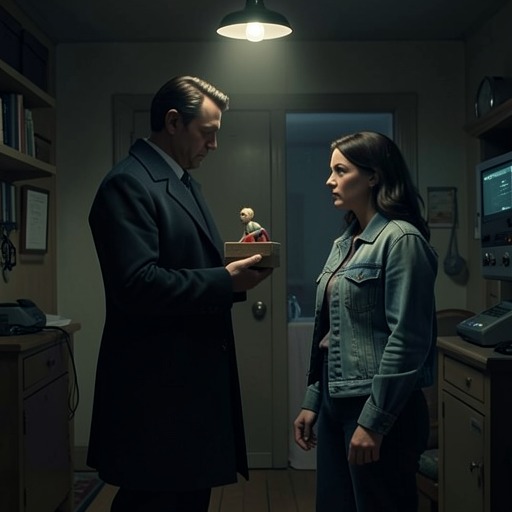
Denis accompanies Doc to Topanga when Doc adopts the cover of a music reporter for the underground fan magazine Stone Turntable. Doc pulls his hair into a tight ponytail, fastens it with a leather clip once given to him by Shasta, puts on a vintage fedora, and carries a tape machine; Denis poses as the photographer, wearing a shirt that pictures God passing Adam a lit joint. Their disguises frame the visit as a bit of countercultural reportage, but Denis’s role is more than costume: he is the partner Doc brings along while approaching a risky scene.
When the visit turns frightening and the mansion’s occupants seem to become flesh-eating creatures, Denis panics and runs. Doc, unable to use him as an anchor in reality, is swept further into the terror. They meet again in the vast kitchen, where Denis is filling a Safeway bag with cookies, frozen candy bars, Cheetos, and other food from the cupboards and refrigerator. He explains that a few minutes earlier the others had tried to take his camera after he took a photograph, so he decided to grab what he could. The joke lies in the mismatch between the scale of the apparent danger and Denis’s practical response: he does not produce a plan or evidence, but provisions.
Doc steers him by the string of love beads around his neck and leads him out through a side exit. Denis had expected free dope and perhaps women, not zombies; Doc’s answer is simply that they should run. Their escape puts the pair’s dynamic in miniature. Doc is the one trying to direct their movement, while Denis supplies a panicked, concrete account of what has gone wrong. His fear does not cancel his loyalty; he is there with Doc, and they flee together.
The evidence Denis brings back from Topanga is compromised but not useless. When the contact prints from his camera are developed, most are blank because he left the lens cap on, or show fragments because he accidentally tripped the shutter. Others catch groupies from a low angle or record the aftermath of drug-related sleep and silliness. One photograph, however, shows a kitchen gathering around pizzas, with Coy Harlingen visible in a vivid blur unlike the rest of the room. The camera’s failures and its one striking image make Denis an imperfect witness: he does not reliably document what is happening, yet one of his photographs preserves a detail Doc wants enlarged.
The Unsteady Familiar
Denis also accompanies Doc when he returns to the address associated with an earlier Ouija-board misadventure. The original hole in the ground has been replaced by a gold-leaf-covered structure that at first resembles a narrow religious building. From the side, its curve and sharp tip resolve into the shape of a six-story golden fang. Doc asks Denis whether he wants to wait in the car or come inside and cover his back. Denis’s presence is therefore both companionship and possible backup, even when the place they have come to investigate carries the residue of a disorienting episode.
Later, Doc finds Denis by the alley, sitting with an unlit joint hanging from his lip and muttering about the Boards. The moment offers no neat explanation for his distress; it registers instead as another point at which the Topanga episode continues to haunt their ordinary surroundings. Denis’s reactions often arrive without a clear account of what has happened, leaving Doc to ask questions and make sense of the scene.
After Doc returns from Las Vegas, Gordita Beach itself seems unfamiliar: people he knows are absent, and even his apartment becomes a source of doubt. When he asks a passerby whether he is in Gordita Beach, the man recognizes him as Denis and asks if he is all right. Doc is relieved enough to accept that this may be Denis, or somebody impersonating him. Denis explains that college break has brought junior hell-raisers into town and says he is staying close to the television until it is over. The exchange makes their usual familiarity briefly uncertain: Doc needs Denis to confirm the place, while Denis offers a mundane explanation for the town’s altered feel.
Even amid that uncertainty, Denis remains available as a companion. He suggests that Doc and he could walk up to see someone, but Doc decides against it, and Denis wanders off to watch Lawrence Welk. He calls back that he is still working out what it is about Norma Zimmer. The small exchange returns him to his familiar mode: distracted, curious, and content to let a television program take up his attention while Doc weighs his own suspicions.
Fire, Shelter, and the Heroin
Denis’s apartment becomes the site of an accident that later has consequences for Doc’s investigation. One night Denis falls asleep with a lit joint in his mouth, as he often does. Usually it drops onto his chest, burns him, and wakes him at least partway; this time it rolls among the bedsheets and begins to smolder elsewhere. Denis wakes, gets up, and wanders into the bathroom to take a shower. While he is there, the bed catches fire.
The fire burns up through the ceiling into the room above, where Denis’s neighbor Chico has a water bed. Chico is fortunately not on it. The plastic bed melts in the heat and releases nearly a ton of water through the hole in the ceiling, putting out the fire in Denis’s bedroom and flooding the floor. When Denis returns from the bathroom, the scene is hard for him to account for. The arriving fire department becomes confused with the police in his mind, and he runs down the alley to Scott Oof’s beach place to report what he believes is deliberate sabotage by the Boards. His suspicion of the Boards gives the accident the shape of a plot, even as the burning joint and melted water bed supply its material causes.
The damage remains visible long afterward. When Doc needs somewhere to conceal twenty kilos of heroin, he passes Denis’s place and finds heaps of soggy plaster, splintered laths, wiring, and plastic pipes still strewn through the wreckage. Denis is living amid the ruins and has improvised power for his refrigerator, television, and lava lamp by bootlegging it from the neighbors. The landlord is away in Baja and has not yet managed to collect enough insurance to repair the building, so the apartment remains in a prolonged state of collapse. To Doc, the ruined room is a perfect hiding place; he hides the heroin in a carton behind a section of fallen ceiling and drapes Chico’s enormous plastic water-bed remnant over it.
The concealment turns Denis’s past accident into a practical resource for Doc. The carton had once held a twenty-five-inch color television, but it now contains professionally packaged heroin. When Doc returns the next day, Denis is sitting in front of the drugs, apparently serious and attentive. He explains that the label said television set; because he could find no power cord, he assumed it might be a new kind of set that did not need one. He has been watching it as if it were an educational channel, slow but no worse than high school, and tells Doc that if he watches long enough it seems to change. The heroin is not merely mistaken for an appliance: in Denis’s account, sustained attention can make it transform. His error is funny, but it also gives the parcel a strange imaginative life just as Doc is trying to treat it as dangerous contraband.
Loyalty and Narrative Function
As Doc faces the return of the heroin and the people who want it, he brings Denis along for the exchange. He admits, at least to himself, that Denis may not be muscle; he is something closer to protection, a boost against the pull of Southern California’s shopping plazas and the desires they represent. Denis does not understand the stakes in the same terms. While Doc talks through the decision to give back the television set, Denis asks why he is returning it. The gap between the two men’s accounts is characteristic: Doc is weighing danger and refusing the consumer promise attached to a suburban future, while Denis hears a simple question about an object.
When Doc reflects that decent people are bought and sold every day and that trusting an evil person once in a while is no more or less sensible, Denis calls the thought heavy and asks what it means. His response is not an argument, but it is a form of attention: he listens, shares the joint, and stays beside Doc. Denis’s significance rests in that imperfect companionship. He is unreliable as a photographer, often bewildered by events, and liable to turn a room of heroin into a television program. Yet Doc repeatedly brings him along—to Topanga, to the golden-fang building, and to the tense heroin exchange—because the presence of another person offers a kind of shelter even when it cannot provide certainty. Through Denis, the story’s comic misrecognitions become more than punchlines: objects fail to stay what their labels say, familiar places become strange, and a damaged home can become both the record of an accident and the hiding place for a new danger.