Doc Sportello
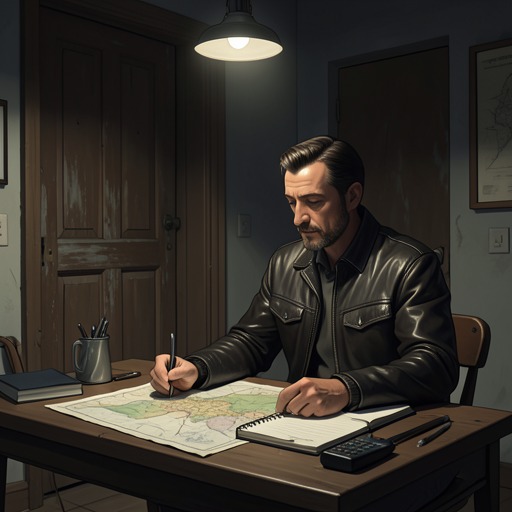
Inherent ViceDoc Sportello is a private investigator whose apparently aimless movement through Los Angeles makes him both a participant in its mysteries and a witness to the forces shaping them. His office advertises “Location, Surveillance, Detection,” but the investigations lead beyond individual suspects to a landscape remade by property development, racial displacement, and police power. Doc’s position is precarious: he can read the city’s connections, yet repeatedly finds himself being used by people with more institutional reach than he has.
Identity and Working Methods
Doc works from an upstairs suite marked by an LSD Investigations sign and a giant psychedelic eyeball. Its thousands of capillaries were painted by a group of speed users who had since moved to Sonoma; potential clients sometimes became absorbed in the image and forgot why they had come. The sign’s promise of observation and detection sits oddly beside Doc’s loose, informal practice, but it also captures his role: he looks for connections others overlook, even when the investigation becomes difficult to control.
When he needs local knowledge of property, Doc turns to Aunt Reet, whose grasp of land use extends from the desert to the sea. She knows the stories that deeds and contracts seldom record: family histories, water flows, and the past of particular lots. Her knowledge gives Doc a way into the material history behind development, not merely its paperwork. The contrast between her detailed, almost uncanny understanding of the land and the imagined future of computerized property records helps frame the kind of detective he is: dependent on people and lived knowledge rather than a clean, impersonal system.
Los Angeles as a Landscape of Displacement
Doc’s work takes him through places where redevelopment has rewritten who can live and move there. Tariq Khalil describes the displacement of his South Central neighborhood: during the Second World War, Japanese residents were sent to camps, and Black residents moved into the area afterward; now his community is being moved aside for Channel View Estates. Doc recognizes the pattern as part of a longer history, linking the removal of Mexican families from Chavez Ravine for Dodger Stadium and American Indians from Bunker Hill for the Music Center to the clearing of Tariq’s neighborhood.
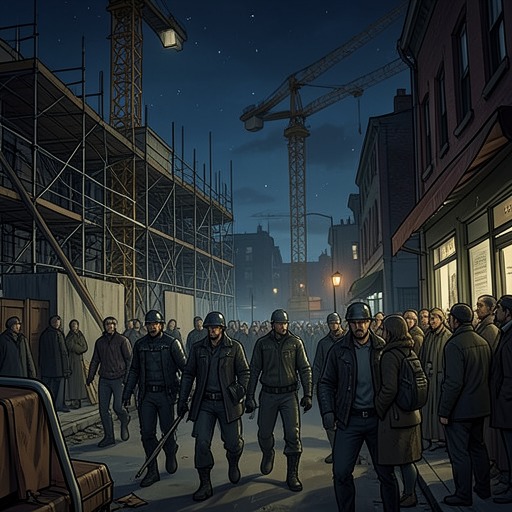
On the drive to Channel View Estates, Doc sees signs presenting the development as “A Michael Wolfmann Concept.” The new homes extend past model units and completed houses into construction sites on the unincorporated edge. He parks on contractor hardpan where street signs are already in place but the streets remain unpaved, at the future corner of Kaufman and Broad. From there, the development’s Spanish Colonial styling and red-tile roofs promise the look of more expensive coastal towns, while the nearby flood-control channel, industrial fill, and absence of shade trees expose the manufactured character of that promise. At the edges of his windshield, Doc notices Black pedestrians who may be looking for the neighborhood that has been taken from them.
This attention to the street-level consequences of development is not separate from his investigations. Doc is tracing individual people and crimes through a city where land, infrastructure, and authority are already arranged to benefit some and displace others. The route to a case is also a route through the history of who has been forced out and who gets to claim that a place has always belonged to them.
Investigation and Entrapment
Doc’s inquiries bring him into contact with Bigfoot Bjornsen, whose account of Glen Charlock turns Doc’s search into a personal danger. Bigfoot identifies the dead man as Glen, whom Doc had been asking for by name only hours earlier, and says witnesses will connect Doc to the inquiry. Glen was also a bodyguard for Mickey Wolfmann, a powerful developer. Bigfoot uses those circumstances to suggest that Doc’s investigation and the death will be read as a case against him; Doc’s own car, he learns, is on its way to impoundment. The episode makes clear how quickly his search for information can be reframed as evidence of guilt.
Later, after Adrian Prussia and Puck Beaverton have become part of the chain of violence Doc is trying to understand, he asks Puck who hired Adrian. Puck refuses to identify anyone, dismissing the question as pointless in a conflict between police. His answer leaves the investigation open: Doc has learned how Adrian’s killing was carried out, but not who commissioned it. The missing employer matters because it points beyond the men who performed the acts toward the power that could arrange them and remain concealed.
Doc’s pursuit of Bigfoot eventually becomes tangled with a larger drug operation. After leaving a lot, he hears a thump in his trunk and discovers twenty kilos of No. 4 China White. He understands the heroin as a setup: Bigfoot can spread word that Doc has it, making him bait once again. Doc hides the drugs in a cardboard carton and disguises the package among garbage and renovation debris before heading to Burbank Airport to try to reach Tito. The sequence makes his resourcefulness concrete, but also shows its limits. He can improvise a way to protect himself and others; he cannot control the network that has put him in danger.
Loyalties, Doubt, and the Unanswered Case
Even when Doc follows Bigfoot, he does not mistake proximity for trust. As Bigfoot’s battered El Camino follows them, Doc wonders how far the trail of the twenty kilos will lead and what, exactly, he still needs to learn: who hired Adrian to kill his partner, whether Adrian was connected to Crocker Fenway’s principals, and whether the Golden Fang existed at all. Each question opens onto a larger one about the meaning of the investigation itself. Doc is not sure what any of it will amount to, or how safe Bigfoot will be without backup. Passing a smoldering joint, he observes that Bigfoot is not his brother but needs someone to look after him. The line registers their reluctant entanglement without converting it into uncomplicated friendship.
Doc’s meeting with Crocker Fenway brings the question of power back to land and ownership. Crocker describes the struggle over Channel View Estates as a fight between residential owners and developers, and insists that his side has acted to prevent urban blight. Doc cuts through this account by identifying property values as the real issue. Crocker answers in the language of permanence: his group has been in place for generations, with control of real estate, water rights, oil, and cheap labor, while newcomers arrive and depart. Doc’s casework has brought him face to face with a world in which the people who claim to defend a place may also be defending their control of it.
The City Seen and Unseen
As Doc approaches downtown Los Angeles, the smog thickens until he cannot see to the end of a block. He imagines a dark, metallic-gray landmass rising ahead, like the submerged Lemuria described by Sortilège. No one else seems to notice it. The moment connects Doc’s drug-tinged perceptions with the book’s sharper account of public agreement: people see what they have collectively been taught to see, and trust the version of events supplied by television or the morning papers. The lost continent would not restore what the city has forgotten; it would make visible the depth of that forgetting.
That vision resonates with Doc’s investigations without resolving them. His repeated questions about hidden employers, concealed connections, and the Golden Fang are not simply puzzles waiting for a single final answer. They arise in a city where visible development can obscure dispossession and official explanations can leave the decisive actor unnamed. Doc’s viewpoint exposes the seams between what appears to be an isolated crime and the larger systems that give it room to happen.
Change and Narrative Role
Doc’s closing exchange with Coy Harlingen distills his modest but consequential form of loyalty. When Coy begins to repeat a saying attributed to Indigenous people about having saved his life, Doc interrupts the attribution, calls it something a hippie made up, and gives Coy a direct instruction: “You saved your life, Coy. Now you get to live it.” He hangs up rather than turn the moment into a speech. The terse exchange shifts attention from borrowed wisdom to Coy’s responsibility for the life he has reclaimed.
Doc is neither an all-seeing detective nor a detached chronicler. He is vulnerable to the same confusions and manipulations that he investigates, yet his attention keeps returning to people caught inside systems that would rather treat them as expendable. His questions remain unresolved, and the investigation leaves him entangled in forces larger than himself. What persists is his habit of looking closely: at a dead man’s connection to a developer, at a neighborhood erased by a housing project, at the gap between a public story and the interests it conceals, and at the person on the other end of a phone who still has a life to live.