Ensenada Slim
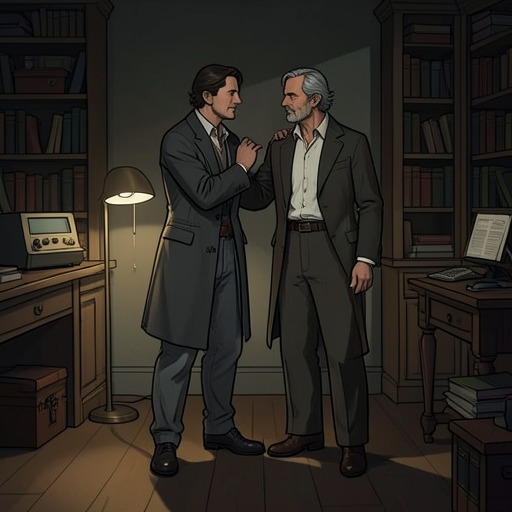
Inherent ViceEnsenada Slim is a head-shop proprietor and village elder in Doc’s coastal circle, a figure whose local knowledge links everyday counterculture life to the novel’s deeper histories of place. He notices Shasta’s return, trades stories with Doc and other surfers, and speaks of a dangerous break as if the ocean itself remembers what the land and its inhabitants have lost.
Identity and Place
Slim owns and operates the Screaming Ultraviolet Brain, a head shop on the street near Pipeline Pizza. The novel presents him as a kind of village elder: he knows the local scene, is recognized by its regulars, and moves easily among its small rituals. At Pipeline Pizza, after winning a dozen free games on a Gottlieb machine, he takes a break and nods to Doc. The setting places his authority in informal social life rather than any official position; his standing comes from familiarity, observation, and the stories accumulated around the coast.
His knowledge also resonates with Aunt Reet’s larger account of land as more than property recorded in deeds. She imagines a future database capable of retrieving lot histories, water rights, encumbrances, and mortgages, but recognizes that this would not capture the stories of families, hatreds, and changing watercourses. Slim’s own local lore similarly treats the coast as a place with a history that cannot be reduced to its visible surface.
Shasta’s Return
When Doc meets Slim at the pizza joint, Slim asks whether the big convertible he saw on the Drive belonged to Shasta. Doc confirms that she had stopped by briefly and says that seeing her again felt strange; he had imagined he would encounter her on television rather than in person. Slim replies that he sometimes thinks he sees her at the edge of the screen, only to discover a look-alike, never as attractive as Shasta.
The exchange establishes that Shasta’s image has persisted in the local imagination even while she has been absent. Slim’s television comparison makes her return feel at once intimate and mediated: she is a person who has come back into Doc’s life, but also someone whose likeness seems to circulate at a distance. Slim does not explain her disappearance or claim special access to her intentions; his contribution is the small, telling fact that he too has been looking for her in the wrong places.
Death’s Doorsill
Slim’s most vivid account concerns a surf break known to old-time surfers as Death’s Doorsill. Stories say the break sometimes appears and sometimes does not, as though something beneath the water were guarding it. A wipeout there is not merely a fall: the wave is said to seize surfers from behind, often just as they are heading toward what seems like safe water, and drag them too deep to surface in time for another breath. The old tales end with the sound of a cosmic Surfaris laugh echoing across the sky.
The assembled surfers answer Slim’s grave account with laughter and a chorus of “Hoo-oo-oo-oo-oo-oo—Wipeout!” Then the talk turns to a disagreement over which “Wipeout” single, on Dot or Decca, includes the laugh. The shift from lethal legend to record-label trivia does not settle whether the break is supernatural; instead, it shows how danger, folklore, and pop culture occupy the same conversational space. Slim’s story gives the surf spot a name and a threatening history, while the group’s joking response keeps the warning from becoming a settled explanation.
Land, Memory, and Displacement
Slim’s stories sit within a broader account of Southern California as a landscape repeatedly remade by development and dispossession. Tariq recalls that before the Second World War much of South Central was a Japanese neighborhood; its residents were sent to camps, and his community later moved into the area. He now sees his own neighborhood being cleared for Channel View Estates. Doc recognizes this as part of a longer history of Los Angeles land use: Mexican families displaced from Chavez Ravine for Dodger Stadium, American Indians displaced from Bunker Hill for the Music Center, and Tariq’s neighborhood bulldozed for a new development.
Channel View’s sales signs advertise “A Michael Wolfmann Concept,” while the unfinished project spreads across former neighborhood space into unincorporated land. The scene makes the contrast between promotional vision and lived memory concrete: prospective buyers tour model homes as black pedestrians appear at the edge of Doc’s windshield, perhaps looking for a neighborhood and rooms that have been taken away. Slim’s local authority belongs to this same contested geography. Like the surf stories, the histories attached to land are hard to see from the polished surface, but they persist beneath it.
Later, as Doc drives through downtown Los Angeles smog, he imagines a dark promontory rising ahead and recalls Sortilège’s thought that a sunken continent might be surfacing. The vision connects the city’s obscured landscape to the coast’s tales of hidden depths, without turning either into a confirmed supernatural event. Across these episodes, Slim’s role is modest but resonant: he is one of the voices through which the novel lets a place carry its own unreliable, threatened, and repeatedly submerged history.