Gotcha!
Inherent ViceGotcha! is the private-investigation shop associated with Doc Sportello and Fritz, a small office whose work ranges from tracking people to following information across institutional boundaries. Its return near the end of the story reveals a changed workplace: what had been a modest investigative operation now contains an elaborate computer network, suggesting a new means of inquiry even as Doc remains uncertain how to use it.
Identity and investigative work
Gotcha! operates as a private-investigation shop. Doc’s earlier connection to its work is recalled through a case in which he pursued a child-support deadbeat onto a Greyhound bus; Adrian Prussia remembers Doc as the young man from Fritz’s shop who declined to use a special-edition Carl Yastrzemski bat during the pursuit. The anecdote gives the agency a history of practical, personal skip tracing rather than a purely technological or bureaucratic method.
The shop’s reach also appears in the clients and leads connected to it. Tariq Khalil says he learned of the agency from Sledge Poteet, then approaches Doc about Glen Charlock, whom he knows to be working as a bodyguard for builder Mickey Wolfmann. A separate federal inquiry connects Doc’s business to the visit from Tariq and to the agencies’ interest in the people and events surrounding Wolfmann’s disappearance. Gotcha! is therefore a point of contact for information that moves among private clients, police, and federal investigators, though the evidence does not establish that the shop itself directs those institutions’ investigations.
Doc’s work beyond the office
Doc’s investigations repeatedly take him outside the ordinary limits of an office inquiry. When Coy Harlingen warns him that he may be caught in circumstances Doc has not understood, Doc offers to investigate from the outside, where he believes he can move in ways Coy cannot. That exchange captures the shop’s practical function through Doc’s work: it can provide a position outside an institution or compromised situation, even when the investigator has no clear access to the whole story.
The cases that touch Gotcha! are entangled with wider systems of information and influence. Federal agents question Doc about Tariq and ask what he knows about Motella Haywood and Lourdes Rodriguez; Doc, in turn, tests their interest by raising the possibility that the Wolfmann disappearance could be framed as a kidnapping by political militants. Elsewhere, an account of Adrian Prussia’s IOUs describes small debts that secure obedience from people in positions of command. These episodes do not make Gotcha! a powerful organization; rather, they show the investigative work around it confronting networks whose influence exceeds the shop’s resources.
The expanded computer room
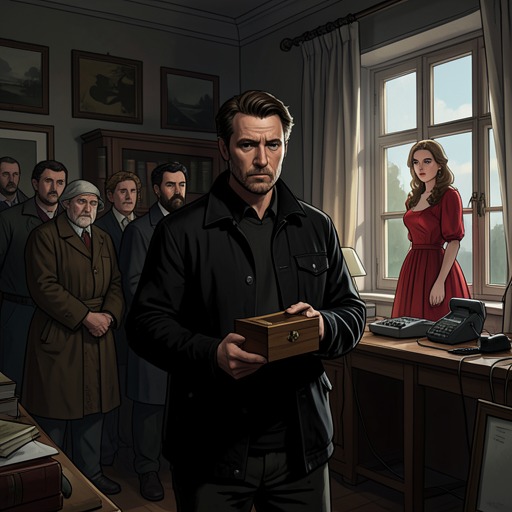
Near the end, Doc returns to Gotcha! after the Lakers lose the final, remembering that he owes Fritz money. Sparky lets him in, and the familiar office has become a busy computer room: tape reels run back and forth, twice as many screens as Doc remembers are lit, and at least a dozen televisions show different channels. A large Italian coffee machine, covered in pipes, valves, gauges, and chrome, stands among the equipment. Sparky enters commands in a code Doc cannot follow, and the machine begins routing steam and hot water.
The scene makes the change in Gotcha! concrete without turning Doc into a technically fluent investigator. Sparky describes the system’s information as recoverable and eternally present. Doc asks whether the network includes hospitals and whether it could establish the status of someone taken to an emergency room in Las Vegas; Sparky answers that access depends on the location. The exchange defines both the promise and the limit of the new setup: information may persist and be retrievable, but the network’s coverage is not universal.
A new resource, not a settled solution
Doc asks whether he may return occasionally without becoming a nuisance, and Sparky agrees, offering to help him establish a system of his own. Doc says he will tell Fritz that he owes him money. Their brief arrangement gives Gotcha! a possible future role in Doc’s investigations, but it does not show that he has already mastered or adopted the technology.
The office’s contrast between old and new methods is central to its significance. Its earlier identity rests on personal pursuit and skip tracing; its later room promises access through stored data, multiple screens, and a network whose usefulness depends on where information is available. Gotcha! thus becomes a small but suggestive bridge between Doc’s improvised detective work and a broader information infrastructure. The possibility is real, while the limits remain visible: Doc still has to ask what the system can reach, and Sparky’s answer is conditional.