Lemuria
Inherent ViceLemuria is the lost Pacific continent that gathers the novel’s competing accounts of place, history, and survival into a single uncertain geography. It is recalled as a homeland swallowed by the ocean, imagined as a landmass rising again, and invoked to connect California’s threatened coast to wars in Indochina and to a possible future beyond the damaged present. The novel never resolves whether Lemuria is historical reality, occult teaching, psychedelic vision, or a story people need; its power lies in how those possibilities overlap.
The Lost Continent and Its Possible Return
At Wavos, a discussion of an anomalous patch of breaking surf leads Sortilège to propose that it might be the trace of something sunk long ago and now slowly returning to the surface. Flaco identifies the idea as Lemuria, the “Atlantis of the Pacific.” Sortilège answers that predictions of its reemergence have circulated for a long time, and places the possibility within an astrological account of the present. The exchange turns a puzzling feature of the ocean into a question about deep time: perhaps what appears as a new formation is instead the return of an ancient, submerged world.
The speculation draws on stories that Pacific islands have risen and sunk. Lemuria is therefore more than a name for a vanished territory: it offers an alternative to the assumption that the ocean floor and coastline are stable. At the same time, the discussion remains conjectural. The people at Wavos do not settle whether Lemuria is an actual island, a lost continent, or a framework for interpreting what they cannot explain. Its return is proposed, questioned, and left open.
Ecology, Memory, and California
The idea acquires an environmental dimension through Sortilège’s teacher, Vehi Fairfield. According to his belief, Lemuria and Atlantis sank because the Earth could no longer accept the toxicity their civilizations had accumulated. Against the setting of Gordita Beach, where oil from nearby industry contaminates the shore, the vanished continents become warnings about what happens when a society poisons its home. Sortilège imagines the Earth as a living system that may reject destructive agents such as the oil industry, and hopes that this response will come before the modern world meets the fate attributed to Lemuria and Atlantis.
The novel also makes Lemuria part of the characters’ uncertain personal memories. During the rain, Sortilège becomes preoccupied with the continent’s final days. She tells Doc that she dreams of it and sometimes wakes with the certainty that she was there in another life; Spike, too, seems to share the dreams. Her suggestion is not simply that the past is being remembered. She wonders whether Lemuria is returning to the present because she and Spike can no longer find a way back to it. That reversal—people unable to return to a lost place, while the lost place itself returns—makes the rain and California’s unstable ground feel like points of contact between the contemporary landscape and submerged history.
A Psychedelic Geography of History
Vehi’s Lemuria is also mediated through psychedelic experience. LSD is the medium of his daily life, and he says that it helps him see. Through these trips he finds Kamukea, a Lemuro-Hawaiian demigod associated with the dawn of Pacific history and with the lost continent beneath the ocean. Vehi’s account does not establish Lemuria as fact, but it gives the idea a guide and a cosmology: an ancient Pacific past can be encountered as an active presence rather than as a remote legend.
One of Doc’s experiences, facilitated by Vehi, transforms Greater Los Angeles into a vast, illuminated ruin. The city is recognizable and strange at once, stretching through inhabited houses and rooms; its beach residents appear both as themselves and as refugees from the catastrophe that submerged Lemuria thousands of years earlier. They have reached the California coast in search of safer land. The vision makes California a place of refuge founded, in this imagined history, by people fleeing an earlier disaster. When water rises through the city’s lower levels and continues to climb as Doc seeks higher ground, Lemuria’s fate becomes a pattern that the present appears to repeat.
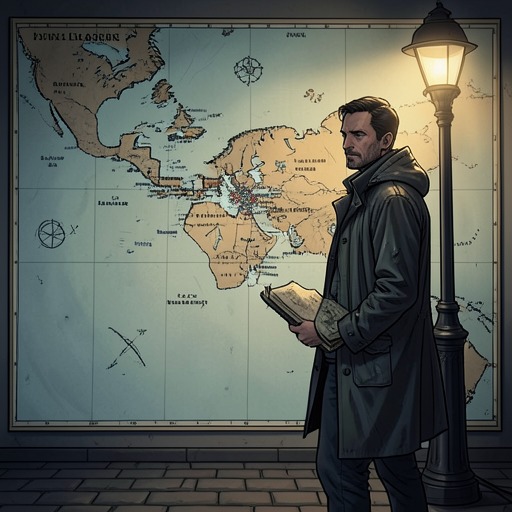
The vision enlarges that repetition into a theory of war. The United States, positioned between the oceans associated with Atlantis and Lemuria, is cast as the middle term in their ancient rivalry. In this account, the U.S. war in Indochina is not wholly an exercise of modern free will but another turn in a karmic conflict reaching back beyond recorded history. Nixon is assigned to Atlantis’s lineage and Ho Chi Minh to Lemuria’s; the tale reaches further back to three Lemurian holy men who escaped the inundation and brought with them a sacred stone from their temple. Set up in Indochina as the heart of their exile, the stone is moved to secret locations whenever invading armies arrive, then established elsewhere after the danger passes. From French colonization through the U.S. occupation, it remains hidden in its own space. The account makes political conflict recur across radically different periods, while the concealed stone preserves an image of continuity beneath changing regimes.
The Drowned Ship and the Possibility of Refuge
As the city in Doc’s vision sinks, Kamukea tells him they must leave. They fly above the Pacific and approach a schooner Doc initially identifies as the Golden Fang; Kamukea corrects him: it is Preserved. Shasta is alone on deck, looking back toward the home she has left. Doc cannot reach her, but Kamukea assures him that she will be all right and that he must learn what is being shown to him. Lemuria’s submerged past thus opens onto a separate uncertainty about departure, safety, and whether leaving home means loss or survival.
Later, the ship returns in Doc’s dream under both names: the Golden Fang has resumed its former working identity and its real name, Preserved. Doc understands it as having been cleared of the dark residues of violence aboard it and of the spirits of those who had suffered there. On the beach, he and Sauncho see—or think they see—the schooner heading out to sea with its sails spread. Sauncho imagines a better shore, an undrowned Lemuria, where the American fate did not occur. Doc wants to believe Coy, Hope, and Amethyst are aboard and safe, though he only almost sees them, and Sauncho is unsure. The scene does not confirm that the ship reaches Lemuria or carries the family; instead, the possible destination lends their uncertain image the shape of hope.
The same refuge story appears in a casual exchange about California. Someone proposes that people who escaped Lemuria may have fled there, making California a kind of ark. The reply undercuts the comfort of the metaphor: California is hardly a stable or reliable piece of real estate. Lemuria consequently provides no uncomplicated promise of rescue. Its refugees may have found a new shore, but that shore can itself be threatened; its imagined return may offer renewal, repeat catastrophe, or simply a language for fear. Across surfing talk, environmental concern, psychedelic vision, and the ship’s ambiguous passage, Lemuria remains both a vanished location and a way of asking whether any refuge can escape the histories it carries.