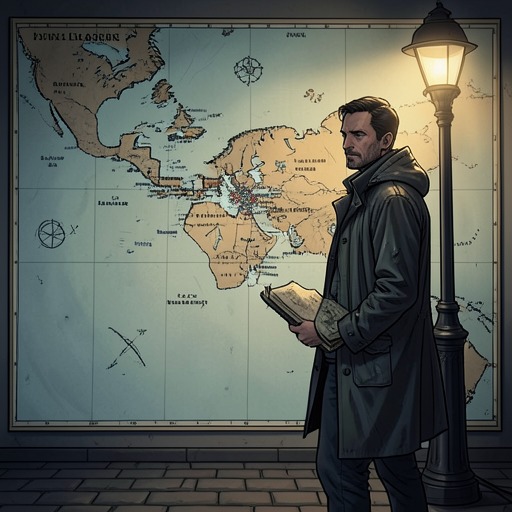
Lemuria and Lemurian cosmology
Inherent ViceLemuria and Lemurian cosmology turn the novel’s drowned continent into more than an ancient legend: they offer a way to imagine history as a cycle that keeps resurfacing in the present. In Doc’s acid vision, the coast of California is settled by refugees from Lemuria’s inundation, while the war in Indochina repeats a conflict older than the modern nations involved. Later, as rain saturates Gordita Beach, Sortilège and Spike begin to dream of Lemuria together, and Doc sees a drowned city, a sinking labyrinth, and Shasta aboard the schooner Preserved. The myth links catastrophe to recurrence, but leaves open whether its revelations are supernatural, drug-induced, or both.
The drowned homeland and its exiles
In Doc’s vision, Lemuria is at once an ancient place and a displaced version of Greater Los Angeles: a vividly lit ruined city stretching for miles, its houses and rooms still inhabited. The people Doc meets seem familiar without being fully recognizable. He and his neighbors are both themselves and refugees from the disaster that submerged Lemuria thousands of years ago; seeking safe land, those exiles settled on the California coast. The vision folds a remote catastrophe into the local landscape, making the beach community appear not simply to live beside history but to descend from one of its migrations.
This account gives the coast a double identity. It is everyday Greater Los Angeles, with its familiar residents, and an outpost of an older world whose destruction has never quite ended. The ancient flight from rising water anticipates Doc’s own movement through the drowned city: as the levels fill, he climbs in search of safety, but the water keeps rising. The ruined homeland is therefore not safely past. It returns as a place whose disaster threatens to happen again.
A cosmology of repeating wars
The vision also enlarges the war in Indochina into a conflict rooted in the vanished continents. The United States, positioned between the oceans into which Atlantis and Lemuria disappeared, becomes the middle term in their ancient rivalry. It imagines that it is fighting in Southeast Asia by free choice, while the vision presents its role as a repetition of a karmic loop as old as the geography itself. Nixon is cast as a descendant of Atlantis and Ho Chi Minh as a descendant of Lemuria; the war becomes the latest version of a struggle that predates the United States, French Indochina, the Catholic Church, Buddhism, and written history.
At the origin of that history are three Lemurian holy men fleeing the inundation. They bring a stone pillar rescued from their temple and establish it as the foundation of a new life in exile. The pillar becomes the sacred stone of Mu. As invading armies arrive and depart over the centuries, it is repeatedly removed to a secret location for safekeeping and set up elsewhere when the danger passes. From the beginning of French colonization through the American occupation, the stone remains invisible, withdrawn into its own space. Its concealment makes the sacred object a counter-image to political conquest: armies can occupy a country, but the vision imagines a sacred history continuing beyond their reach.
The sinking city and the schooner
Doc’s journey through the vision is framed by Tiny Tim’s song, still playing on repeat. As he moves through the three-dimensional city labyrinth, the lower levels grow damp; soon water reaches his ankles. He realizes that the entire structure is sinking and tries to climb to higher levels, only to find the water rising after him. Panic breaks through the dreamlike exploration. He curses Vehi, who has acted as a travel agent for his drug trips, and senses the Lemurian spirit guide Kamukea as a shadow of deep clarity. Kamukea’s voice tells him that they must leave.
They fly above the Pacific, close to the waves, toward a schooner whose sails gradually resolve out of a white blur. Doc first recognizes it as the Golden Fang, but Kamukea silently corrects him: it is Preserved. The vessel is rendered with material specificity: its sails and rigging are working, and Doc hears canvas snap and timbers creak. This is not, the vision insists, merely a dream ship. On deck he sees Shasta alone, apparently brought aboard under duress and looking back toward the home she has left. Doc calls to her, but words have no force in this space. Kamukea assures him that she will be all right and says that he must learn what is being shown to him. Yet Doc senses that the honest old fishing vessel has become inhabited, or possessed, by an ancient and evil energy. The assurance of Shasta’s safety and the menace he perceives remain in unresolved tension.
Rain, shared dreams, and return
The cosmology reappears during the prolonged rain that damages the coast and unsettles its residents. Hillsides slide, houses in Gordita Beach become saturated and spongelike, and people begin to lose their composure even when sober. Against this physical inundation, Sortilège becomes absorbed in Lemuria and its tragic final days. Doc proposes that she was there in a former life, but Sortilège locates the experience in dreams rather than making the theory certain: she and Spike wake convinced at times that they have been dreaming the same thing. They cannot find a way back to Lemuria, she says; instead, it is returning to them, rising out of the ocean. When Doc asks whether the place spoke to them, she cannot say. It is not simply a place.
That uncertainty is essential to the cosmology’s effect. Lemuria is at once a remembered homeland, a shared dream, and a force apparently returning through weather and perception. The novel does not settle whether the dreams confirm a past life or whether the rain and drug culture have made myth feel immediate. It lets the competing explanations coexist, so that the ancient continent’s return is both an uncanny possibility and a pattern through which characters understand present instability.
Doc encounters another image of that return on the front of Shasta’s postcard. It shows underwater ruins—broken columns and arches, collapsed retaining walls—with fish moving through exceptionally clear water that seems to glow blue-green. The photograph has no credit, copyright date, or place of origin. Doc finds it familiar and concludes that it must be a message from somewhere beyond the Pacific island named in the postcard. The blank provenance turns the image into a link without a reliable address: it calls him back toward the earlier Ouija-board misadventure and prompts him to revisit its location.
Myth, history, and uncertain knowledge
The Lemurian material repeatedly joins physical evidence to unverifiable interpretation: rising water to ancestral catastrophe, the Indochina war to a prehistoric rivalry, a stone pillar to a hidden sacred history, and a postcard photograph to a message from elsewhere. Doc’s visions are vivid and concrete, but their vividness does not settle their status. Even the schooner is named twice, as the Golden Fang in Doc’s recognition and as Preserved in Kamukea’s correction, while its working sails and audible timbers make it feel materially present. The same scene holds the familiar and the alien together.
Across these appearances, Lemuria makes disappearance a form of persistence. Its homeland is submerged, its refugees survive in a transformed world, its sacred stone is hidden rather than destroyed, and its history reappears in dreams and contemporary war. The cosmology does not offer a stable key that explains every mystery; instead, it gives the novel a recurring image of the past rising into the present, like water through the levels of a city, while leaving the source of that recurrence uncertain.