Los Angeles Police Reserves
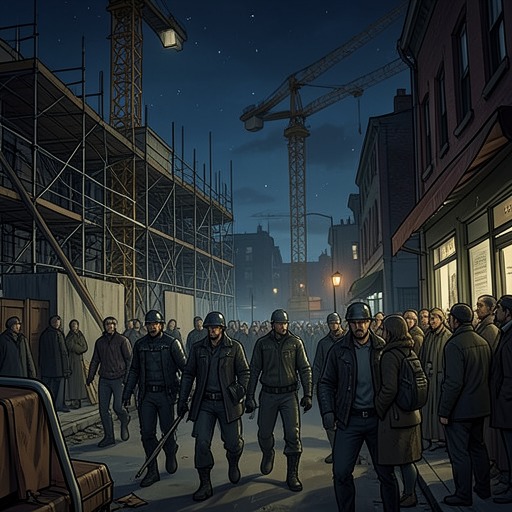
Inherent ViceThe Los Angeles Police Reserves are an armed civilian auxiliary presented as a reserve force for the Los Angeles Police Department, but the novel exposes a darker function beneath that reassuring title. Recruited into a supposedly official structure during the 1965 Watts uprising, some members use the authority of police affiliation to enact racial intimidation; later, the department can call on the reserves as a private militia for work it would rather not own publicly. Their presence in the Channel View Estates assault links neighborhood defense, racial displacement, and police power.
Origins and the Politics of the Street
Fritz Drybeam supplies Doc Sportello with a list of police auxiliaries whose license plates may connect them to the attack on Chick Planet Massage. He explains that some men joined the reserves during the Watts uprising so they could play “run-nigger-run” and make the violence legal. The phrase exposes the gap between nominal service and actual purpose: the reserve status gives private racial hostility the appearance of authorized order. Fritz further describes the men as a small private militia used by the Los Angeles Police Department when it does not want to look bad in the papers.
The reserves belong to a longer history in which force and land use reinforce one another. Tariq Khalil recalls that many Japanese residents of South Central were sent to camps during World War II, after which Black families moved into the neighborhood; now, he says, those residents are being moved along in turn. The novel places the demolition of that neighborhood for Channel View Estates within a sequence of dispossessions, including Mexican families removed from Chavez Ravine for Dodger Stadium and American Indians displaced from Bunker Hill for the Music Center. The reserves’ role is therefore not isolated from urban development: their counterinsurgent vocabulary and armed presence accompany a city whose neighborhoods are repeatedly cleared and remade.
Civilian Members and the Appearance of Respectability
Doc follows Fritz’s list by contacting the men under false pretenses, using ordinary sales calls and other harmless-sounding approaches to draw out their households. He encounters Arthur Tweedle, a civilian machinist with a regular day shift at a naval weapons station. On weekends and sometimes weeknights, Tweedle puts on surplus fatigues and attends meetings of Vigilant California with his neighbor Prescott, another countersubversive hobbyist. The juxtaposition matters: reserve and vigilante commitments sit beside stable employment and domestic routine, rather than belonging to a separate world of professional soldiers.
Tweedle describes himself as a standby member, ready to reach wherever the authorities need him in under an hour. His claim is echoed by Doc’s carefully flattering suggestion that the Los Angeles Police Department needs all the help it can get amid a dark and ugly situation. As the conversation loosens, Tweedle displays his home-defense collection: pistols, magnums, Vietnam-surplus grenade launchers, and a separate stock of automatic weapons in an outbuilding. His pride is a two-person Gleichschaltung Model 33 Automatic Bazooka, mounted with a modified electric golf cart carrying a magazine of up to a hundred rounds. The domestic setting—family, television, beer, and a well-stocked weapons shed—makes the reserves’ militarized culture appear both ordinary and unsettling.
The reserve identity is also tied to a broader countercultural backlash. Tweedle attends Vigilant California meetings in surplus military clothing from the Santa Monica shop favored by the Manson family. He talks of his wife’s marksmanship and of teaching the children to use .22 rifles. When Doc asks how the organization keeps members busy, Tweedle mentions weekend urban counterguerrilla maneuvers and occasional individual assignments: stakeouts, or a rock through a window accompanied by a warning note. These jobs bring cash on the spot. In this account, the line between reserve service, private intimidation, and ideological vigilantism is deliberately indistinct.
Channel View Estates and the Hidden Assignment
A Nordic-style ski mask in Tweedle’s workshop resembles the masks seen in footage of the assault on Chick Planet Massage. Doc probes the resemblance indirectly, pretending his own mask had antlers and a red, battery-operated nose. Tweedle says the mask is standard issue for maneuvers, turning an incriminating-looking object into a purported piece of uniform. Asked whether his group was present at the gathering where Mickey Wolfmann disappeared, Tweedle confirms that it was. He says they chased a gang of bikers around Channel View Estates and describes them through a racist comparison to Black residents.
The answer does not establish that Tweedle personally took part in every act of the assault, but it places the reserves at the scene and confirms that they were operating there. Their stated pursuit of bikers sits uneasily beside the broader evidence of an organized raid, the disappearance of Mickey Wolfmann, and the resemblance between the masks. The reserves are not merely a background political tendency: their members’ own account puts them among the armed forces moving through the development during the night of the disappearance.
Channel View Estates itself materializes the conflict. Signs announce it as an “A Michael Wolfmann Concept,” and the development spreads over land where a Black neighborhood had been cleared. Doc sees newly finished homes, model units, and streets marked out before they are paved, with Spanish Colonial styling set against an altered landscape of fill, industrial debris, and a neglected flood-control channel. The reserves’ counterguerrilla activity in this setting makes the project’s polished promise inseparable from the coercive history that cleared the ground and the armed presence that helps secure it.
Institutional Cover and Narrative Significance
The reserve system works through a division of responsibility. Fritz’s account casts the reserves as a force the Los Angeles Police Department can use without appearing in the press as the direct author of every operation. Tweedle’s own description reinforces the arrangement: he is not a full-time officer stationed in Los Angeles, but remains equipped and on standby, while his group also undertakes deniable tasks for cash. Official recognition, private weapons, and informal assignments overlap without collapsing into a single transparent chain of command.
That ambiguity shapes Doc’s investigation. He receives the plate-number list from Fritz, follows it to homeowners such as Tweedle, and turns a routine inquiry about property defense into an encounter with a paramilitary arsenal and an admission of presence at Channel View. Other authorities meanwhile try to frame Doc’s contact with Tariq Khalil as part of a Black nationalist threat, making the reserves’ own racialized violence easier to treat as security rather than as a source of danger. The reserve network thus participates in a contest over what counts as a threat, whose armed activity is legitimate, and which version of events institutions will accept.
The Los Angeles Police Reserves embody the novel’s suspicion that public institutions can extend their reach by relying on people who retain the appearance of private citizens. Their uniforms and police affiliation make intimidation look lawful; their civilian status makes official distance possible. Against the background of Watts and the redevelopment of Channel View, they turn the language of neighborhood protection into a mechanism of surveillance and coercion. The result is a force that stands at the seam between police power and vigilantism, helping preserve an order whose benefits and burdens are distributed along racial and property lines.