Los Angeles’s post-Manson climate of fear
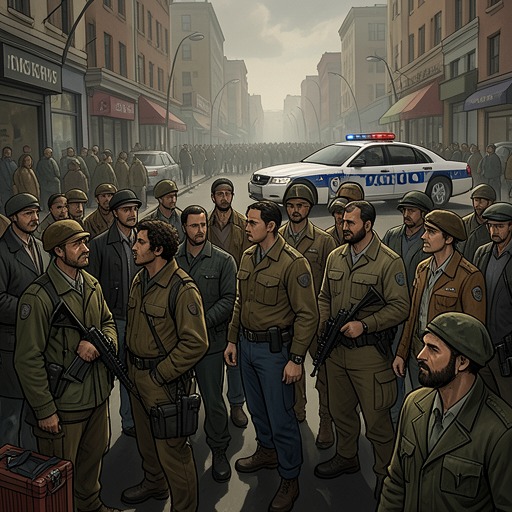
Inherent ViceLos Angeles’s post-Manson climate of fear is a civic atmosphere in which the arrest of Charles Manson makes suspicion of countercultural people newly useful to authorities and newly visible in ordinary life. The fear is not confined to a single crime or institution: it appears in private security embedded in a political rally, in police efforts to classify gatherings as possible cults, and in a city’s longer history of racial exclusion and redevelopment. The novel sets this anxious public mood against the slow, material changes to neighborhoods that fear can distract from or help enforce.
A Political Climate of Suspicion
At a rally for Vigilant California at Century Plaza, news coverage shows Richard Nixon addressing Republican activists while identical-suited operatives stand strategically among the crowd, apparently paying little attention to the speech. When a long-haired protester shouts abuse at Nixon and his family, the operatives move together to seize and remove him. Nixon jokes that the man should be taken to a drug clinic. The scene joins political performance to private-sector crowd control: the protester’s visible defiance is treated as a threat to be contained, while the coordinated watchers suggest preparation rather than spontaneous response.
The incident also makes the rally’s fear uneven. Some audience members are merely unruly, but the watchers alarm Doc more because their attention is directed away from the president and toward the crowd. Penny suspects they are private operatives, not Secret Service. Her observation frames the response as something beyond ordinary protection of a public figure: an organized effort to monitor and manage dissent. Doc’s reaction, in turn, registers the changing terms of public visibility for countercultural people. After Manson’s arrest, he notices that people from the straight world make less eye contact with hippies, as if avoiding them might protect them from the possibility of mass murder.
Fear as Administrative Routine
The climate extends from televised politics into an encounter on the road. During a stop involving Doc, Denis, Japonica, and Dr. Blatnoyd, officers explain that a new program called Cultwatch treats any gathering of three or more civilians as a potential cult. Their stated criteria include references to Revelation, men with shoulder-length hair, and what they call automotive absentmindedness. The officers take identification and say the information will go into a master data bank in Los Angeles and Sacramento; absent outstanding warrants or other concerns, the people stopped should hear nothing more.
The stop gives the new suspicion a bureaucratic form. The criteria mix religious language, appearance, and conduct, turning ordinary signs of nonconformity into reasons for surveillance. The officers themselves are described as vibrating with the area’s post-Manson nerves. Their unease is thus both personal and institutional: the state records people because it fears what their appearance and associations might signify, and that recording makes the fear durable beyond the immediate encounter.
Bigfoot describes the wider mood as collective terror. He says that everyone is scared, then likens fear to blood spreading through a swimming pool: unseen at first as a governing force, it fills the day until imagined predators begin to feed on one another. His account links the present to the Hollywood blacklist and the Watts uprising, suggesting that Los Angeles has known recurring periods when fear reorganizes public life. He also argues that the Manson case has altered how the straight world looks at hippies, replacing curiosity with avoidance and sick fascination. Crime coverage, public anxiety, and the appetite for sensational stories reinforce one another, making fear feel both omnipresent and difficult to locate in any single source.
Older Histories Beneath the New Panic
The novel places this post-Manson anxiety within a much longer history of racialized space. When Tariq Khalil arrives at Doc’s office, his presence in Gordita Beach is treated as unusual. The town’s reflex has a violent precedent: after a Black family tried to move there shortly after the Second World War, white residents, with advice from the Ku Klux Klan, burned the property. The lot remained empty until it became a park. The park’s later use by local youth gives the site a bitter reversal: a place made vacant through racist violence becomes a gathering place that unsettles the same town’s parents without notably diminishing property values.
Tariq connects the present to earlier removals in South Central. During the Second World War, Japanese residents were sent to camps; Black residents moved into the neighborhood afterward, in Tariq’s account, only to face displacement in their turn. He identifies the clearance of his neighborhood for Channel View Estates as another episode in a sequence of communities moved aside. His account challenges a simple story in which the Manson-era panic is the city’s central crisis: public fear is new in its immediate form, but the unequal distribution of safety and belonging has a longer history.
Aunt Reet’s knowledge of property gives that history a local, material counterpart. She understands land use lot by lot, from the desert to the sea, and knows stories that deeds and contracts omit: family conflicts, water movement, and the past of particular parcels. Her expertise makes real estate more than a record of transactions. It is a way of reading what official documents leave out and how older histories persist in the present landscape.
Channel View and the Geography of Fear
Doc drives to Channel View Estates, a development advertised as “A Michael Wolfmann Concept.” The tract houses, unfinished construction, and streets marked before they are paved make visible a landscape still being assembled. At the edges of the development, Doc sees Black pedestrians who may be looking for the former neighborhood and for the rooms and routines that redevelopment has displaced. Their presence makes the development’s polished promise inseparable from the loss that precedes it.
Later, Crocker Fenway describes a struggle between established property owners and developers such as Mickey Wolfmann. Crocker presents resistance to dense housing as an effort to prevent urban blight and protect the environment; Doc counters that property values are the real issue. Crocker’s account of being “in place” exposes the power behind the rhetoric. He invokes land, water rights, oil, and cheap labor as resources his group has possessed for generations, while dismissing newcomers as transient and replaceable. The exchange connects land-use politics to the same larger climate of fear: anxiety about disorder can be expressed as defense of property and neighborhood character, even where the underlying conflict concerns who controls space and who is forced to leave.
The result is a contrast between visible panic and slower displacement. Cultwatch makes fear legible through checklists, identification, and databases; Channel View’s transformation unfolds through property decisions, construction, and the removal of an existing community. The novel does not treat these as identical processes, but places them in the same city and asks how attention is allocated. While authorities watch countercultural gatherings for signs of danger, the longer reshaping of neighborhoods proceeds under the language of development, order, and protection.
Narrative Significance
Fear in the novel is both a feeling and a method of organizing public life. The political rally shows it policing dissent through coordinated private surveillance; Cultwatch turns it into an administrative category; Bigfoot’s account describes its spread as a collective condition. Against these scenes, Tariq’s history and the development at Channel View reveal that Los Angeles’s anxieties are layered over prior and continuing racial displacement.
The city’s geography therefore functions as a record of power as well as a setting for it. Empty lots, parks, freeways, tracts, and contested neighborhoods embody decisions about who may remain and whose presence is treated as a threat. By placing post-Manson suspicion beside the history of cleared communities and the defense of established property, the novel makes fear’s consequences harder to separate from the older arrangements it can obscure or reinforce.