San Pedro
Inherent ViceSan Pedro is a coastal setting where the novel brings together port commerce, discreet nightlife, maritime surveillance, and the politics of land use. Across its harbor and nearby streets, apparently separate worlds—clubs, boats, real-estate development, and displaced communities—share the same contested geography. The schooner Golden Fang’s unannounced appearances make that overlap especially visible: the waterfront is not merely a backdrop, but a place where business and power operate beyond ordinary public view.
Harbor and Pacific-facing commerce
Club Asiatique stands in San Pedro opposite Terminal Island, with a filtered view of the Vincent Thomas Bridge. Its nighttime atmosphere suggests a place shielded from observation, a meeting point for business arriving from across the Pacific Rim. The club’s subdued bar, waitresses carrying elaborate drinks, and patrons leaning together in conversation establish a social world organized around discretion. A downstairs area hosts fantan, mah-jongg, and Go, extending the venue’s activities beyond its public-facing dining and drinking rooms.
The club’s carefully cultivated privacy is matched by the harbor around it. The bridge and Terminal Island locate San Pedro within a working maritime landscape, while the club evokes commercial connections that pass through that landscape without becoming fully visible. Its importance lies less in a single transaction than in the way the setting gathers different forms of exchange under cover of night.
The Belaying Pin and the Golden Fang
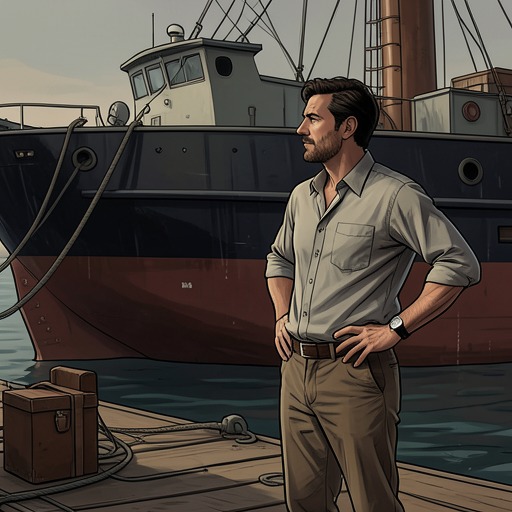
At the Belaying Pin, a seafood restaurant by the San Pedro yacht harbor, Doc meets Sauncho Smilax for lunch and looks out over the water. Sauncho describes the clientele as people with substantial possessions financed through debt, and the restaurant’s yacht-owning patrons provide a view of the harbor’s more conspicuous property culture. His choice of the restaurant is practical as well as social: the window gives Doc a clear vantage over the water.
Using a pair of old World War II field glasses, Sauncho points out the schooner Golden Fang, registered out of Charlotte Amalie in the Virgin Islands. Doc sees a large vessel with sleek, strikingly inhuman lines, a profusion of antennas and radomes, gleaming decks, and no flag identifying its national origin. The boat’s appearance sets it apart from an ordinary pleasure craft; it does not seem equipped for casual recreation.
Sauncho says that the schooner tends to arrive without warning in the middle of the night, with neither running lights nor radio traffic. People who suspect it is involved in drug business sometimes linger in hope of learning more, but soon leave, unsettled by the unexplained intimidation surrounding its visits. The harbormaster appears nervous, as though pressured to waive the fees charged to transient vessels, and reacts sharply when the office radio sounds. Sauncho cannot identify the owner and tells Doc that people have considered hiring him to find out. In this harbor scene, the Golden Fang is simultaneously a physical presence and an unanswered question about who can enter, operate, and evade scrutiny.
Land, redevelopment, and displacement
San Pedro’s maritime setting belongs to a wider history of Los Angeles land use. Aunt Reet, whose unusually detailed knowledge of property extends across the Los Angeles Basin, understands land through more than deeds and contracts: she also attends to family histories, water, and the stories that formal records leave out. Her perspective gives the novel a way to connect individual parcels to the history that shaped them.
Tariq describes how South Central’s Japanese residents were sent to camps during World War II, after which Black residents moved into the neighborhood. He sees the later displacement of his own community as another turn in a recurring process. The account links the wartime removal of Japanese Americans to the bulldozing of Tariq’s neighborhood for Channel View Estates, a development advertised under the slogan A Michael Wolfmann Concept.
That development is presented as part of a longer pattern across Los Angeles: Mexican families were displaced from Chavez Ravine for Dodger Stadium, American Indians were cleared from Bunker Hill for the Music Center, and Tariq’s neighborhood was cleared for Channel View Estates. The sequence makes redevelopment legible not simply as construction, but as a transfer of place and access from existing communities to powerful new uses.
Doc drives to Channel View Estates along Artesia, passing signs for the development and unfinished construction at the edge of the expanding city. Model units and completed houses give way to new construction skeletons in the unincorporated wastes. Near the road, the homes imitate the Spanish Colonial style associated with more expensive coastal towns, while an overlooked branch of the Dominguez Flood Control Channel lies cut off by fill, regrading, and industrial debris. The landscape makes the sales image and the underlying remaking of land visible at once: polished architectural suggestion rests on extensive physical alteration.
San Pedro within the novel’s geography of power
The port and the housing development are distinct settings, but the novel places both within a larger argument about property, infrastructure, and control. At Channel View Estates, Mickey Wolfmann’s development promises a new built environment while the history of its site records who has been forced out. At the waterfront, the Golden Fang’s unexplained access and apparent ability to avoid ordinary harbor procedures suggest a different kind of control—one exercised through secrecy and unequal access rather than visible construction.
Crocker Fenway frames disputes over development as a struggle over being in place, invoking property values, real estate, water rights, oil, and cheap labor as forms of entrenched power. His claim that his group has always occupied that position stands in stark contrast to Tariq’s account of communities repeatedly moved aside. Read together, these scenes make San Pedro part of a regional map in which roads, land, waterways, and harbor access are not neutral features. They are the material means through which people establish power, conduct business, and displace others.