Sauncho Smilax
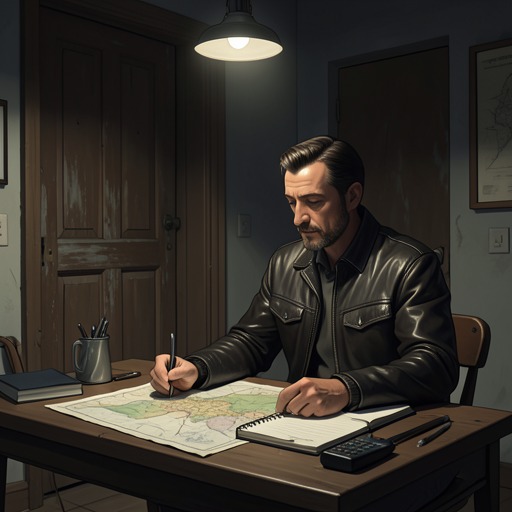
Inherent ViceSauncho Smilax is a maritime lawyer who becomes Doc Sportello’s de facto attorney and a recurring guide through the novel’s entangled legal and maritime mysteries. Though his criminal-law experience is limited, he repeatedly helps Doc navigate police stations, bail, federal evidence, and the sea’s shifting rules of ownership. His work links investigations of Mickey Wolfmann, the Golden Fang, and Adrian Prussia to tangible objects and institutions, while his digressions into television and law give the story’s paranoia an unexpectedly practical, comic counterweight.
Identity and Introduction
Sauncho works for the Marina-based maritime law firm Hardy, Gridley & Chatfield. He and Doc first meet by accident at a Food Giant on Sepulveda, when Sauncho, a novice doper newly anxious about buying a flour sifter, freezes at the checkout. Doc crashes his shopping cart into Sauncho’s while rushing for chocolate; the collision prompts Sauncho to ask if he can conceal the sifter among Doc’s purchases. Their first bond is thus a small, shared episode of suspicion, followed by Doc’s teasing recognition that paranoia can attach itself to the most ordinary errand.
At the time, Sauncho has only recently left law school at SC and lives at the beach, not far from Doc. He never formally goes on retainer, but after several late-night calls from Doc he shows an unexpected aptitude for dealing with bail bondsmen and police-station desk staff around the Southland. The informal arrangement gradually becomes a professional reality: both men recognize that Sauncho has become Doc’s lawyer in practice, if not by contract.
Lawyer, Ally, and Investigator
When Doc is detained, Sauncho comes to his aid. The book presents his criminal-law résumé as limited, but when he finally appears at Doc’s door after an extended exchange with Bigfoot Bjornsen, he immediately challenges the lieutenant to charge Doc or let him go. Doc, meanwhile, tries to temper the intervention, aware that Sauncho’s courtroom confidence may not account for Bigfoot’s temperament. Their partnership rests less on formal expertise than on Sauncho’s willingness to show up, speak plainly, and work the institutions Doc is struggling to navigate.
Sauncho’s maritime practice becomes especially useful as Doc follows the trail of the Golden Fang. At the Belaying Pin, a San Pedro fish restaurant overlooking the yacht harbor, Sauncho agrees to tell Doc what he knows about the boat. His knowledge of maritime clients and the local harbor supplies a different view of wealth: the yachtsmen around them appear to possess their boats and other belongings through extensive credit, not simply through cash. The setting turns Sauncho’s professional world into a way of reading the larger financial landscape.
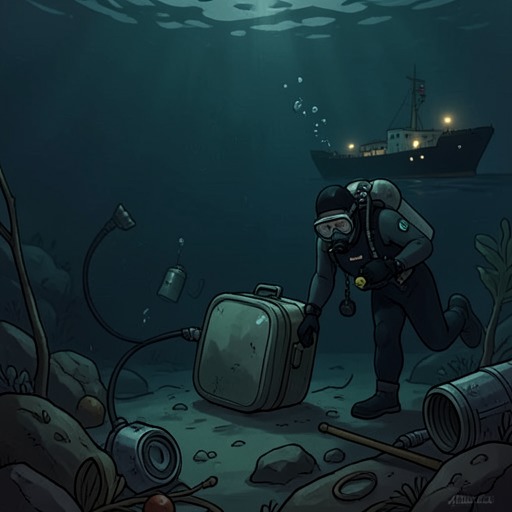
His work also brings him aboard a heavily equipped Justice Department vessel with federal agents. They visit a location where the Golden Fang is believed to have left a lagan, and divers recover connex containers filled with shrink-wrapped U.S. currency. The bills bear Nixon’s face regardless of denomination. Sauncho reports that intelligence contacts associate Nixon’s image on counterfeit North Vietnamese bills with a CIA effort to destabilize enemy currency, but that history does not readily explain Nixonized American money. He later points out the legal anomaly: the rule he describes requires a person to be dead before appearing on U.S. currency. He interprets the altered bills as sympathetic magic expressing a wish for Nixon’s death, while also showing Doc that the notes can circulate unnoticed: he has bought distinctive white loafers with one of the Nixon twenties.
Evidence, Money, and the Golden Fang
The recovered money returns to the investigation when Doc finds a photograph of Adrian Prussia beside a box full of Nixon bills. Sauncho cannot confirm that the photographed money is the same batch that the federal party recovered, or that the currency was safely retained as evidence. He says he would like to believe most of it remains in a federal evidence room, then acknowledges that the atmosphere aboard the vessel had become unusually casual and that federal agents, like other people, cannot necessarily live on their salaries. Doc’s photograph also appears to connect the men in it with the Golden Fang: they look as if they have just disembarked from it or are about to board. Sauncho’s response does not resolve the chain of custody, but it helps make the uncertain passage of evidence itself part of the mystery.
Sauncho brings another financial lead to Doc: an ocean marine insurance policy was taken out on the Golden Fang shortly before the vessel sailed, covering only that voyage, the one Shasta Fay Hepworth was supposed to be aboard. The listed beneficiary is Golden Fang Enterprises of Beverly Hills. Doc asks whether the company would collect if the boat sank, and Sauncho confirms that it would. In this way, the vessel’s legal and financial arrangements suggest that its disappearance at sea could serve a purpose beyond transportation.
His knowledge of maritime law becomes consequential again when the Golden Fang is found abandoned during a storm. Sauncho explains that if it can be brought into safe receivership and its owners fail to claim it within a year and a day, it can be deemed abandoned; ownership would then become a matter for marine law. While the Coast Guard boards the schooner, shortens sail, rigs lines and lights, and awaits an oceangoing tug, Sauncho’s account gives Doc a precise legal horizon amid the immediate danger of the vessel running aground. For Sauncho, even an apparently lost ship remains entangled in questions of custody, claim, and eventual title.
Relationships and Character
Sauncho’s alliance with Doc is both professional and companionable. Doc can call him in a panic, ask him to look into a maritime question, or turn to him when official evidence needs tracing. Sauncho, in turn, answers the telephone with concern, visits Doc at home, shares what he learns, and brings him along when events move from the office to the water. Their familiarity includes teasing and incomplete explanations, but it also supplies a dependable channel between Doc’s private investigation and legal institutions.
Sauncho’s manner is not defined solely by the cases he handles. He is a devoted viewer of the daytime serial The Way to His Heart and updates Doc on its tangled domestic and culinary intrigues during pauses in their conversations. Once, while watching, he shouts at the television and draws his face close to the screen. The detail is more than a passing distraction: it establishes how fully he invests in a separate, serialized world, one whose rivalries and unresolved scores continue while Doc’s investigations move through danger and uncertainty.
His interests can seize his attention at inconvenient moments. After seeing The Wizard of Oz on a color television for the first time, he tells Doc with evident anxiety that the film begins in black and white and then changes to color, asking what that transformation means. Doc has to redirect him to a question about the Nixon bills. Later, Sauncho imagines a class-action lawsuit over disputed endings and choices in studio films, then defends the idea to his firm’s senior partner as a business opportunity. He is thus not only a legal resource but a mind drawn to questions of evidence, interpretation, and what could have happened differently—even when those questions arise from television or movies rather than a case file.
Later Investigations and Ending
When Doc learns that Adrian Prussia appeared beside a box of Nixonized currency, Sauncho helps him consider whether federal agents kept the recovered bills. The photograph’s date, less than a year before Doc finds it, makes the connection recent enough to matter; Sauncho’s account of the federal vessel’s relaxed atmosphere leaves open the possibility that the evidence did not remain securely accounted for. The uncertainty is not resolved in the conversation, but it enlarges the network Doc must consider, linking Prussia, the counterfeit money, federal personnel, and the Golden Fang.
Near the end of the novel, Sauncho still moves readily from talk into action. Doc finds him at Linus’s Tavern, where a phone call makes him leave at once. Sauncho runs to the pier, casts off a small fiberglass inboard-outboard belonging to Hardy, Gridley & Chatfield, and Doc manages to climb aboard as the boat pulls away. The episode again makes Sauncho’s professional access concrete: the firm’s vessel is available at the moment the investigation demands movement on the water.
The novel gives their maritime pursuit a more uncertain, elegiac counter-image in a dream Doc has about the schooner, now restored to its working identity and real name, Preserved. In that dream, the ship has been cleared of the residues of violence, and Sauncho delivers a courtroom-like reflection on time, memory, and a future displaced by those who seize the land’s promise. Doc and Sauncho think they see the ship sailing toward a better shore, though Sauncho is less certain than Doc that the family he hopes to see aboard is there. Their disagreement preserves the difference between legal or practical knowledge and the desire to believe in a safe destination.
Even after the storm and the schooner’s abandonment, Sauncho continues to turn events into legal questions, including who might claim an uncollected vessel after the one-year-and-one-day period. His employer’s senior partner, C. C. Chatfield, calls him over about Sauncho’s proposal for an MGM-related class action, another sign that he carries speculative ideas from informal conversation into professional life. Sauncho ends not as a detective who solves every mystery, but as a working lawyer whose practical help, maritime expertise, and readiness to follow a lead make him one of Doc’s most durable connections to the systems surrounding the case.
Narrative Role
Sauncho repeatedly translates the novel’s elusive networks into concrete legal and material questions: who insured a ship, who benefited if it sank, where recovered currency went, and when an abandoned vessel might change hands. These questions do not dissolve the larger conspiracy, but they give Doc a way to follow its consequences through contracts, evidence, and jurisdiction. His maritime knowledge is especially apt in a story where ships and money move between places, ownership remains uncertain, and apparent disappearance may conceal a transfer.
His comic enthusiasms prevent that role from becoming merely functional. The daytime serial, the color transformation in The Wizard of Oz, and his imagined class action over studio endings set his appetite for narrative beside Doc’s search for an explanation. Sauncho is attentive to how stories are assembled and to who controls their outcomes, yet he also knows that a plausible legal account cannot guarantee a just one. His recurring presence offers Doc assistance without certainty: a lawyer can pursue the record, trace a claim, or put a boat to sea, while the ultimate destination remains open.