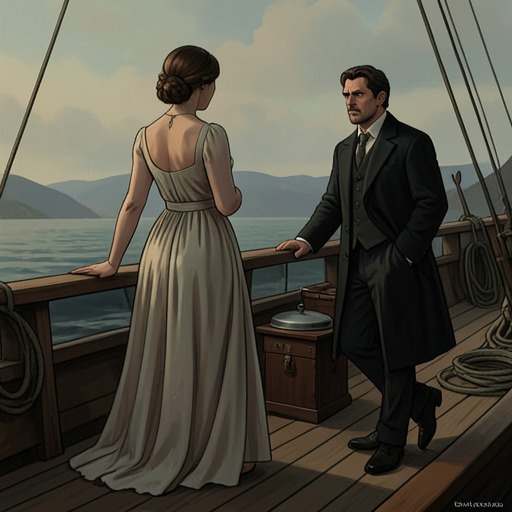
Shasta Fay Hepworth's boarding the Golden Fang and escape
Inherent ViceShasta Fay Hepworth's boarding the Golden Fang and escape is recounted retrospectively by Shasta to Doc Sportello. What first appeared to be an absence explained as a family visit up north was, she reveals, a journey she had not chosen: two men took her to San Pedro and put her aboard the ship. She did not know what they intended, but at Maui she found a way to get off. The episode turns an unexplained gap in her whereabouts into a story of uncertain plans, escape, and a persistent connection to Doc that she had not yet been able to explain.
The Voyage and Escape
Shasta had told others that she was up north dealing with family matters. In recounting what actually happened, she corrects that cover story: two men found her, took her to San Pedro, and put her aboard the Golden Fang. Her account establishes the essential circumstances without resolving who the men were or what they meant to do with her. She explicitly says that she never knew their real plans, leaving the purpose of the voyage uncertain rather than presenting a settled explanation.
The route provides the one clear turning point. When the ship reached Maui, Shasta hustled off. The escape does not disclose what awaited her afterward, but it marks a change from being carried along on a voyage whose purpose she could not determine to acting on her own behalf and leaving the vessel. The account therefore frames her departure as a practical response to uncertainty, not as proof that she had learned the ship's intentions.
The Other Island and the Vision
Shasta adds another episode from the same period. She says she was chief cook, then recalls that at Pukalani she encountered Flip hitchhiking. He handed her the keys to a place and asked her to house-sit. This detail places her on the islands after the voyage had begun and gives her account an ordinary, specific circumstance alongside its unresolved danger: an encounter on the road and a temporary responsibility for a house.
Around that time, Vehi Fairfield gave Shasta acid. While under its effects, she saw Doc on the Golden Fang. In her recollection, she was somewhere out in the wind, repeatedly trying to get aboard and staying close as long as she could. The vision reverses the positions of the two former lovers: in the remembered voyage Shasta is aboard while Doc appears to be outside, trying to reach the ship; in the actual account she is the one who has been taken aboard and has escaped. The image supplies no evidence that Doc was physically present. Its force lies instead in Shasta's experience of seeing him bound to the same vessel in her altered perception.
The Postcard and the Ship's Promise
Shasta describes the vision as feeling like a haunting. She connects that feeling to the postcard she sent Doc from the first island they reached. The card thus becomes a small, concrete trace of an experience she could not readily explain: her memory of the Golden Fang and her image of Doc pursuing it had already entered their correspondence before she gave him the fuller account. Her confession changes the significance of the message from a simple sign of contact into an attempt to reach him from within a disorienting experience.
The ship's own assurances sharpen the contrast between apparent protection and uncertainty. Someone aboard wonders whether a man knew that everybody on the vessel was armed, including officers, crew, and passengers. Another voice addresses a woman as a passenger and promises protection, while a separate remark describes the cargo as highly desirable, particularly in the Third World. These statements situate Shasta's passenger status within a ship marked by armed people, valuable cargo, and claims of safety. They do not establish what the two men intended for her, nor do they identify her with any specific cargo or plan; the gap between reassurance and the unknown remains part of the event's significance.
Significance and Limits of the Account
The episode brings together a physical escape and an unsettling image without making them the same kind of evidence. Shasta's journey from San Pedro to Maui and her decision to leave the ship are presented as events she recounts as fact. Her vision of Doc aboard the Golden Fang is explicitly tied to taking acid, and she describes its emotional effect as haunting. The narrative lets the two strands echo one another while preserving the distinction between what happened aboard the ship and what she saw while tripping.
For Doc, Shasta's account supplies a missing explanation for her time away and a new context for the postcard. For the reader, it makes the Golden Fang more than the setting of a journey: it is the vessel around which Shasta's uncertainty, attempted escape, and vision of Doc converge. Yet the central question of the voyage remains unanswered. Shasta got off at Maui, but she never learned what her captors had planned, and her account does not claim otherwise.