Sparky
Inherent ViceSparky is a young computer operator at Gotcha! whose growing technical command makes the agency’s expanding network useful to Doc’s investigations. He is at once a practical researcher and a wary interpreter of the technology: he can retrieve a recent hospital record, but he also foresees a world in which surveillance leaves people nowhere to disappear. His work gives information a material form—screens, tapes, networked records—and makes access to that information a source of both investigative power and anxiety.
Identity and Work at Gotcha!
When Doc arrives at Gotcha! after the Lakers lose Game 7 of the finals, a very short-haired young man opens the back door and identifies himself as Sparky. Fritz had told him Doc might come by. With Fritz away in the desert pursuing debtors, Sparky is the one who receives Doc and works the computers.
The room has grown markedly since Doc last saw it: twice as many computer screens are lit, tape reels run back and forth, and at least a dozen television sets show different channels. A large coffee machine has replaced the old percolator. Sparky enters a sequence of commands in a code Doc cannot follow; the machine responds by routing steam and hot water. The scene places his skill amid equipment that remains visibly improvised and mechanical, rather than presenting computing as an invisible or effortless power.
Sparky is not simply the person who operates the equipment. He is learning how its capabilities are changing and thinks about what those changes mean. When Doc asks whether the network has taken Fritz’s soul, Sparky rejects the idea that it absorbs people into a collective consciousness. Its power, he explains, lies in discovering information someone else did not expect to be found. The distinction keeps his account grounded in access and knowledge rather than supernatural transformation.
The Network’s Reach and Limits
Sparky describes the system as data—ones and zeros—that remains recoverable. Yet he does not claim that the machinery is already omnipotent. Compared with the speed and capacity imagined in spy films and television, the equipment is still clunky; even infrared and night-vision technology used in Vietnam falls short of the fantastical vision of X-ray spectacles. His assessment holds technological limitation and rapid change together: the tools remain imperfect, while their capacity grows exponentially.
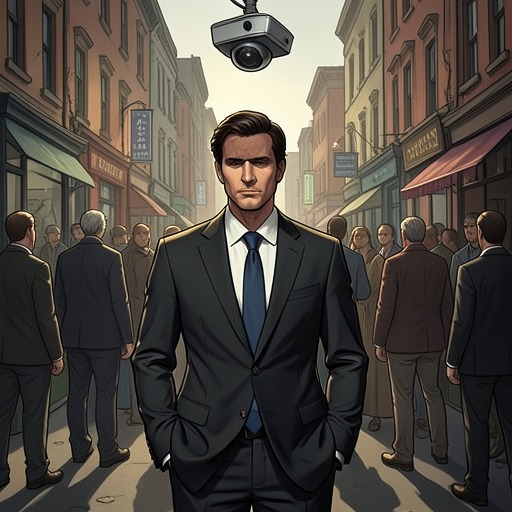
That growth shapes his routine. Sparky tries to work late so the next morning’s changes will be less of a shock. He predicts that people may eventually wake to find themselves under surveillance they cannot escape, with nowhere left for people who want to vanish to go. The warning comes from a technician who knows the system’s present shortcomings, not from someone claiming that total surveillance has already arrived.
The novel repeatedly places information in different media and under different conditions of access. A federal folder contains a telephoto photograph of Doc; Farley Branch’s 16-mm camera records environmental damage and the Channel View Estates raid; and the FBI monitors Doc’s computer connections. Sparky’s network belongs to this wider field of files, film, communications, and surveillance. Its distinctive promise is speed of retrieval, but its reach depends on what records exist and whether the system can access them.
Finding Trillium Fortnight
Doc turns Sparky’s general description into a specific request: could the network check whether someone admitted to an emergency room was all right? Sparky answers that it depends on the location. For Las Vegas, he thinks the information might be available through the University of Utah and begins searching. He finds records for Sunrise Hospital and Desert Springs, then looks for Trillium under either Beaverton or Fortnight.
The search returns a recent Sunrise Hospital record for Trillium Fortnight, whose home address is in Los Angeles. She had been admitted for observation and treatment after a concussion, cuts, and bruises, stayed two or three nights, and was released into her parents’ custody the previous Tuesday. Doc recognizes the record as the person he sought and thanks Sparky. The sequence shows both the network’s practical reach and the limits of what it supplies: it gives Doc a place, a time, and a documented hospital outcome, not an explanation of everything that happened to her.
Sparky’s role in the discovery is quiet but decisive. He does not pursue the lead on Doc’s behalf; he makes the record accessible, and Doc interprets what the result means for his search. The exchange turns the computer room into an investigative junction where a question about a person’s condition becomes an answer retrieved from an institutional record.
Narrative Role and Significance
Sparky links the novel’s private investigations to an emerging infrastructure of stored and searchable information. His workstation’s screens, reels, televisions, and coded commands make technological mediation visible: knowledge arrives through devices, and what can be known depends on access to records. In this setting, a hospital entry can reconnect Doc to a missing or hard-to-locate person, just as a photograph or surveillance feed can make him legible to authorities.
His outlook is deliberately double. Sparky can help Doc by searching the network, yet he understands that the same accumulation of recoverable data threatens the possibility of escape. He neither celebrates the system as limitless nor dismisses the danger because its present machinery is clunky. That tension makes him more than a technical assistant: he articulates how a tool for finding someone can also become a structure from which no one can hide.