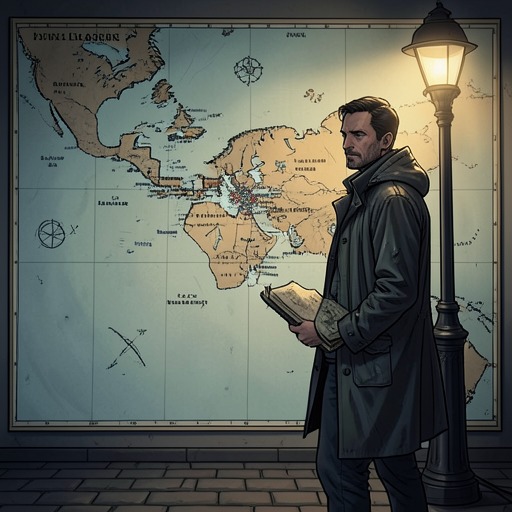
Spike
Inherent ViceSpike is a Vietnam veteran and a friend of Doc who is learning to live among the beach community after returning to a country that feels unfamiliar to him. His adjustment is neither a clean break from the war nor a simple embrace of the counterculture: it proceeds through his relationship with Sortilège, the motorcycle he repairs, other veterans, and a growing concern about pollution and development.
Return from Vietnam
After Vietnam, Spike was intensely wary of places where he might encounter hippies. He feared that long-haired people would recognize where he had been and respond to him as an enemy. When Doc first met him, Spike was trying frantically to fit into the counterculture, greeting its music and politics with conspicuous enthusiasm. The effort reflects the disorientation of returning to a United States whose social world had changed while he was away.
His account of military service is more matter-of-fact than his initial anxiety might suggest. Spike says he worked on helicopters and spent time in town with Charlie, listening to Armed Forces Radio and smoking local marijuana. People there sometimes warned him not to sleep on base, a warning he says saved him more than once. He does not present himself as a combat hero or make a grand claim about the war; he says the country belonged to the people who wanted it, and that he wanted to be left alone to work on his motorcycle.
Sortilège and life at the beach
Spike is Sortilège’s boyfriend, and Doc finds him on the porch with coffee when he visits. Sortilège is urging Spike to see her guru; Spike responds that she is always right. Their connection predates his return: they had been a year apart at Mira Costa High School, dated, and begun writing to each other while he was overseas. Their correspondence helped lead him to reconsider reenlisting.
As time passes, Spike becomes more at ease in the social life of the beach. His Moto Guzzi draws people to gather outside the garage where he works on it, sharing beer and marijuana. The bike is more than a possession in this account: it gives Spike a practical focus and a point of entry into a community he had first approached with apprehension. He says that working on it, along with Sortilège, helps keep him cheerful.
Friendship and environmental concern
Among those who gather around the motorcycle, Spike finds veterans who want a similarly undisturbed civilian life. He becomes especially close to Farley Branch, a former Signal Corps serviceman. Farley has acquired equipment no one wanted, including a durable, army-green Bell & Howell 16-mm camera dating from the Second World War. The two men sometimes ride out together looking for opportunities to film environmental damage, a shared interest shaped by what they had seen in Vietnam, including defoliation and polluted land.
Farley has already recorded extensive footage of environmental abuse in the United States, particularly at Channel View Estates, whose cleared landscape recalls jungle clearings to him. Spike reports that Farley was present on the same day as Doc during the vigilante raid there and is waiting for the footage to come back from the laboratory. The camera thus links their postwar environmental attention to the novel’s investigation of violence and development; Spike himself is not identified as having filmed the raid.
Spike also grows preoccupied with the El Segundo oil refinery and its tanks. He describes the coast as burdened by crude oil: spills wash ashore, and the oil clings to beachgoers’ feet. The detail places his concern within daily life rather than treating pollution as a distant abstraction. Even the different ways residents deal with oil on their feet become a small measure of how thoroughly industrial damage has entered the beach community’s routines.
Narrative significance
Spike’s trajectory is one of gradual adaptation rather than conversion. He begins by fearing the counterculture and trying to imitate it, then finds a steadier place through a relationship rooted in his prewar life, mechanical work, and friendships with fellow veterans. His environmental concern extends that personal adjustment outward: the landscape, like the people returning from war, bears marks that cannot be dismissed simply because the war is over. Through Spike and Farley, the novel connects military experience to the damaged environments of California without making their civilian lives a straightforward escape from the past.