Tariq Khalil
Inherent ViceTariq Khalil is a former prisoner seeking payment and firearms from Glen Charlock, a onetime associate who now works for developer Mickey Wolfmann. His case brings Doc Sportello into a deal rooted in prison gang politics: Tariq and Glen had arranged the killing of an informant to secure Glen’s entry into the Aryan Brotherhood, and Tariq’s people, the Warriors Against the Man Black Armed Militia, are still waiting for the weapons Glen promised. Tariq’s own return from prison has also brought a disorienting discovery: the Artesia Crips and the neighborhood that gave them their name have disappeared beneath redevelopment.
Introduction and First Encounter
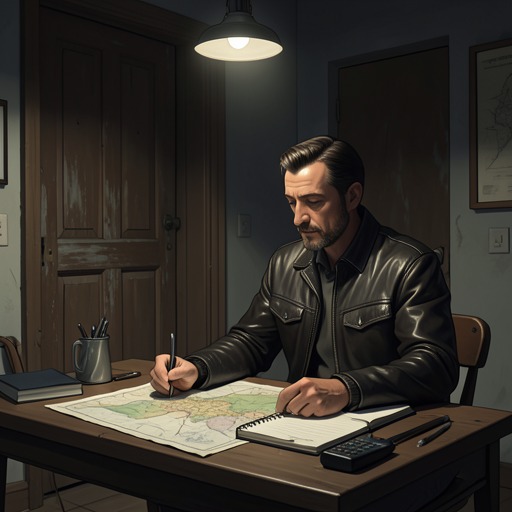
Tariq comes to Doc’s office in Gordita Beach, where his presence is treated as unusual because he is a Black visitor in a town with a history of racist exclusion. The narration recalls how, after a Black family tried to move into Gordita Beach shortly after the Second World War, townspeople, assisted by the Ku Klux Klan, burned the family’s house to the ground. The site remained empty until the town confiscated it and made it a park; later, young people gathered there to drink and take drugs. Tariq’s arrival thus occurs in a place whose ordinary routines carry the imprint of racial violence.
Doc greets him with an overfamiliar show of brotherhood. Tariq dismisses the performance, gives his name, and stares at Doc’s Afro. His skeptical question about whether Doc has a secretary underscores the improvised nature of the agency. When Doc explains that he will take notes himself, Tariq gets to the matter at hand: he was in prison with a white man, did business with him, and is owed a substantial amount, but cannot disclose the details because he swore an oath. He can, however, give Doc the man’s name: Glen Charlock.
The Search for Glen Charlock
Tariq knows where Glen works but not where he is staying. Glen is a bodyguard for a builder named Wolfmann, a detail that gives Doc a lead while also placing the debt within the world of powerful real-estate interests. Doc reacts to the name with a moment of drug-induced faintheadedness and then becomes suspicious, though he tries not to let Tariq notice. Tariq says he heard of Doc’s agency through Sledge Poteet.
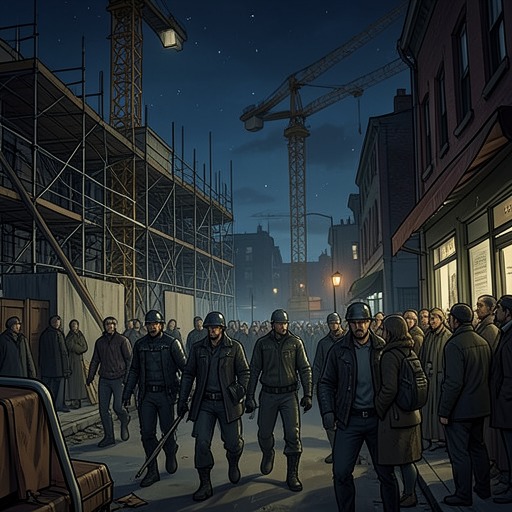
When Doc asks what else is troubling him, Tariq describes the loss of his old neighborhood. After getting out of Chino, he went looking for members of his street gang, the Artesia Crips, and discovered that not only the people but the turf itself seemed to be gone. He describes the land as ground up into little pieces, with seagulls picking at it. Thinking at first that he must be hallucinating, he drove around and returned; the neighborhood was still gone. His search for Glen therefore begins alongside a second, less solvable search: how to recognize home after the ground beneath it has been cleared.
The Prison Bargain
Later, after Doc enters his office and finds Tariq with Clancy Charlock, Tariq resumes his account of the business he and Glen conducted inside. Its origins lay in a conflict between Nuestra Familia, based in Northern California, and the Sureños, based in Southern California. An informant called El Huevoncito had caused trouble for prisoners across racial and gang lines. Everyone hated him, but the tangled history between the Chicano factions made it difficult for either side to arrange his killing directly. The task was therefore subcontracted to the Aryan Brothers.
Glen was being recruited for the Aryan Brotherhood, and killing someone formed part of the initiation. A lesser act, such as cutting a man’s face, could leave the initiate exposed to later retaliation; Tariq explains that killing the target outright was the way to settle the matter. The bargain linked Glen’s recruitment, the factions’ shared hatred of the informant, and Tariq’s participation in arranging the job. Tariq does not present the story as a simple private transaction: it was a solution produced by competing loyalties and the prison’s intricate gang history.
El Huevoncito was later found dead after an early-morning shake-and-bake on Tariq’s block. The circumstances gave Tariq a perfect alibi, and the killing was never traced to him. Glen’s time was accounted for as well. He asked Tariq for brotherly help disposing of a mess-hall shank on which he had put some of his own blood; he was accepted into the Aryan Brotherhood and, after Tariq’s release, found himself outside prison too. Soon afterward, Mickey Wolfmann offered him work. The old prison arrangement thus led directly to the employment that now makes Glen difficult for Tariq to reach.
Weapons, Waiting, and Character
Tariq’s claim is not only a demand for money. The original deal also involved firearms, and his people, the Warriors Against the Man Black Armed Militia (WAMBAM), have been waiting while Glen arranged the small-arms portion. Logistics delayed the transaction long enough for Tariq’s associates to grow anxious, prompting Tariq to seek Doc’s help. When Doc asks what form payment should take, Tariq indicates firearms with a small trigger-finger gesture. Doc says that his friends specialize in that area and asks how many are needed; Tariq describes an amount sufficient to arm a force somewhere between a platoon and a company.
Tariq’s conduct shifts between guardedness and directness. At first he withholds the details of the prison deal because of his oath, but later tells the story once the conversation settles. He is skeptical of Doc’s improvised office, impatient with Doc’s performance of familiarity, and precise about the practical aim of the investigation. His account connects an unpaid debt and a delayed weapons delivery to the histories of incarceration, gang recruitment, and a neighborhood erased during his absence. The book does not resolve Tariq’s claim or show whether he obtains the promised weapons; his function in the narrative is to make those entangled histories visible through the demands of a case that appears, at first, to concern a missing debtor.