The Arrepentimiento project stalls
Inherent ViceThe Arrepentimiento project stalls after Mickey Wolfmann disappears and reappears in a radically changed public role. Conceived as a city built from scratch in the desert, it becomes a half-abandoned site of unpaid contractors, withdrawn money, and recurring military flyovers. Through Riggs’s account, the project’s failure connects Mickey’s personal transformation to a wider struggle over who controls land, who is displaced to make room for development, and whose version of the landscape endures.
A desert-city dream
Before the project stalled, Mickey had long cherished the idea of building an entire city from scratch in the desert. His ambition gave Arrepentimiento the scale of a personal dream, rather than that of an ordinary subdivision: the settlement was meant to embody the possibility of remaking space on a grand scale. His older reputation as an acid-head philanthropist made that vision seem of a piece with his impulse to give wealth away, though the later collapse would make the distance between the ideal and its material consequences unmistakable.
The project also belongs to a larger history of land use in Los Angeles and its surroundings. Aunt Reet understands land through more than deeds and contracts: she knows the histories, family conflicts, water flows, and older claims that official records may leave out. That long view gives the desert development a political context. Tariq describes South Central as a Japanese neighborhood before the Second World War, whose residents were sent to camps; Black residents then moved in, only to face another removal as the neighborhood was bulldozed for Channel View Estates. Doc recognizes a recurring pattern in the displacement of Mexican families from Chavez Ravine for Dodger Stadium, American Indians from Bunker Hill for the Music Center, and Tariq’s community for a new development. Arrepentimiento’s rise and failure occur within this broader landscape of land cleared, reorganized, and claimed by those with greater power.
The project loses its support
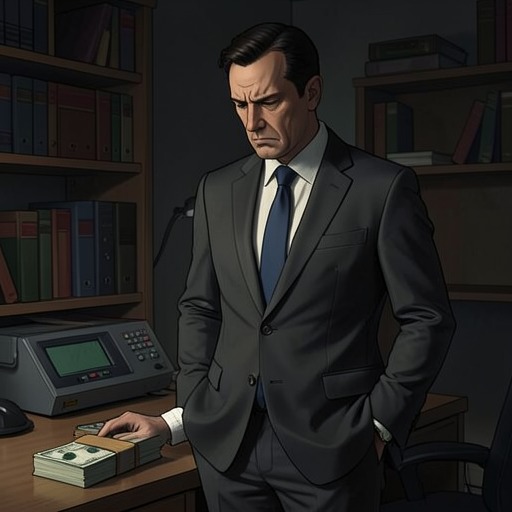
Riggs describes the decisive change as arriving around the time Mickey disappeared. When Doc encounters him at Arrepentimiento, the project has already lost the money that sustained it. Mickey has withdrawn his funding, contractors have been left unpaid, and everyone has walked away except Riggs. The site’s stalled state is not simply an unfinished dream: it has left a trail of broken obligations and a person still waiting amid the remains.
The physical setting makes the abandonment feel exposed and precarious. Military fighter jets from Nellis pass overhead every half hour, day and night. Riggs says he first took the flights for a routine path, then came to believe the buzzing was deliberate and authorized. He fears that Mickey will be made to approve a rocket strike that would destroy Arrepentimiento—and its records. The repeated noise turns the possibility of erasure into a constant presence over a settlement whose history is already at risk of disappearing.
Mickey’s return and Riggs’s account
Riggs does not treat Mickey’s disappearance and return as an ordinary change of heart. He says that Mickey came back with Sloane, presenting himself as a devoted family man and behaving possessively toward her in public. Riggs, who had been seeing Sloane, experiences the reconciliation as a personal rejection; he says she no longer gives him the time of day or even makes eye contact with other men, especially men she had been seeing. In his account, Mickey’s new domestic persona is part of a larger transformation: whoever took control of him, Riggs believes, changed his brain and reprogrammed his sexual behavior as well.
The stalled desert project sharpens Riggs’s conviction that this change has been imposed. He contrasts Mickey’s former philanthropic identity with a man who has abandoned the settlement and returned to a conventional marriage. Yet these claims reach Doc through Riggs, whose fear, jealousy, and isolation are part of the scene. The account conveys the project’s collapse and Riggs’s interpretation of Mickey’s transformation, not independent proof of who caused it or exactly what happened during Mickey’s disappearance.
Mickey’s public business dealings make the contrast more complicated. Riggs recounts that Mickey bought a tiny parcel on the Las Vegas Strip, too small even for a parking lot, and announced plans for a “mini-casino” with one slot machine, one roulette wheel, and one blackjack table. The neighboring casino objected to the prospect of downscale customers arriving next door, but eventually yielded and paid Mickey an extraordinary multiple of his purchase price. Riggs says the proceeds would finance renovation and expansion of the Kismet Casino and Lounge, where Mickey had become an active partner. The episode presents Mickey as capable of turning conflict over land into a lucrative transaction even as Arrepentimiento, his larger desert vision, is being left behind.
Abandonment and the politics of place
Arrepentimiento’s halted development concentrates the book’s recurring conflict over who gets to define a place and who can afford to remain there. At Channel View Estates, new homes bearing the slogan “A Michael Wolfmann Concept” spread over land where an older neighborhood had been cleared. Doc sees black pedestrians at the edges of the development, perhaps looking for a neighborhood and familiar rooms that have been taken away. Beyond the model units and finished homes, construction skeletons extend toward unincorporated land; the houses offer filtered views of a neglected flood-control channel, while paving, grading, and industrial debris have already altered the surrounding ground. The development’s promise of order and value is thus bound to earlier dispossession and continuing environmental change.
Crocker Fenway later describes the same conflict from the perspective of established property owners. He presents the fight against high-density development as environmental preservation, while Doc counters that it is about property values. Crocker’s own defense turns on being “in place”: he claims enduring control over real estate, water rights, oil, and cheap labor, and casts transient newcomers as an inexhaustible supply. The argument gives the stalled project a pointed counterpoint. Arrepentimiento is a dream of creating a new place in the desert; the land conflicts around Channel View reveal the unequal power already at work in deciding which places are built, whose claims count, and who is moved along.
Riggs’s fear that the project may be bombed and its records destroyed extends that conflict from displacement to historical erasure. In a landscape repeatedly remade by development, a place can disappear twice: first through the loss of its purpose and inhabitants, then through the removal of the evidence that it existed. The project’s stalled condition leaves that threat unresolved, with Riggs still at the site and the jets continuing to pass overhead.