The Police “Eleventh Commandment”
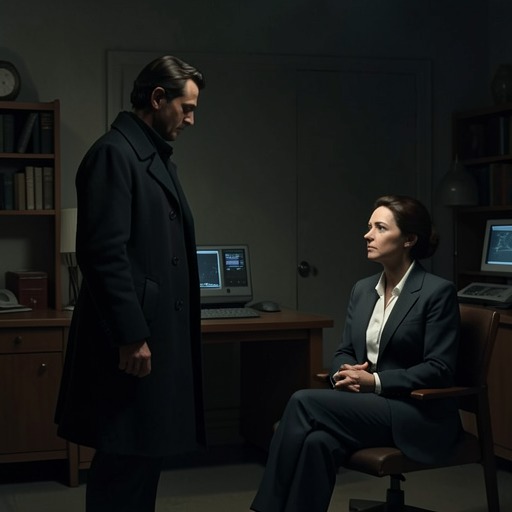
Inherent ViceThe Police “Eleventh Commandment” is the informal prohibition on criticizing another police officer. The rule is invoked when Doc Sportello asks Bigfoot Bjornsen about a cop whom Puck Beaverton hated and who apparently hated Puck in return. Bigfoot begins to offer an explanation, then stops; Doc recognizes the boundary as a matter of police solidarity. The exchange makes the commandment more than a workplace courtesy: it is a mechanism for withholding knowledge about officers, their conflicts, and their conduct.
The Rule in Conversation
Bigfoot tells Doc that Puck’s hatred of the unnamed officer was mutual, then breaks off before giving a reason. Doc says he understands the Eleventh Commandment against criticizing a fellow officer and asks whether the man is still on the job. Bigfoot answers that his status is inactive. When Doc guesses that the file is unavailable too, the conversation underscores how a silence about an officer can persist alongside the withholding of the official record.
The rule is never presented as a written regulation or formally defined procedure. Its force appears instead in the pause: Bigfoot’s unfinished explanation and Doc’s knowing response mark a boundary both men understand. The label “Eleventh Commandment” lends that boundary the sound of an additional law, while its subject is not public duty but the protection of one officer from another’s criticism.
Policing and Racialized Space
The rule’s significance sits within a novel that repeatedly shows how policing and racial power shape who may occupy public space. When Tariq Khalil arrives at Doc’s office in Gordita Beach, the narration recalls that a Black motorist there had once triggered calls for backup, a task force, and roadblocks along Pacific Coast Highway. That reflex has a longer history: after World War II, townspeople, aided by the Ku Klux Klan, burned a Black family’s attempted home to the ground. The vacant lot later became a park, where young people gathered to drink, use drugs, and have sex, even as the town’s racist history remained built into its landscape.
Tariq describes another history of displacement: Japanese residents of South Central were sent to camps during World War II, after which Black residents moved into the neighborhood; now, he says, Black residents are being moved along. His account connects state action against one community to the redevelopment and removal confronting another. The Eleventh Commandment concerns police speech rather than land policy, but the surrounding episodes make the stakes of institutional silence legible: official power can act on racialized communities while officers’ conduct and internal conflicts remain difficult to scrutinize.
The Double Standard of Protection
The racial hostility shown elsewhere in the novel sharpens the contrast between institutional solidarity and the vulnerability of those outside it. Art Tweedle boasts that his armed group will prevent “darkies sneaking onto this watermelon patch anytime soon,” and describes an arsenal that includes a modified automatic bazooka. He also confirms that the group was present during the Channel View Estates incident in which Mickey Wolfmann disappeared, claiming that its members pursued bikers and comparing them dismissively to Black people. In this setting, the protection afforded by the Eleventh Commandment reads as selective: officers close ranks around fellow officers, while racist language and armed intimidation are voiced with little sign of comparable restraint.
The rule does not itself explain the unnamed officer’s conduct or establish why his file is unavailable; the conversation leaves those matters unresolved. Its narrative function is precisely to mark that gap. Bigfoot’s silence, the officer’s inactive status, and Doc’s suspicion about the missing file make institutional protection visible as a limit on what can be said and known. The commandment thus turns an apparently casual exchange into evidence of a larger structure in which loyalty among police can obstruct scrutiny, even as racialized violence and displacement remain exposed in the surrounding story.