U.S. currency portrait eligibility rule
Inherent ViceThe U.S. currency portrait eligibility rule holds that a person must be dead before their portrait can appear on American currency. In the novel, this seemingly straightforward legal condition turns Nixon’s image on counterfeit bills into a clue and a joke with darker implications: if the bills could pass as legal tender, their portrait would imply that Nixon was dead. The rule does not resolve the mystery, but it gives Doc Sportello and Sauncho Smilax a concrete hinge between evidence, political suspicion, and the novel’s unsettled sense of cause and effect.
The Rule and the Nixon Bills
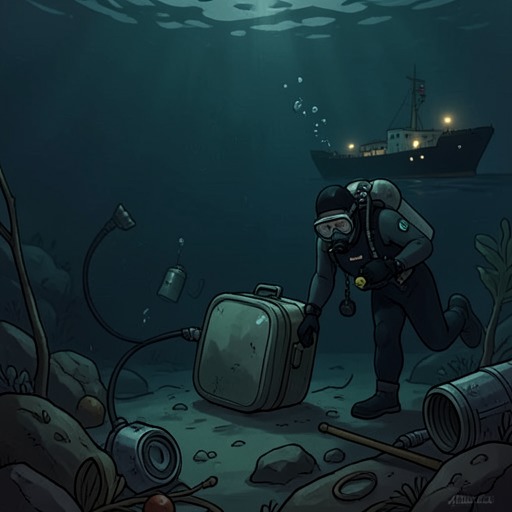
Sauncho explains the rule to Doc after a federal expedition recovers shipping containers of currency from the ocean. The bills bear Nixon’s face across denominations, rather than the familiar portraits of past American leaders. The discovery surprises the task force and connects the recovered money to a possible shipment Cookie and Joaquin had been trying to locate. The image is not merely an odd counterfeit design: under the rule Sauncho cites, putting a living person on U.S. currency would violate the stated eligibility condition.
Sauncho therefore reads the bills as an act of sympathetic magic by someone who wants Nixon among the dead. His interpretation converts a technical rule into a political wish, but it remains speculation, not a confirmed explanation of who made the bills or why. He also notes their collectors’ value and has already spent one of the Nixon twenties, buying white loafers on Hollywood Boulevard without the bill being examined. The counterfeit money can thus circulate as usable cash even while its portrait invites a second, more ominous reading.
The Image Reappears
Later, Doc wakes at Penny Kimball’s apartment to Nixon speaking on television. What arrests him is the president’s expression: it matches the Nixon pictured on the fake twenty-dollar bill Sauncho gave him. Doc checks the note against the televised face and sees the likeness as exact. That resemblance makes the currency seem to anticipate, or somehow already contain, an image Doc recognizes from the present broadcast.
Doc’s ensuing explanation is deliberately extravagant. He imagines a CIA engraver copying Nixon’s television image in a secure workshop and somehow sending it backward in time through a covert mailbox powered near an electrical substation; he even invents the possibility of insurance against a message being lost in temporal disturbances. The passage presents this as Doc’s speculative chain of thought, not as proof of time travel or an established account of the bills’ manufacture. The rule supplies a grounded legal premise, while the matching faces open the door to paranoid conjecture.
Meaning and Limits
The rule sharpens the contrast between official systems and the unstable information surrounding them. The money is counterfeit, yet it has been recovered in bulk from the sea and at least one note has passed in an ordinary purchase. Its portrait carries a meaning that cannot be verified: for Sauncho, it suggests a wish for Nixon’s death; for Doc, the similarity between bill and broadcast strains ordinary chronology. Neither interpretation identifies the maker or settles the purpose of the shipment.
As a result, the dead-person requirement functions less as a solution than as a compact instrument of the novel’s investigative uncertainty. A formal condition governing whose image belongs on money becomes entangled with political fantasy, covert operations, and the possibility that evidence may arrive before its apparent cause. The bills remain material clues, but the rule cannot tell the investigators whether they are looking at a practical fraud, a message, or an uncanny coincidence.