Amity
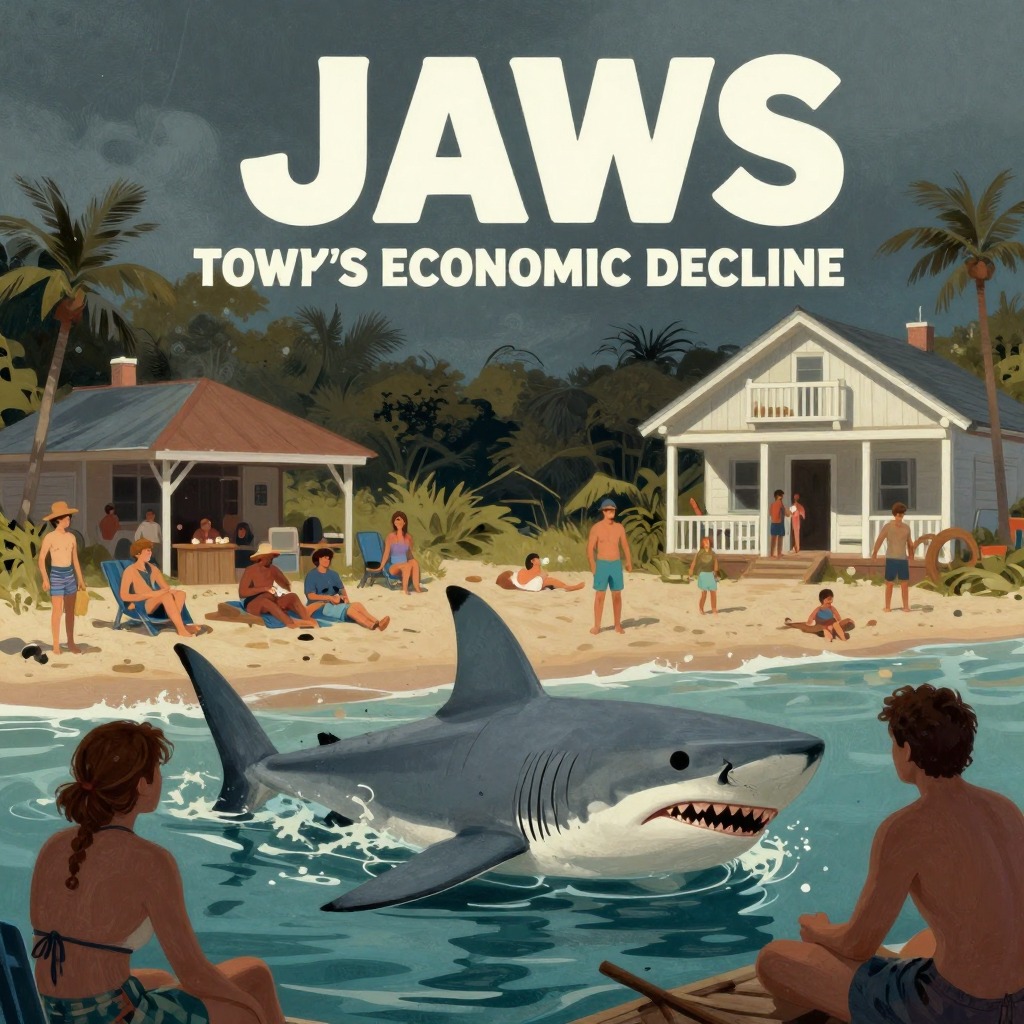
JawsAmity is a small, year-round resort community on the south shore of Long Island, approximately midway between Bridgehampton and East Hampton, whose entire economy depends on a successful summer tourist season. The arrival of a great white shark that kills four people and threatens a fifth throws the town into a crisis that exposes its fragile economy, its corrupt local politics, and the moral compromises its leaders are willing to make to preserve the appearance of safety.
Geography and Demographics
Amity has a wintertime population of about 1,000, which swells to nearly 10,000 in the summer. The town is a classic Long Island beach community, with a public beach, a town dock with twenty slips, and a main street lined with boutiques, a hardware store, a delicatessen, and a liquor store. The beachfront along Old Mill Road and Scotch Road is lined with large summer homes, many of which are owned by wealthy families from New York City. The year-round residents are a mix of tradespeople—carpenters, electricians, plumbers, fishermen—and a small professional class that includes the police chief, the newspaper editor, and the mayor. The town's black community, most of whom work as gardeners, butlers, bartenders, and maids, is particularly vulnerable to economic downturns.
Economy and the "Amity Understanding"
The town's economy is almost entirely dependent on the twelve-week summer season. Merchants, from the hardware store owner to the pharmacist, need a boom summer to carry them through the winter, during which they never break even. Charter fishermen, restaurants, and pubs all rely on the crowds. After even the best of summers, three of every ten families go on relief, and dozens of men are forced to move to the north shore of Long Island to shuck scallops for a few dollars a day. This economic fragility has created a tacit "Amity understanding": everyone is expected to do their bit to make sure Amity remains a desirable summer community. This understanding manifests in the suppression of bad news—such as the previous summer's rapes, which were reported only as "molestations"—and in the quiet expulsion of undesirable businesses, like the Felix Brothers, who were driven out of town for using substandard materials. The police chief, Martin Brody, and the newspaper editor, Harry Meadows, are the key enforcers of this understanding, balancing the need for public safety with the imperative to protect the tourist trade.
Political Structure and Corruption
Amity is governed by a Board of Selectmen, whose members include the mayor, Larry Vaughan, a real estate broker; Tony Catsoulis, a builder; Ned Thatcher, owner of the Abelard Arms Inn; Paul Conover, owner of Amity Liquors; and Rare Lopez, a representative of the black community. The police chief is an elected official, but the selectmen have the power to remove him for "good and sufficient cause." This political structure is exploited by Vaughan, who is secretly in debt to Tino Russo, a second-echelon figure in one of the five Mafia families in New York. Vaughan, through a shell company called Caskata Estates, has been buying up depressed real estate with Russo's backing, and he pressures Brody to keep the beaches open to protect his investment. The selectmen, with the exception of Albert Morris, are either Vaughan's allies or too intimidated to oppose him.
The Shark Crisis and Its Aftermath
The shark attacks begin with the death of Christine Watkins, a young woman swimming at night off Old Mill Road. Brody wants to close the beaches and publicize the danger, but Vaughan and Meadows persuade him to suppress the news, arguing that the odds of another attack are astronomical and that a panic would ruin the summer. The decision proves catastrophic: the shark kills a six-year-old boy, Alexander Kintner, and a sixty-five-year-old man, Morris Cater, on the same day. The resulting media storm and public outcry force the beaches closed, but the damage is done. The town's economy collapses: real estate agents face mass cancellations, stores postpone their openings, and the sporting goods store holds a clearance sale in June. The crisis also destroys Vaughan, who is exposed as a front for the mob and flees town. Brody, driven by guilt and a sense of duty, joins the fisherman Quint and the oceanographer Matt Hooper on a final, desperate hunt for the shark, which ends with Hooper's death and the sinking of Quint's boat, the Orca. Brody survives, swimming to shore, but the town's future remains uncertain.
In the film adaptation, Amity's depiction was significantly altered from the novel. Director Steven Spielberg found the book's characters unlikable and removed several subplots, including the affair between Ellen Brody and Matt Hooper and Mayor Vaughn's Mafia connections. The character of Harry Meadows, a major figure in the novel, was reduced to a minor role. These changes shifted the town's portrayal from a morally compromised community to a more sympathetic setting, emphasizing the conflict between public safety and economic interests. The film's Amity was shot on location in Martha's Vineyard, Massachusetts, which stood in for the fictional Long Island town. This choice gave the film a distinct New England coastal atmosphere, different from the novel's Long Island setting. The film's success made Amity a recognizable fictional location, and the town's struggle with the shark became a template for disaster narratives.