An unlimited idea of freedom
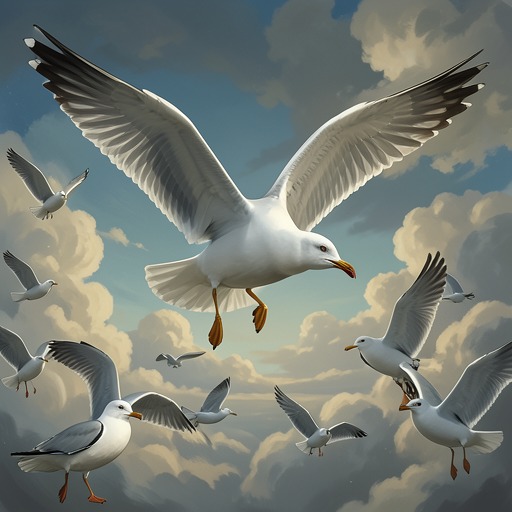
Jonathan Livingston Seagull“An unlimited idea of freedom” is the teaching that a seagull’s essential nature is not confined to its measurable body or ordinary uses. Jonathan Livingston Seagull links this idea to flight as a practice of self-realization: precision and speed matter not as ends in themselves, but as steps toward expressing a nature that can exceed physical limits. The phrase begins as Jonathan’s hard-won insight and becomes a lesson he entrusts to others.
From Flight to a Larger Nature
For most Seagulls, flight is a means of traveling between shore and food; Jonathan instead makes flight itself his central pursuit. His experiments begin in the body, with low glides close to the water, then develop into dangerous tests of speed. Repeatedly losing control at seventy miles per hour, he revises his method: he flaps up to fifty, then holds his wings steady. From two thousand feet, the adjustment lets him pass ninety miles per hour. Later, at terminal velocity, a fraction-of-an-inch movement of one wingtip feather gives him a smooth curve, while moving more feathers can send him spinning. These discoveries establish the expression’s practical foundation: freedom is not carelessness, but the capacity developed through exacting attention and practice.
Jonathan’s technical achievements do not, by themselves, explain what flight means. After arriving in the new world, he asks whether heaven is a place. Chiang answers that heaven is neither a place nor a time, but perfection, and defines perfect speed not as a number but as being there. That teaching shifts the scale of Jonathan’s inquiry: a flight practice measured in speed and control becomes part of an effort to understand a nature not bounded by measurable limits.
The Idea as Experience
Chiang teaches Jonathan to stop imagining himself as trapped inside a body with a forty-two-inch wingspan and chartable performance. Jonathan must understand that his true nature is present everywhere across space and time. He works at the lesson from before sunrise until past midnight, yet moves not a feather-width. The effort makes the gap between physical practice and understanding unmistakable: repeating a technique cannot substitute for grasping what the technique is meant to reveal.
The change comes when Jonathan closes his eyes on the shore and recognizes himself as a perfect, unlimited gull. He opens them beside Chiang on a different seashore, beneath a green sky and twin yellow suns. The shift turns the teaching into an experienced possibility rather than an abstract claim, though Chiang immediately notes that Jonathan’s control still needs work. The expression’s freedom therefore does not erase the need for learning; it names a wider nature that practice helps him understand and express.
Teaching, Love, and Return
Jonathan’s understanding acquires a purpose beyond his own achievement. After Chiang disappears, Jonathan thinks of Earth and of gulls who might be struggling against the same limits he once faced. He increasingly wants to return, because he sees teaching as his way of sharing what he has learned with a gull willing to seek the truth. Chiang’s last instruction to keep working on love gives that return a further dimension: knowledge of freedom is tied to a responsibility toward others, not merely to individual mastery.
Before leaving, Jonathan tells Sullivan that overcoming space and time need not destroy their friendship: beyond space there is only Here, and beyond time only Now. He holds in thought an image of gull-flocks from another time and understands himself not as bone and feather but as a perfect idea of freedom and flight, limited by nothing. The expression thus joins the story’s account of thought-speed flight to its account of connection: transcending limits does not have to mean abandoning fellow gulls.
The Lesson Passed On
On Earth, Jonathan teaches six Outcast students by the end of three months. They enjoy the demanding, exciting practice, but struggle to believe that the flight of ideas can be as real as the movement of wind and feather. Jonathan tells them that each is an idea of the Great Gull, an unlimited idea of freedom, and that precision flying is a step toward expressing their real nature. High-speed work, low-speed work, and aerobatics have significance because they help the students put aside what limits them.
After Jonathan vanishes, Fletcher Lynd Seagull faces a new group of eager students and repeats the teaching: a seagull is an unlimited idea of freedom, an image of the Great Gull, and the visible body is thought itself in bodily form. The students, expecting a rule for a loop, do not immediately understand. Fletcher sighs and begins with level flight instead. The ending preserves a productive tension in the expression: the principle is larger than a flying trick, but it must still be approached through instruction and practice. Fletcher’s realization that Jonathan was no more divine than he is makes the teaching less a doctrine of distant perfection than an invitation to discover and embody the freedom it describes.