Fletcher’s Crash and Return
Jonathan Livingston SeagullFletcher’s Crash and Return is the abrupt collision of flight training, apparent death, and the Flock’s reaction to the impossible. When Fletcher swerves to save a young gull, he strikes solid granite at more than two hundred miles per hour. He awakens in a strange sky, where Jonathan explains that the crash has changed his level of consciousness rather than ended his life. Fletcher elects to return to his students, but his revival at the cliff’s base turns him into both a supposed miracle and a supposed devil; as the crowd closes in, Jonathan removes them from its reach.
Causes and Circumstances
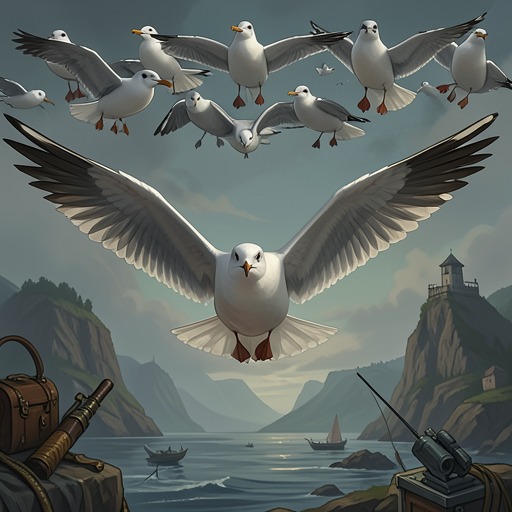
A week after Fletcher had begun demonstrating high-speed flying to a new class, he pulled out of a dive from seven thousand feet. He streaked just inches above the beach when a young gull on its first flight glided directly across his path, calling for its mother. With only a tenth of a second to avoid the bird, Fletcher snapped hard left at more than two hundred miles per hour and hit a cliff of solid granite.
The collision follows from the same precision and danger that make Fletcher a teacher of advanced flight: he is demonstrating a technique at high speed, but the unexpected presence of a novice bird leaves almost no room to correct his course. The scene’s decisive choice is not whether he can avoid all danger, but that his evasive turn protects the young gull at the cost of sending him into the cliff.
The Strange Sky and Jonathan’s Explanation
For Fletcher, impact is like passing through a hard door into another world. Fear, shock, and darkness give way to a strange sky in which he forgets and remembers in turns, feeling afraid, sad, and sorry. Jonathan’s voice reaches him as it did when they first met, linking this disorienting experience to their earlier teacher-student relationship.
Jonathan tells Fletcher that they have been overcoming limitations patiently, and that flying through rock comes later in the program. When Fletcher asks whether he has died, Jonathan answers that speaking to him proves he has not: he has changed his level of consciousness abruptly. The explanation connects the apparent catastrophe to the lessons Jonathan has given about the body and thought, while also making clear that Fletcher has moved to a level higher than the one he left.
Jonathan presents Fletcher with a choice. He can remain and learn at this new level, or return and continue working with the Flock. Fletcher immediately chooses to go back because he has barely begun with the new group. Jonathan then reminds him that the body is nothing more than thought itself, a teaching that frames Fletcher’s return not as a physical escape from injury but as an exercise of the understanding he has been developing.
Return to the Flock and Mob
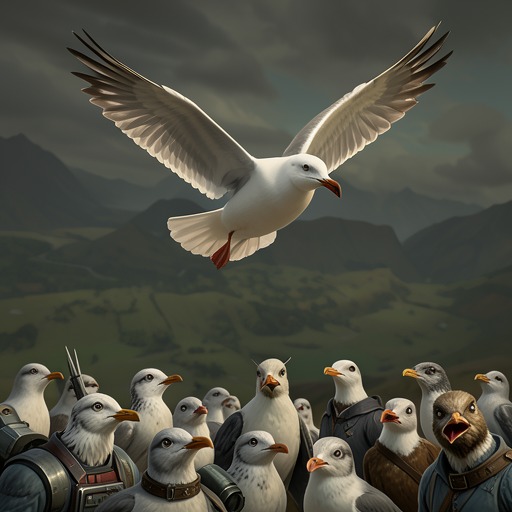
Fletcher opens his eyes at the base of the cliff, in the middle of the assembled Flock. The first response is a great clamour as the birds see him move. Some announce that the supposedly dead gull lives; others declare that Jonathan touched him with a wingtip and brought him back. The scene’s initial wonder quickly divides into competing interpretations of what the return means.
The crowd’s fear turns to violence. One cry labels Jonathan a devil who has come to break the Flock, and the accusation spreads through four thousand gulls. With eyes glazed and beaks sharp, they close in to destroy the pair. The apparent miracle does not make the Flock receptive to the freedom Jonathan teaches; instead, fear recasts the event as a threat to the established community.
Jonathan asks whether Fletcher would prefer to leave. Fletcher says he would not object, and in an instant the two stand half a mile away, while the mob’s flashing beaks close on empty air. The escape shifts the immediate outcome from a crowd attack to safety, but leaves the central conflict unresolved: the Flock has witnessed Fletcher’s return without understanding what it demonstrates.
Consequences and Significance
After they escape, Jonathan wonders why it is so difficult to convince a bird that he is free and can prove it through practice. Fletcher, still blinking from the change of scene, asks how they got there. Their different responses register the event’s two sides: Jonathan sees the Flock’s refusal to accept freedom, while Fletcher is still absorbing his own sudden passage from the cliff to safety.
The episode reverses the apparent meaning of the crash. What first looks like death becomes a choice between continuing on a higher level and returning to teach; Fletcher’s decision confirms his commitment to his students. Yet the return does not bring acceptance. The crowd’s movement from astonishment to a violent accusation shows how an event that could have served as evidence of expanded possibility instead intensifies hostility. Fletcher survives, resumes his place among the Flock, and escapes with Jonathan, but the community’s fear remains the barrier their teaching must confront.