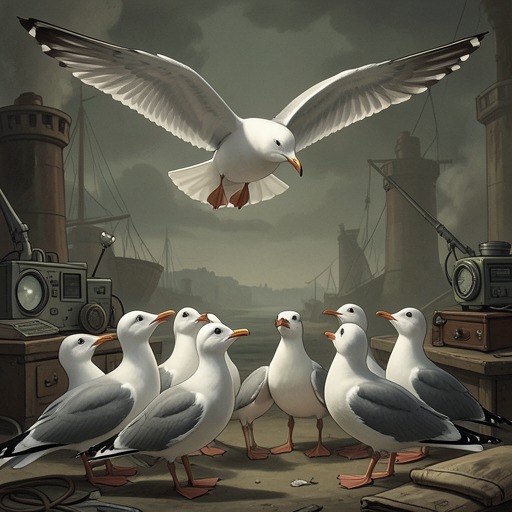
Jonathan Learns Thought-Speed Flight from Chiang
Jonathan Livingston SeagullJonathan Learns Thought-Speed Flight from Chiang is the spiritual and practical turning point in Jonathan Livingston Seagull’s apprenticeship: with Chiang’s guidance, flight ceases to mean covering distance through bodily effort and becomes the realization that Jonathan’s true nature is not confined by space, time, or his physical form. The lesson culminates in his instantaneous arrival on another world, but Chiang makes clear that mastery is not merely a spectacular power; it leads onward to the harder work of understanding kindness and love.
From Physical Flight to Perfection
Jonathan’s desire to learn from Chiang grows out of a lifetime spent treating flight as an end in itself. While most gulls learn only enough to travel between shore and food, Jonathan values flying more than eating. His earlier experiments with speed and control had pushed the body toward its limits: he learned to hold his wings still through a steep dive, reached ninety miles per hour, and later discovered that a minute movement of one wingtip feather could shape a high-speed turn. The new training does not discard that discipline, but changes the question it can answer. Physical technique can refine a flight through the air; it cannot by itself explain how to go anywhere instantly.
When Jonathan asks whether there is a place called heaven, Chiang rejects the idea of heaven as a location or a time. Heaven, he teaches, is being perfect. Speed in the ordinary sense cannot reach that perfection, because any numerical speed remains limited. Perfect speed means being there. Chiang demonstrates the distinction by vanishing and appearing first at the water’s edge, fifty feet away, and then beside Jonathan, each movement completed in an instant. He explains that he can go to any place and any time he can imagine. The demonstration makes the lesson visible, while its terms overturn the familiar measure of flight: distance and duration are no longer obstacles to be crossed faster, but limits that no longer define the journey.
Chiang’s Method and Jonathan’s Breakthrough
Chiang’s instruction begins not with a maneuver but with a change in understanding. To travel as fast as thought, Jonathan must begin by knowing that he has already arrived. Chiang asks him to stop identifying himself with a bounded body: a gull with a forty-two-inch wingspan whose performance can be plotted on a chart. Jonathan’s true nature, Chiang teaches, is a perfect idea existing everywhere across space and time. The body’s measurable capacities are real within ordinary flight, but they are not the full account of what Jonathan is.
The teaching proves difficult precisely because Jonathan cannot solve it by applying the sort of effort that had advanced his earlier experiments. He practices fiercely day after day, from before sunrise until past midnight, yet does not move even a feather-width from his spot. Chiang tells him not to rely on faith: flying requires understanding, and this new flight is the same. The stalled practice marks a contrast with Jonathan’s earlier physical training. Repetition and exertion alone have not brought the breakthrough; he must understand what the exercise assumes about the self.
One day on the shore, Jonathan closes his eyes and concentrates until he knows what Chiang has been telling him: he is a perfect, unlimited gull. The realization brings a shock of joy. When he opens his eyes, he is standing with Chiang on a wholly different seashore, where trees reach down to the water and twin yellow suns turn overhead. Jonathan exclaims that it works; Chiang accepts the success but immediately notes that his control still needs work. The arrival is therefore both proof and beginning: Jonathan has grasped the principle, but must continue learning how to use it.
Arrival, Control, and Further Learning
The new shore makes the abstract lesson concrete. Jonathan has not merely traveled at a higher speed across a familiar sky; he has arrived in surroundings unlike the place where he began. His first response is delight at the discovery that Chiang’s teaching works. Chiang, by contrast, is unimpressed by the unfamiliar planet and turns attention back to control. Their differing reactions distinguish wonder at a new capability from the disciplined work required to master it.
When they return, it is dark. The other gulls look at Jonathan with awe because they have seen him disappear from the place where he had remained rooted for so long. Jonathan receives their congratulations only briefly, insisting that he is the newcomer and still has to learn from them. His response keeps the breakthrough from becoming a claim to final authority: reaching a new capacity does not end the practice of learning. Sullivan, standing nearby, observes that in ten thousand years he has never seen a gull less afraid of learning.
Chiang then points toward what is still ahead. They can work with time until Jonathan can fly the past and the future; after that, he will be ready for the most difficult and powerful lesson of all, learning the meaning of kindness and love. Jonathan has learned a way to cross the apparent limits of place, and the next stage will ask what that freedom is for. Chiang’s teaching thus makes technical mastery part of an ethical education rather than its conclusion.
From Apprenticeship to Return
After Chiang vanishes, Jonathan repeatedly thinks of Earth and of how much more life might have meant if he had known even a fraction of what he now understands. He imagines that another gull there may be struggling to break free of limits, to see flight as more than a way to reach a breadcrumb from a rowboat, or may have been made an Outcast for speaking against the Flock. As Jonathan practices kindness and tries to understand love, his desire to return grows. He sees instruction as his own way of demonstrating love: giving another gull the chance to encounter the truth for itself.
Sullivan doubts the plan, but Jonathan argues that friendship cannot depend on space and time if those are precisely what they are practicing to overcome. If they overcome space, he says, all that remains is Here; if they overcome time, all that remains is Now. He believes they can still meet within that shared present. Sullivan laughs kindly, accepts that Jonathan may be able to show a gull on the ground how to see a thousand miles, and says goodbye. Jonathan answers that they will meet again, holding in thought an image of the great gull-flocks on a shore in another time. He knows himself not as bone and feather but as a perfect idea of freedom and flight, limited by nothing.
Significance of the Lesson
The apprenticeship transforms the meaning of Jonathan’s lifelong pursuit without denying its physical foundations. His earlier flights depended on close attention to wings, speed, and control; Chiang’s lesson asks him to recognize that the body is not the boundary of his identity. The movement from measurable performance to thought-speed travel carries the story from skilled practice toward a conception of perfection in which distance and time lose their authority.
Yet the lesson does not culminate in escape or solitary power. Chiang directs Jonathan toward love, and Jonathan’s later decision to return to Earth gives that direction practical form. Learning to reach anywhere becomes the capacity to reach another gull with what he has learned. The decisive achievement is therefore double: Jonathan discovers that he is not confined to the limited body he once took himself to be, and he begins to understand freedom as something to share through teaching.