Jonathan’s Arrival in the New World
Jonathan Livingston SeagullJonathan’s Arrival in the New World is the turning point that transforms Jonathan Livingston Seagull’s hard-won flight skill from a private achievement into the beginning of a larger education. Two radiant gulls meet him in the night, call themselves his brothers, and lead him away from the life in which he had been Outcast. His arrival brings welcome and a community of fellow practitioners, but not a final resting place: this new world has its own lessons, and the understanding Jonathan gains there will ultimately send him back to Earth to teach.
From the Outcast’s Sky
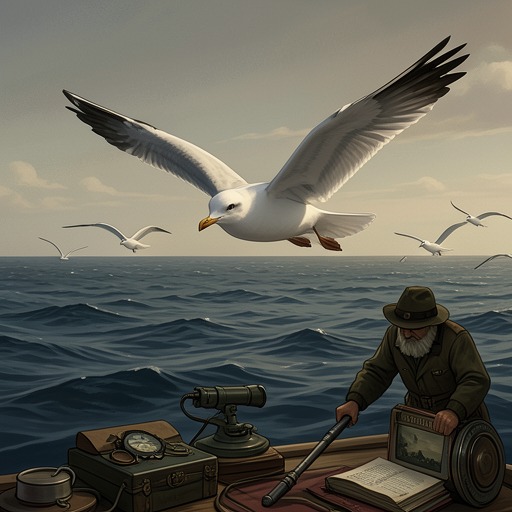
The arrival begins with an encounter that tests flight before it asks for trust. The two gulls appear at Jonathan’s wings while he glides alone through the sky. He challenges them through a series of demanding maneuvers: slowing to just above a stall, dropping into a dive at a hundred ninety miles an hour, then turning the dive upward into a vertical slow-roll. They hold formation throughout, their skill answering his suspicion with proof. The episode presents recognition as something earned through shared practice: Jonathan does not accept the strangers merely because they have come to him; he first sees that they can fly as he does.
Only after the test does one of the visitors explain that they are from his Flock and are his brothers, come to take him higher and take him home. The offer unsettles Jonathan because his identity has been shaped by exclusion. He answers that he has no home or Flock, that he is an Outcast, and that even at the peak of the Great Mountain Wind his old body cannot lift him higher than a few hundred feet. His response defines the threshold he is being asked to cross: the familiar world has made his separation seem permanent, while the visitors treat it as neither the last word on belonging nor the limit of his flight.
The visitors tell him that he can rise higher because he has learned, and that one school has ended so another can begin. Understanding comes to Jonathan with the force of recognition rather than an argument. He accepts that they are right, looks across the silver land where he has learned so much, and says he is ready. He then rises with the two star-bright gulls and disappears into the dark sky. The departure closes one period of solitary mastery while opening another, in which his ability will be tested and enlarged within a new community.
Arrival and First Welcome
The new world is not introduced as a place of effortless bliss. As Jonathan flies above the clouds in close formation with his guides, his body grows as bright as theirs and feels like a seagull’s body, yet performs far better than the body he had known on Earth. He anticipates that the improved form will bring greater speed for less effort. But the first landscape he sees is sparsely populated: a jagged shoreline, a few gulls working the cliff updrafts, and a handful more far to the north. The sight raises questions about why so few gulls are here and why he is suddenly tired. His expectation that heaven should be crowded and free of fatigue meets an unfamiliar reality.
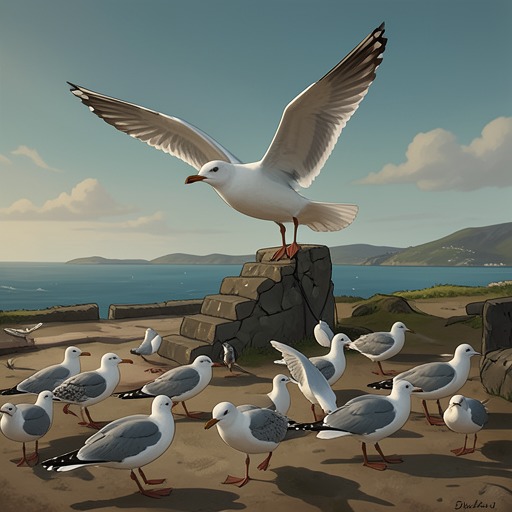
The arrival is marked less by an explanation than by welcome. A dozen gulls from the shoreline come to meet him without speaking. Jonathan feels that he is welcome and that this is home, though the day has been so full that he no longer remembers its sunrise. He lands by beating his wings to stop an inch above the beach and dropping lightly to the sand. The other gulls display a different kind of control: they alter the curve of their feathers and stop precisely as their feet touch down, without flapping. Jonathan recognizes the beauty of their technique, but exhaustion leaves him unable to attempt it; he falls asleep on the beach before anyone has spoken.
That silent welcome contrasts sharply with the rejection that defined his previous life. Jonathan had been alone and Outcast, whereas here a dozen birds receive him as one of their own without requiring him to explain or defend his passion for flight. Yet the scene does not erase the history he carries. His memory of Earth is already beginning to blur, retaining impressions of fighting for food and exclusion more readily than a clear account of the life he left. The new home offers belonging, but the transition also loosens his hold on the details of his former world.
A Community of Practice
In the days that follow, Jonathan learns that the new world contains as much to discover about flight as the life behind him. The difference is social as well as technical. Here, the gulls share his conviction that the most important thing in living is to reach toward perfection in what they love doing. They devote hour after hour to practicing flight and testing advanced aeronautics. Flight is no longer an eccentric pursuit set against the community’s ordinary priorities; it is the shared work through which the community understands a life well lived.
The contrast throws Jonathan’s earlier choices into sharper relief. The gulls he left on Earth treated flight chiefly as a means of reaching food and competing for it, while Jonathan had cared more about flying than eating. In the new world, that central commitment no longer isolates him. He has entered a society whose daily discipline answers the desire that once kept him apart. The change does not make learning complete: the gulls practice continually, and Jonathan’s arrival is the beginning of further training rather than a reward that ends the need for effort.
For a time, the intensity of this shared practice draws Jonathan’s attention away from Earth. He forgets the Flock that had kept its eyes closed to the joy of flying and used its wings to find and fight over food. But the memory returns in brief moments. That recurrence matters to the event’s wider arc: the new community gives Jonathan acceptance and a higher level of instruction, yet it does not permanently sever his relation to the birds he left behind. What he learns among those who share his values will eventually change how he understands responsibility to those who do not.
Heaven as Continuing Education
Jonathan initially reads his ascent through the language of arrival in heaven, but the new world complicates that expectation. His first thought on entering it is that it must be heaven, accompanied by the recognition that analyzing heaven at the moment of entry seems hardly respectful. The question becomes more difficult as he encounters sparse shores, fatigue, sleep, and the prospect of still more learning. His surroundings offer genuine welcome and a better-flying body, but they do not supply the effortless, completed perfection he might have expected from the name.
The Elder later makes the distinction explicit: heaven is not a place or a time but the condition of being perfect. Jonathan’s arrival is therefore not the attainment of a fixed destination so much as entry into a continuing discipline. The Elder connects that discipline to perfect speed, which is not any measurable rate—not a thousand miles an hour, a million, or even the speed of light—but being there. Numbers remain limits; perfection cannot be reduced to an ultimate figure. This teaching gives a conceptual shape to what the arrival has already shown in practice: a new world can expand the possibilities of flight without marking the end of striving.
The same education moves beyond technique. The Elder proposes that Jonathan work with time until he can fly the past and the future, and then begin the most difficult and powerful practice: learning the meaning of kindness and love. The episode’s religious pattern is thus grounded in training rather than a single revelation. Jonathan crosses out of the world that rejected him, joins a community ordered around a higher ideal, and discovers that the ideal demands further learning. Even the language of heaven remains active and changing, tied to what the learner can understand and practice.
The Return Latent in the Arrival
The community that welcomes Jonathan also equips him to see his former world differently. After learning in the new world, he thinks repeatedly of Earth and wonders how much more life there might have meant if he had possessed even a fraction of his present understanding there. He imagines that some gull may be struggling to move beyond the Flock’s limits, to see flight as more than a way to travel toward a breadcrumb from a rowboat. He also considers that another gull might have been made Outcast for speaking the truth in the face of the Flock. Those possibilities turn memory into a reason to return.
Jonathan’s growing desire to go back is connected to his lessons in kindness and love. In spite of his lonely past, he understands himself as born to be an instructor; for him, love means giving another gull who asks the chance to see the truth for himself. The new world’s welcome is therefore not only a personal consolation after exclusion. Its teaching changes the meaning of what Jonathan owes to the world he left: he can carry knowledge across the boundary that once seemed to separate the Outcast from the Flock.
His departure from the new world is expressed through a conception of identity that makes such crossings possible. In bidding farewell to Sullivan, Jonathan holds in thought an image of the great gull-flocks on the shore of another time and understands himself not as bone and feather but as a perfect idea of freedom and flight, limited by nothing. That later understanding completes the significance of his arrival without making the new world merely a stopping place. It is both a home where his love of flight is shared and a school whose lessons make his return imaginable. The ascent begins in acceptance, continues through practice and instruction, and opens outward toward the teaching of others.