Jonathan’s Flight Breakthrough
Jonathan Livingston SeagullJonathan’s Flight Breakthrough is the turning point at which Jonathan Livingston Seagull turns repeated high-speed crashes into a controlled new form of flight. By changing how he holds and folds his wings, he reaches 214 miles per hour and survives a dive through the Breakfast Flock. The discovery is at once a practical achievement and the beginning of a larger change: flight becomes, for Jonathan, a way to pursue freedom, excellence, and a fuller meaning of life.
From experiment to failure
For most Seagulls, flight is a means of getting from shore to food and back; what matters is eating. Jonathan Livingston Seagull reverses that priority. Flight itself matters most to him, and he spends his time learning what the ordinary gull has no reason to learn. His breakthrough belongs to this sustained practice, not to a sudden escape from it: speed is the subject of his experiments, and his first progress comes through failures that reveal the limits of his current technique.
From a thousand feet, Jonathan drives into a steep power-dive. In six seconds he reaches seventy miles per hour, the speed at which a wing becomes unstable on the upstroke. The pattern repeats: his left wing stalls, he rolls sharply left, the right wing stalls as he tries to recover, and he tumbles down into the water. He tries ten times, and all ten attempts end in a crash. The speed record he is pursuing is not yet a breakthrough; at that velocity, he cannot control his wings well enough to make the flight useful or safe.
Dripping wet after the attempts, Jonathan identifies the crucial adjustment: he must flap only until he reaches fifty miles per hour, then hold his wings still. From two thousand feet he dives again, beak straight down, wings extended and stable once he passes that speed. The method works. In ten seconds he passes ninety miles per hour, setting a seagull speed record. But the success is incomplete: when he begins to pull out and changes his wing angle, the old loss of control returns. The dive ends in a violent crash into the sea, showing that reaching a new speed and managing the transition out of it are separate problems.
The discovery of the short-wing dive
After the crash, Jonathan lies on the ocean in the moonlight with ragged wings and the sense that failure is heavier than his injured body. In the night he notices the decisive clue: a falcon’s short wings. He realizes that he can imitate their narrow profile by folding most of his wings close to his body and leaving only the tips extended. Instead of trying to stabilize a broad wing at extreme speed, he can reduce the exposed wing area and use the narrow tips to control the dive.
Jonathan climbs two thousand feet, folds in his forewings, and points the narrow, swept tips into a vertical dive. The wind roars against him as he passes seventy, ninety, and then 120 miles per hour. At 140, the strain on his wings is less severe than it had been at seventy in the earlier attempt. A faint twist of the tips is enough to ease him out of the dive and send him above the waves. The important change is not speed alone: for the first time, he can reach extreme velocity and remain in control.
By sunrise he is practicing again, this time from five thousand feet. As he dives, he reaches terminal velocity: 214 miles per hour, the limit at which the wind becomes a solid wall of sound and he cannot go faster. He knows that if his wings unfold at that speed they will be torn apart, yet the speed feels to him like power, joy, and beauty. He begins his pullout at one thousand feet, with the boat and the gulls growing rapidly in his path, and realizes that he does not yet know how to stop or turn at that velocity.
The public demonstration
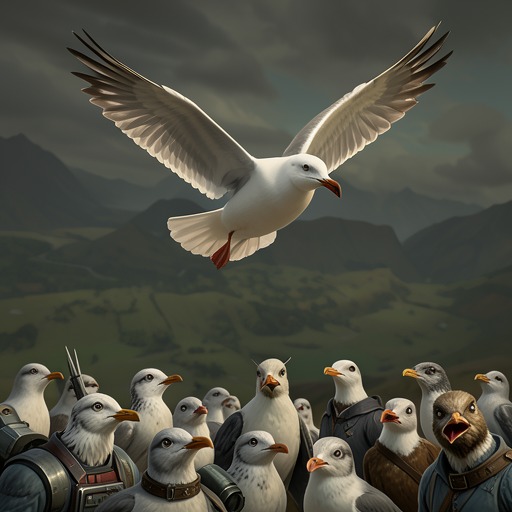
The risk becomes public when Jonathan fires through the center of the Breakfast Flock just after sunrise, moving at 212 miles per hour. His eyes are closed against the blast of wind and feathers. No gull is killed, but the passage is close enough to make the feat more than a private experiment: he has brought his new speed through the very flock whose ordinary morning routine his flying challenges.
Jonathan pulls his beak upward and is still traveling at 160 miles per hour. Only after slowing to twenty can he stretch his wings again; by then the boat is a speck four thousand feet below. He understands the achievement as a breakthrough and immediately returns to his lonely practice area to learn how to turn. The public demonstration therefore marks both arrival and unfinished work: the record has been reached, but control must continue to develop if the new speed is to become a broader skill.
That development begins with tiny movements. Jonathan finds that shifting a single wingtip feather by a fraction of an inch produces a smooth sweeping curve at tremendous speed. Moving more than one feather, however, spins him like a rifle ball. By learning to distinguish the effect of one small adjustment from the danger of a larger one, he extends the breakthrough beyond the straight dive. He discovers the loop, slow roll, point roll, inverted spin, gull bunt, and pinwheel, and later lands with a loop and snap roll. The discovery has become an expanding practice of precise control rather than a single record-setting maneuver.
Consequences and meaning
Jonathan expects the other gulls to celebrate. For him, the breakthrough means that life need not be a drab journey back and forth to fishing boats: gulls might rise out of ignorance and become creatures of excellence, intelligence, and skill. He connects the technical freedom to a larger promise—to be free and to learn to fly. That hope meets a sharp contrast when he returns to the beach and finds the gulls assembled for a Council gathering, waiting rather than welcoming him. The breakthrough changes what Jonathan can do, but it does not make the flock ready to accept what he has learned.
The discovery also anticipates a later change in his understanding of flight. In the new world, Chiang tells Jonathan that heaven is not a place or a time but a state of perfection, and that perfect speed is not a larger numerical velocity: it is being there. That teaching does not diminish the earlier experiment. Instead, it places physical mastery within a broader pursuit, in which limits can be questioned and flight can become a route toward understanding. Jonathan later learns thought-speed flight, while Chiang describes love and kindness as further stages of learning.
After Chiang’s departure, Jonathan thinks of returning to Earth because there may be another gull struggling to see flight as more than transportation or to break beyond the limits imposed by the flock. His experience of being outcast helps shape that decision, and he eventually returns with students. They arrive at Council Beach in a close formation at 135 miles per hour, perform a slow roll and loops, and land before the flock. The reception is still governed by the Elder’s command to ignore the outcasts, but younger gulls wonder where they learned to fly that way. In retrospect, Jonathan’s first breakthrough has consequences beyond its record: its practical discoveries become demonstrable knowledge, and demonstration makes teaching—and the possibility of change—thinkable.