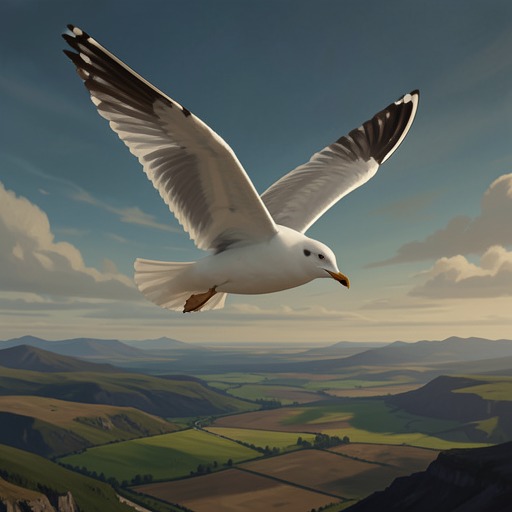
Jonathan's high-speed dive experiment and broken wing breakthrough
Jonathan Livingston SeagullJonathan Livingston Seagull’s high-speed dive experiments are a defining episode in his pursuit of flight: repeated failures force him to revise how he uses his wings, and each breakthrough opens a new limit to test. The sequence moves from a dangerous seventy-mile-per-hour stall to a controlled dive at 140 miles per hour, while making flight itself—not food or conformity—the measure of what a gull might learn and become.
A Different Measure of Flight
For most Seagulls, flight serves the practical passage between shore and food; Jonathan Livingston Seagull cares more about flying than eating. That difference shapes his experiments. He practices alone, repeatedly probing what the body can do rather than treating flight as a mere means of getting by. His speed trials are not an isolated stunt but an especially hazardous extension of a sustained commitment to learning.
The episode begins with an open question: what happens when a gull tries to dive at power? Jonathan climbs to one thousand feet, flaps hard, and tips into a steep descent toward the waves. After a week of practice, he has learned more about speed than any gull alive, but the first clear answer is failure: at seventy miles per hour, his wing becomes unstable on the upstroke. Speed supplies both the goal and the feedback that exposes the limit.
Repeated Failure and a Changed Technique
The loss of control recurs despite care and effort. Jonathan climbs, powers forward, and pushes into a vertical dive; his left wing stalls on an upstroke, he rolls left, the right wing stalls as he recovers, and he tumbles into a spin. Ten attempts end the same way. Each time, at seventy miles per hour, he crashes into the water, turning a precise experiment into a repeated bodily risk.
At last, dripping wet, he identifies a change he can make: flap only until he reaches fifty miles per hour, then keep his wings still. From two thousand feet he tries this with his wings extended and stable as he passes that speed. It takes tremendous strength, but the adjustment works: in ten seconds he exceeds ninety miles per hour, setting a speed record for Seagulls. The advance comes not from simply exerting more force, but from changing the wing action at the point where the earlier attempts failed.
Success, however, proves conditional. As soon as Jonathan begins to pull out of the dive and alters his wing angle, the old loss of control returns. At ninety miles per hour the crash strikes with terrible force, and he smashes into the hard sea. The experiment has solved the problem of accelerating through the dive, not the separate problem of safely changing direction at its end. Its dramatic reversal makes the record inseparable from the danger that the new speed brings.
Folding the Wings
After the crash, Jonathan turns the language of limitation into a technical clue. The thought of a falcon’s short wings suggests that he need not use the full span of his wings to dive fast. He climbs two thousand feet above the dark sea, draws his forewings tightly against his body, and leaves only the narrow, swept tips extended.
The result is a markedly different kind of control. The wind roars as the speed passes seventy, then ninety, then 120 miles per hour. At 140, the strain on his wings is less than it had been at seventy when he was trying to fly with them spread. With the faintest twist of the wingtips, he eases out of the dive and shoots above the waves, under control. The decisive adjustment is not to resist the air with greater force, but to reduce the exposed wing area and guide the movement with minute changes at the tips.
The breakthrough also reverses the meaning of the earlier failure. A body that seemed to confirm a gull’s fixed limits becomes something Jonathan can understand and use differently. He rejoices in reaching 140 miles per hour under control and immediately imagines trying a dive from five thousand feet. The success does not end his experiments; it renews them.
From Speed to Aerobatics
Later, after diving from eight thousand feet, Jonathan reaches terminal velocity: 214 miles per hour. He then turns from straight-line speed to the problem of turning. A single wingtip feather, moved a fraction of an inch, produces a smooth sweeping curve at tremendous speed. But moving more than one feather sends him spinning like a rifle ball. The difference between a controlled turn and a dangerous spin lies in an adjustment almost too small to see.
Having found how a feather can guide a high-speed curve, Jonathan spends the day flying past sunset and discovers a range of maneuvers: the loop, slow roll, point roll, inverted spin, gull bunt, and pinwheel. He returns to the Flock’s beach at full night, dizzy and terribly tired, and performs a loop into his landing with a snap roll just before touchdown. His new flying has expanded from a single record attempt into an increasingly varied practice of control.
Jonathan expects the Flock to celebrate the breakthrough as a reason for gulls to rise above ignorance and learn skill. Instead, the experiments mark him as a bird apart, and he is eventually Outcast. The contrast between his hope of shared discovery and the community’s rejection gives the technical achievement a social consequence: the same pursuit that makes flight a source of possibility for Jonathan places him outside ordinary flock life.
A Practice That Keeps Expanding
The dive experiments establish a pattern that persists beyond physical speed. Jonathan learns by defining a problem, trying a controlled change, reading the result, and revising his method. Repeated crashes teach him where the wing fails; a change in wing position carries him beyond that failure; and a fractional movement of one feather later makes high-speed turning possible. In each case, mastery depends on attention to a specific limit rather than on a vague wish to go faster.
That discipline becomes part of a larger conception of flight. Jonathan’s later teachers connect perfection not to reaching a higher numerical speed but to being present wherever he intends to go. He learns to understand himself as more than a body with a measurable wingspan, and the practice that began with physical experiments eventually reaches toward movement at thought-speed. The story does not erase the importance of technique: it makes close study of the body the first stage of learning to exceed what the body appears to permit.
The sequence also anticipates Jonathan’s decision to return to Earth. Remembering the flock he left behind, he wonders whether another gull might be struggling to see flight as more than a way to travel to a breadcrumb. He comes to regard teaching as a way of sharing what he has learned, and understands freedom not simply as personal speed but as the possibility that others may learn to fly. His early experiments therefore carry consequences beyond their records: they establish the method, the ambition, and the example he will eventually take back to the Flock.