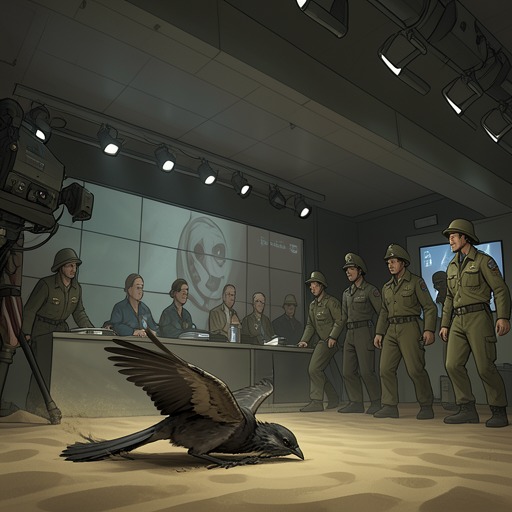
Kirk Maynard’s First Flight
Jonathan Livingston SeagullKirk Maynard’s First Flight is the decisive public demonstration of Jonathan Livingston Seagull’s teaching: a gull who arrives unable to move his injured wing rises into the night after Jonathan tells him that he is free. Kirk’s flight turns an intimate lesson among outcasts into a spectacle the Flock cannot ignore, and by sunrise nearly a thousand gulls are listening to Jonathan speak about freedom as a gull’s nature.
Background and Stakes
Jonathan’s teaching begins from a conviction that flight matters in itself, not merely as a way to reach food. For most gulls, flying is practical travel between shore and a meal; Jonathan instead treats it as a practice through which a gull can learn what it is capable of becoming. His return to the Flock therefore brings more than flying lessons: it challenges a community that has punished birds for departing from its accepted limits.
The lesson has a spiritual dimension as well as a physical one. Jonathan’s earlier teachers have framed heaven not as a place or time but as being perfect, and have linked the pursuit of kindness and love to the continuing work of learning. Jonathan’s own return to Earth grows from the wish to pass on what he has learned to a gull who wants the chance to discover truth. Kirk’s request gives that purpose a concrete test: can the principle of freedom reach a bird whose wing seems to make flight impossible?
Kirk’s Arrival and the Lesson
The first gull from the Flock crosses the boundary to ask Jonathan for instruction a month after the outcasts’ return. That choice has an immediate social cost: in asking to learn, Terrence Lowell Gull is condemned and labeled an Outcast. Kirk comes the following night, so the growing interest in Jonathan’s circle is not merely quiet curiosity; another gull is willing to risk exclusion for the possibility of flight.
Kirk does not arrive as an able-bodied beginner. He wobbles across the sand, drags his left wing, and collapses at Jonathan’s feet. He asks for help in a voice compared to that of someone dying, then explains that his wing cannot move. His wish is nevertheless unequivocal: he wants to fly more than anything else in the world. The contrast between that desire and his apparent physical incapacity sets the stakes of the encounter.
Jonathan invites Kirk to climb with him away from the ground and begin, but Kirk’s objection is specific: the problem is not lack of instruction in an ordinary maneuver; he cannot move his wing. Jonathan responds by declaring Kirk free to be himself, his true self, here and now, and says that nothing can stand in his way. He names this principle the Law of the Great Gull, the Law that Is. When Kirk asks whether Jonathan is saying he can fly, Jonathan sharpens the answer: he says that Kirk is free. The teaching shifts the focus from a damaged limb to the identity and possibility Jonathan believes lie beyond limitation.
The First Flight
Kirk spreads his wings simply and quickly, then lifts effortlessly into the dark night air. The scene gives an immediate, visible result to Jonathan’s otherwise abstract claim: the gull who had dragged one wing across the sand is now flying. From five hundred feet above the ground, Kirk cries out that he can fly, repeating the declaration loudly enough to wake the Flock.
The transformation is striking partly because the narrative does not describe a gradual rehabilitation or a physical treatment. Kirk arrives unable to move his wing, hears Jonathan’s teaching, and rises. The flight makes the difference between the two approaches legible: Kirk names the apparent bodily obstacle, while Jonathan directs him toward freedom as his true self. The episode thus presents flight not simply as a technique acquired through incremental practice, but as an ability that becomes available when Kirk accepts the possibility Jonathan has asserted.
Consequences and Significance
By sunrise, nearly a thousand birds stand outside the students’ circle, looking curiously at Kirk. The crowd no longer hides its interest in the way the night-time listeners had: the birds are willing to be seen and to hear Jonathan. Kirk’s flight has changed the scale of the teaching. What had circulated in the darkness around a small group now draws the attention of the wider Flock, whose members can see the result in the gull who rose above them.
Jonathan explains that it is right for a gull to fly, that freedom is the very nature of a gull’s being, and that whatever obstructs that freedom should be set aside, whether ritual, superstition, or limitation. The point reaches beyond Kirk’s injured wing. His flight supplies the gathering with a concrete instance of the freedom Jonathan is describing, while the address frames that freedom as something a gull may claim rather than a privilege conferred by the community.
The event also gives Jonathan’s return a pivotal consequence. He had imagined that there might be a gull on Earth struggling to break out of limits, perhaps even one made an Outcast for speaking against the Flock. Kirk’s request and flight answer that hope: a gull from the community has asked to learn, and his demonstration has brought others to listen. Yet the encounter does not resolve the conflict between teaching and tradition. As Jonathan speaks, a voice from the multitude asks whether the call to set aside restrictions applies even to the Law of the Flock. The question leaves the event at a threshold: Kirk has flown, the audience has gathered, and the community’s governing rule is now openly at issue.