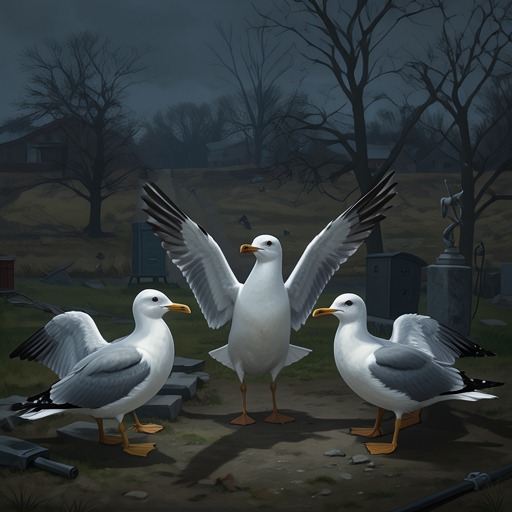
Law of the Flock
Jonathan Livingston SeagullThe Law of the Flock is the customary code by which the gull community marks transgression, banishes those judged to violate its traditions, and bars the banished from returning. Its force lies not only in formal judgment but in collective behavior: the Council declares the penalty, while the Flock enforces separation by refusing to look at or speak to an Outcast. Jonathan’s defiance turns that social rule into a conflict over whether tradition or freedom should govern a gull’s life.
Judgment and Exclusion
At the Council Gathering, the Elder summons Jonathan Livingston Seagull to the center and condemns him for reckless irresponsibility and violating the dignity and tradition of the Gull Family. Being centered for shame means expulsion from gull society and a solitary life on the Far Cliffs. The ceremony converts a disputed judgment about his flight into a public sentence: the community treats his pursuit of a new purpose as an offense against its inherited order.
Jonathan answers that a gull who follows a higher purpose is acting responsibly. He argues that gulls need not spend their lives scrabbling after fish heads, but can learn, discover, and become free. The Flock does not engage his appeal. Its members declare the Brotherhood broken, close their ears, and turn their backs, making social abandonment part of the punishment. Jonathan’s sorrow is not solitude itself but the other gulls’ refusal to believe in the possibilities flight has opened.
The Ban on Return
The rule also reaches beyond the moment of expulsion: an Outcast is not to return to the Flock. When Jonathan turns east toward the home grounds with his students, Henry Calvin warns that they are Outcasts and unwelcome. The students recognize the gravity of the decision because, as they understand it, the Law has not been broken in ten thousand years. Jonathan nevertheless flies ahead toward a potentially hostile Flock; Fletcher reasons that those outside the Flock need not obey its law and that the group may be more useful there than at a distance.
The students follow in a formation of eight, flying across Council Beach at 135 miles per hour, with Jonathan leading and Fletcher at his right wing. Their return makes the prohibition visible as a test of authority: the old rule says they must stay away, while Jonathan’s action insists that exclusion cannot dictate where they may go. The Flock is first struck by confusion rather than the anticipated battle, as the returned Outcasts’ skill unsettles the expectation that the ban will define them completely.
Enforcement and Challenge
The Elder’s instruction takes almost an hour to pass through the Flock: gulls must ignore the Outcasts, and any gull who speaks to or even looks upon one becomes an Outcast in turn. The Law is thus maintained by extending the threat of exclusion to anyone who acknowledges the excluded. Gray-feathered backs turn toward Jonathan, but he continues holding practice sessions directly over Council Beach and presses his students to the limits of their ability. The rule can control recognition and contact; it does not stop him from teaching in view of the community.
When the watching gulls ask whether freedom can set aside even the Law of the Flock, Jonathan answers that the only true law is the one that leads to freedom. He rejects the idea that inherited limits are justified merely because they are laws. His further example is practical rather than exceptional: Fletcher, Lowell, Charles-Roland, and Judy Lee are not divinely gifted, he argues; they have begun to understand what they are and to practice it. The challenge therefore shifts the question from obedience to capacity—whether the Flock’s members will accept a rule that suppresses the very freedom and learning they might develop.
Meaning and Consequences
The Law of the Flock works through both formal punishment and shared consent. The Elder names shame and expulsion; the community gives the decree continuing force by turning away and treating even a glance toward an Outcast as a breach. Yet the return of Jonathan and his students shows that the rule’s reach is not absolute: those it excludes can still act together, demonstrate their abilities, and teach within sight of the Flock.
The conflict does not show that the prohibition has been formally repealed. Instead, it exposes the difference between the Law’s established authority and its justification. By placing freedom, discovery, and practice against a rule defended through tradition and enforced through social isolation, the story presents obedience as a choice with consequences—not as proof that the rule itself is right.