Love as a Practice
Jonathan Livingston SeagullLove as a Practice is the principle that turns Jonathan Livingston Seagull’s pursuit of flight into a commitment to teach. It is not approval of cruelty or a feeling that arrives automatically; it is a discipline of looking past a hostile crowd to recognize the potential of individual gulls, then helping them recognize that potential in themselves. The principle binds technical practice to kindness and gives Jonathan’s return to Earth its purpose.
From Flight to a Wider Aim
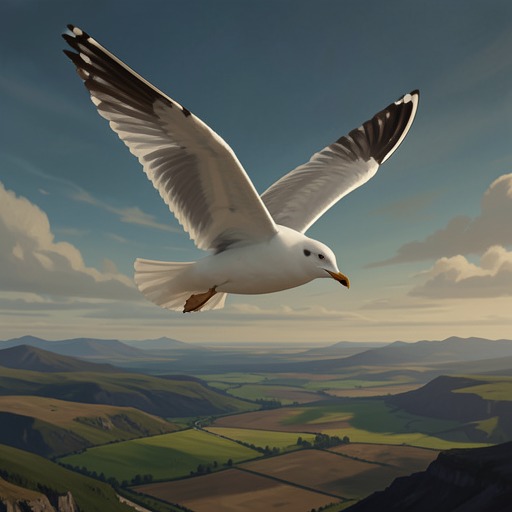
At first, Jonathan’s attention is fixed on flight itself. Most gulls learn only enough to travel between shore and food, because eating matters more to them than flying. Jonathan reverses that priority: he loves flight and tests what his wings can do, even when solitary experimentation dismays his parents and makes him unpopular with other birds. His devotion begins as a pursuit of excellence, distinct from the Flock’s practical habits.
That pursuit develops through failure as well as achievement. In repeated dives, Jonathan discovers the danger of flapping through high speeds, then learns to hold his wings still to pass ninety miles per hour. Later, he finds that a single wingtip feather can guide a smooth curve at tremendous speed. These experiments make flight a practice of attention, understanding, and correction rather than mere motion. They also establish the pattern that will carry into his later teaching: learning comes through sustained effort and a willingness to revise what one thinks possible.
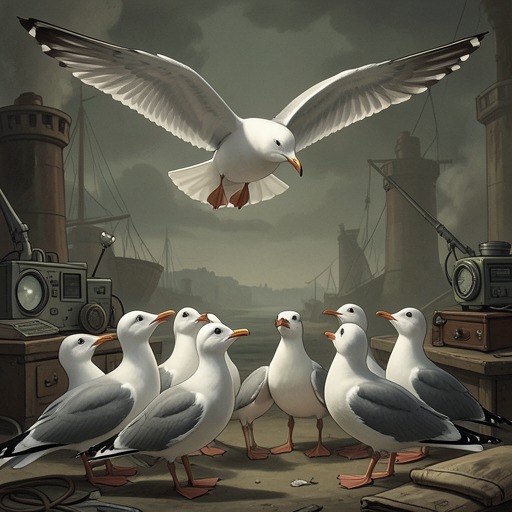
His first breakthrough does not win the response he hopes for. Returning to the beach eager to share what flight might make possible, Jonathan is summoned to the center not for honor but for shame. The Flock condemns him for violating its tradition, and he becomes an Outcast. The rejection makes his later commitment to the Flock morally consequential: loving it cannot simply mean enjoying fellowship with it, since fellowship has been withdrawn and its members have treated his pursuit as an offense.
Learning Kindness and Love
In the new world, Chiang connects Jonathan’s development to a horizon beyond speed or technique. He teaches that heaven is not a place or time but a condition of perfection, and that perfect speed is not a measurable number: it is being there. Jonathan’s training similarly moves from physical control toward a changed understanding of what he is. He practices thought-speed flight day after day, initially without moving even a feather-width, until he understands himself as an unlimited gull and appears with Chiang on a different shore.
The instruction eventually names love as the next stage of learning. Chiang tells Jonathan that he will be ready to study the meaning of kindness and love after learning to work with time and fly through past and future. Before Chiang disappears, his final counsel to Jonathan is to keep working on love. The wording matters: love is something to practice and continue learning, not a status already secured by Jonathan’s skill or by his experience of transcendence.
Jonathan’s education changes what he wants to do with what he has learned. Remembering Earth, he imagines that a gull there may be struggling to move beyond the Flock’s limits, perhaps even an Outcast for speaking what that gull believes to be true. The more Jonathan practices kindness and tries to understand love, the more he wants to return. The decision arises from a particular recognition: his own lonely history may help him serve a learner who asks only for a chance to see the truth for himself. Jonathan understands teaching as his way of giving something of that truth to another gull.
Returning to the Flock
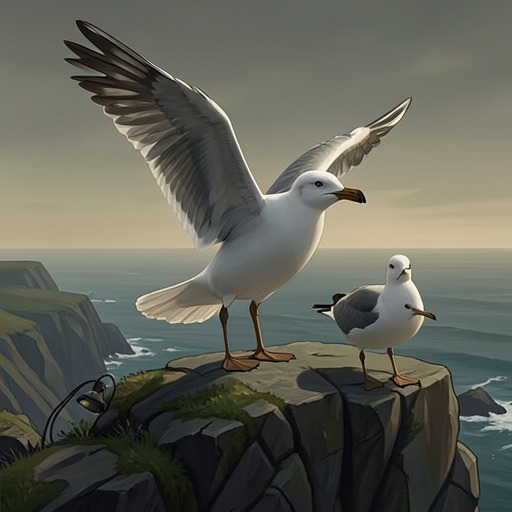
Jonathan’s return gives the principle its practical test. On Earth, he begins teaching Fletcher Lynd Seagull and other Outcasts, whose experience of exclusion recalls his own. Fletcher has been expelled after pursuing more in flight than travel from place to place, and he initially looks toward the Far Cliffs with anger at the injustice done to him. Jonathan’s work with him is not merely to pass on difficult maneuvers; it is to help him discover a different direction for the life that exile might otherwise make bitter.
The contrast becomes explicit after the Flock tries to kill Jonathan and Fletcher asks how his instructor can love a mob of birds responsible for such hostility. Jonathan draws a boundary: love does not mean loving hatred or evil. It means practicing the ability to see the real gull—the good in each bird—and helping that bird see the good in itself. In this account, love is neither endorsement of the crowd’s behavior nor a denial of what happened. It is an effort to address the individual capacities that the crowd’s hostility obscures.
Jonathan makes the principle concrete by recalling Fletcher’s change. He describes the young Fletcher as newly Outcast, prepared to fight the Flock and to build a bitter life on the Far Cliffs; now Fletcher is building his own heaven and leading the Flock in that direction. The example turns love into attention to a person’s development across time. Fletcher is not defined by his anger at expulsion, nor by the group’s judgment of him: Jonathan sees the learner and emerging teacher he can become.
Teaching Passed On
By the end, love has become inseparable from the transfer of responsibility. When Jonathan suggests that other flocks and other Fletchers may need an instructor more than this one, Fletcher is frightened by the possibility of leading without him. Yet the work has prepared Fletcher to continue: he begins a lesson in level flight with his students and suddenly sees them as they really are. His response is not only approval but love, and the race to learn begins for him anew.
That closing change echoes Jonathan’s original attention to flight while altering its direction. The young Fletcher once treated flight as a means of escaping the limits imposed by the Flock; as instructor, he sees the students before him as learners whose potential deserves his care. The text does not make love a substitute for practice: Fletcher’s new perception starts a renewed effort to learn. Instead, it makes learning relational. The teacher must keep looking, and the student’s possibilities become the reason to continue.
The story’s ethic therefore depends on both vision and action. Jonathan’s understanding of perfection and freedom would remain private achievement if he did not return to teach; his love becomes legible through the repeated work of helping another gull learn. Fletcher’s succession carries that work beyond Jonathan’s presence. Love as a Practice is the bridge between individual liberation and a community’s possible change: not obedience to the crowd, and not indulgence of its harm, but a patient commitment to see and cultivate what the birds within it might become.