Stand to Center
Jonathan Livingston Seagull“Stand to Center” is the flock’s ceremonial summons to the center of an assembly, where a gull may be marked for either great honor or great shame. In Jonathan Livingston Seagull’s story, the phrase first promises recognition for his flight breakthrough, then delivers his expulsion; its later echo in the rules enforced against returning Outcasts shows how ceremony and law can make communal judgment visible and consequential.
Meaning and Ceremony
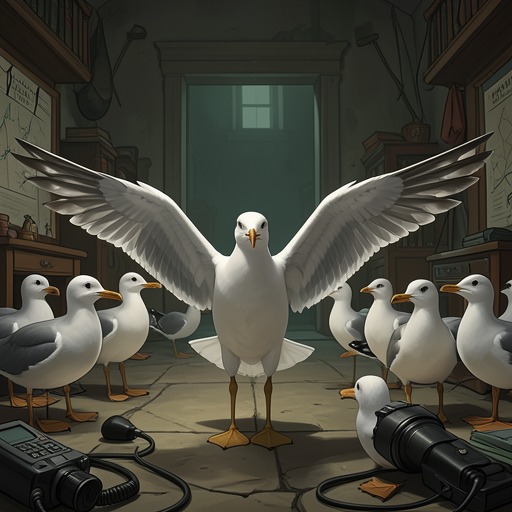
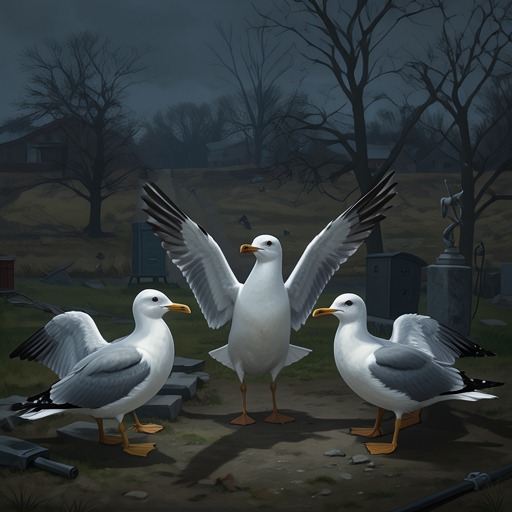
At the Council Gathering, the gulls are already assembled and waiting when Jonathan lands. The Elder calls his name and orders him to “Stand to Center!” The narration explains that the command signifies only great shame or great honor, and that the foremost leaders of the gulls are marked by standing at the center for honor. The phrase is therefore not a neutral request to approach: it announces a public judgment whose meaning depends on the verdict that follows.
Jonathan initially reads the summons as recognition. He assumes the Breakfast Flock witnessed his breakthrough and imagines that the Council intends to honor him. But he does not want honors or leadership; he wants to share what he has found and show the others new horizons. He steps forward expecting an opportunity to communicate his discovery, not to claim status.
The Reversal and Expulsion
The Elder instead declares Jonathan centered for shame in the sight of his fellow gulls. The sudden reversal leaves him physically shaken: his knees weaken, his feathers sag, and his ears roar. He cannot reconcile the punishment with what he understands as a breakthrough, and the public ceremony makes the flock’s rejection immediate and unmistakable.
The Council’s stated charge is reckless irresponsibility and violation of the dignity and tradition of the Gull Family. The consequence attached to being centered for shame is expulsion from gull society and a solitary life on the Far Cliffs. The Elder’s warning frames the flock’s purpose narrowly: life is unknowable, but gulls are supposedly born to eat and remain alive as long as possible. Jonathan answers that seeking meaning, learning, discovery, and freedom is a more responsible purpose than endlessly scrabbling after fish heads. His reply contests the moral basis of the verdict even as he faces its cost.
From Ceremony to Law
The logic behind Jonathan’s punishment persists in the rule governing Outcasts: an Outcast must never return to the flock. His students recognize that the rule has not been broken in ten thousand years, yet Jonathan flies back toward the home grounds, and they follow. Their return makes the conflict between law and freedom public rather than merely personal. When the returned gulls arrive at Council Beach in formation, the Elder’s Word commands the flock to ignore them: speaking to an Outcast makes a gull an Outcast, and even looking at one breaks the Law of the Flock.
The summons and the later prohibitions share a method: communal judgment is given force through words that define who may belong and what others may do. The Elder’s verdict casts Jonathan out; the Word then tries to make that exclusion contagious. But the students’ return and the growing curiosity of other gulls expose the limits of the rule’s authority. A month after the return, Terrence Lowell Gull asks to learn flying and is himself labeled an Outcast, becoming Jonathan’s eighth student.
A Counter-Rule of Freedom
The flock’s challenge to Jonathan’s teaching is stated plainly by a voice in the multitude: should freedom be pursued even if it means setting aside the Law of the Flock? Jonathan answers that the only true law is the one that leads to freedom. The contrast gives the earlier ceremony a wider significance. “Stand to Center” is not only an individual punishment; it is the first formal expression of a community that treats inherited tradition as a reason to condemn a new purpose.
Yet the story also shows the judgment losing its power to settle what gulls may become. Jonathan teaches that flight is a gull’s right and freedom its nature, and points to his students as proof that they are not uniquely gifted: they have begun to understand what they are and to practice it. After Jonathan vanishes, Fletcher Lynd Seagull faces a new group of eager students and begins teaching in turn. The ceremonial center once used to mark Jonathan for shame gives way, in the larger arc, to repeated acts of learning that carry his challenge beyond the Council’s verdict.