Sullivan
Jonathan Livingston SeagullSullivan is Jonathan Livingston Seagull’s instructor, fellow learner, and friend in the new world, where flight becomes both a disciplined practice and a path toward understanding. He helps Jonathan interpret his rapid progress, explains how learning shapes a gull’s next world, and then faces a difficult choice with him: remain among advanced students or return to Earth to teach gulls who may be struggling as he once did.
Identity and Role
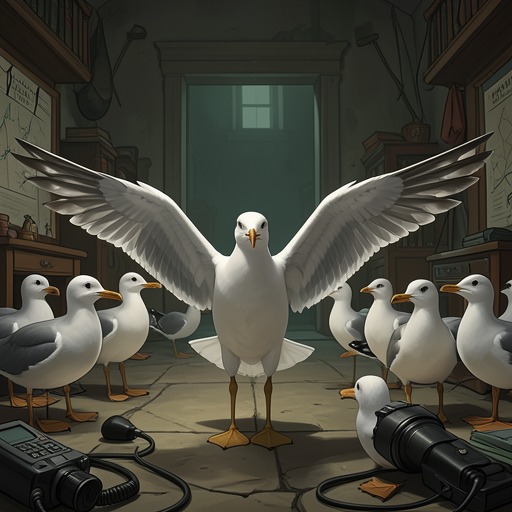
Sullivan belongs to a community of gulls who regard the pursuit of perfection in flight as central to living. In this world, gulls spend hours practicing and testing advanced aeronautics, unlike the Flock on Earth, which chiefly uses flight to find food and compete for it. Sullivan serves as Jonathan’s instructor within this learning community, but his role is not limited to technical training: their conversations also give Jonathan a way to understand the meaning of his progress and the possibility of further growth.
Sullivan himself advances in the practice. By the time Jonathan considers leaving, Sullivan is adept at thought-speed flight and helps other gulls learn it. His own mastery makes him a credible guide to the learning available in this world, while his work with the newcomers shows that he has become a teacher as well as Jonathan’s instructor.
Teaching and the Meaning of Learning
During a rest on the beach after practicing folded-wing snap rolls, Jonathan asks Sullivan why there are so few gulls in this world when Earth had thousands. Sullivan answers with a long view of spiritual and intellectual development: most gulls move through many lives without discovering that life can mean more than eating, fighting, or gaining power in the Flock. Only gradually do they apprehend perfection as a possibility and come to see the search for it as a purpose.
He connects that progression to the choices made in the present. Gulls choose their next world through what they learn in this one; learning nothing leaves them with the same limitations to overcome. Sullivan contrasts that slow passage with Jonathan’s exceptional rate of growth: Jonathan has learned so much at once that he did not need a thousand lives to reach this world. His teaching gives Jonathan’s unusual speed a larger meaning. It is not simply a talent for mastering difficult maneuvers, but evidence of a readiness to move beyond an older understanding of what life is for.
Sullivan also acknowledges the limits of what Jonathan has yet learned. After an exchange with the Elder, Jonathan begins to understand heaven not as a separate place or time but as perfection, and learns that perfect speed means being there rather than attaining a finite number of miles per hour. Later, when Jonathan has worked intensely at thought-speed flight without moving even a feather-width, Sullivan is part of the learning environment in which Jonathan persists. The effort eventually turns on understanding: Jonathan recognizes himself as an unlimited gull and finds himself with the Elder on a different shore. The episodes mark a widening of the curriculum from measurable performance toward a conception of identity and freedom that exceeds bodily limits.
Friendship and Intellectual Kinship
Their connection rests on shared practice and conversation as much as on instruction. Jonathan’s skill develops in a community where gulls communicate telepathically instead of through cries, and he asks Sullivan directly about the difference between this small company and the thousands of gulls he remembers from Earth. Sullivan answers without dismissing the question, treating Jonathan as a student capable of confronting the long history behind that difference.
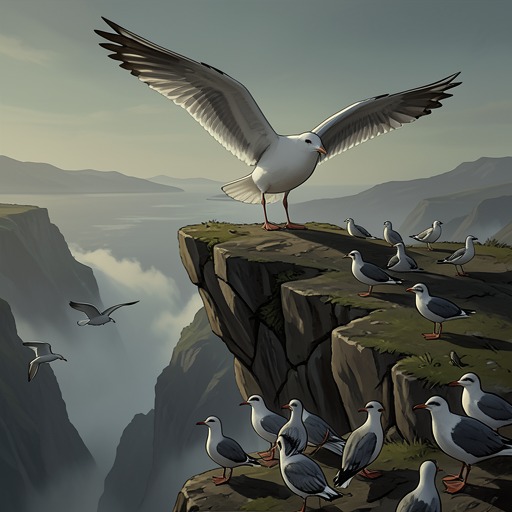
When Jonathan later tells Sullivan that he must return to Earth, Sullivan argues against the decision. Jonathan has been an Outcast there, and Sullivan doubts the old Flock will listen to a gull who has left it. He invokes the proverb that the gull who flies highest sees farthest: Earth’s gulls, he says, remain caught in squabbling and cannot see what Jonathan hopes to show them. He urges Jonathan to stay and help the newcomers who are already high enough to understand his teaching. His objection is not a rejection of their friendship; it is a practical judgment about where Jonathan’s knowledge can be heard and used.
Jonathan answers by challenging the idea that distance can define their bond. If friendship depends on space and time, he reasons, then overcoming space and time should not destroy their brotherhood; it should leave them with a shared here and now. Sullivan laughs despite himself and admits that, if anyone can show a grounded gull how to see a thousand miles, it will be Jonathan. He then says goodbye as a friend, not merely as a teacher releasing a student.
Jonathan’s Return and Sullivan’s Aftermath
Jonathan’s decision grows out of his memories of Earth and his developing understanding of kindness and love. He wonders whether a gull there might be trying to break free of inherited limits, perhaps even an Outcast who has spoken against the Flock. He imagines how much his own life might have meant if he had possessed even a fraction of what he knows now when he was expelled. Teaching, for him, becomes a way of giving another gull the chance to see the truth for itself.
Sullivan recognizes both the difficulty and the possibility of that plan. Once Jonathan says that the students already in their care can help Sullivan bring along the newcomers, Sullivan does not continue to argue. He says he will miss Jonathan, and their farewell turns the disagreement into an expression of trust: Jonathan insists that mastery of space and time need not undo their friendship, and Sullivan accepts the promise implicit in that belief. Jonathan departs holding in thought the image of great gull-flocks on another shore, confident in his identity as an idea of freedom and flight rather than a body limited by bone and feather. Sullivan remains behind, able to continue helping new gulls learn.
Narrative Significance
Sullivan links Jonathan’s personal apprenticeship to the book’s larger account of learning across lives and worlds. He interprets exceptional flight not as a final achievement but as one stage in a continuing education, and his counsel helps distinguish technical excellence from the deeper work of understanding perfection, kindness, and love. His warning about the old Flock gives Jonathan’s return real uncertainty: the teacher may be rejected again, and the students already gathered around Sullivan offer a more immediate place to serve.
Yet Sullivan’s eventual acceptance allows the story to present teaching as a form of friendship rather than possession. He does not hold Jonathan to the community where he has flourished; he recognizes that the lessons learned there may have their fullest test elsewhere. Their parting therefore preserves two connected paths: Sullivan stays to teach the gulls arriving in the new world, while Jonathan carries the practice and its meaning back to Earth.