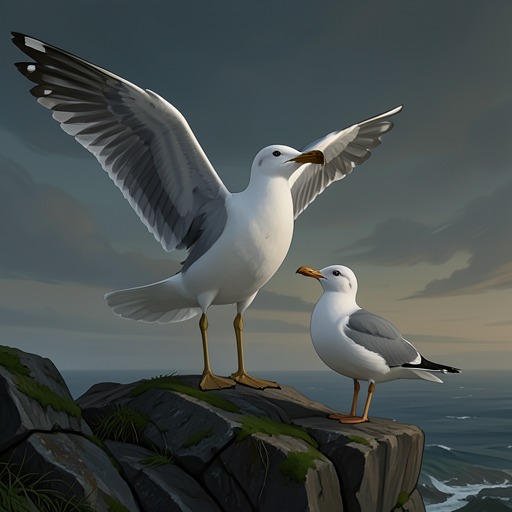
The master-apprentice relationship between Jonathan Livingston Seagull and Fletcher Lynd Seagull
Jonathan Livingston SeagullJonathan Livingston Seagull’s mentorship of Fletcher Lynd Seagull transforms flight from a personal discipline into a practice that can be taught, questioned, and passed on. Jonathan offers more than advanced technique: he asks Fletcher to learn freely, forgive the Flock that cast him out, and return to help it learn. Their relationship reaches its decisive change when Jonathan departs and Fletcher takes up the work, discovering that teaching requires both practical instruction and a new way of seeing his students.
Origins of the Apprenticeship
Fletcher enters the relationship as a young outcast already convinced that flying must mean more than getting from place to place. After a playful barrel-roll around the Elder Gull leads to his expulsion, he flies toward the Far Cliffs in anger, determined to prove what the Flock refuses to recognize. His grievance is not simply that he has been punished: he believes the flock has denied the possibility of learning flight for its own sake. That conviction makes him receptive to a different teacher, but his hurt also makes reconciliation a real demand rather than a lesson he can accept without resistance.
Jonathan meets that opening with a question that makes desire the condition of instruction. He asks Fletcher whether he wants to fly, then whether he wants it enough to forgive the Flock, learn, and one day return to help it understand. Fletcher’s answer is quiet but affirmative. The exchange establishes the ethical shape of the apprenticeship: technical ambition alone is not its end. Jonathan links the wish to fly with a willingness to learn and with a future obligation to the community that rejected Fletcher.
The first instruction is deliberately basic: level flight. Jonathan does not treat Fletcher’s eagerness as proof that he is already accomplished; the student must begin with fundamentals and build through practice. This starting point also makes the relationship distinct from a simple encounter between a gifted flyer and an admirer. Fletcher has ability and drive, but he enters as a learner who must accept correction and work through the limits of his present control.
Practice, Demonstration, and Correction
Fletcher’s early training shows both his promise and the difficulty of converting effort into precision. He is strong, light, and quick, with an especially powerful desire to learn. In one exercise he comes out of a dive at 150 miles per hour and attempts a sixteen-point vertical slow roll, calling out the points as he goes. He loses airspeed near the top, fails to complete the final points, and falls into a violent recovery. The scene makes his commitment visible while refusing to confuse intensity with mastery.
When Fletcher despairs that he is too stupid ever to succeed, Jonathan diagnoses a concrete flaw rather than accepting the student’s judgment of himself. Fletcher has lost forty miles per hour at the entry because he pulls up too hard. Jonathan tells him to be smooth—firm but smooth—and drops down to fly the maneuver alongside him. Their practice is collaborative: instruction means identifying the error, explaining its consequence, and attempting the movement together, not merely displaying a superior performance from above.
This method continues the book’s broader image of Jonathan as a learner who treats flight as something to investigate rather than as a means of reaching food. Earlier, he experimented with low glides and discovered how flying close above the water could keep him aloft longer with less effort. Later, while studying speed, he repeatedly attempted steep power-dives from 1,000 feet and encountered instability at 70 miles per hour. Those experiments are not Fletcher’s lessons, but they clarify what Jonathan brings to the relationship: technical knowledge acquired through observation, failure, and repeated practice. His teaching translates that exploratory discipline into guidance another gull can use.
The lesson grows beyond isolated maneuvers. Jonathan and his students practice difficult formation point-rolls, requiring him to reverse the curve of his wings while thinking upside down and staying in exact harmony with his instructor. The scene demonstrates learning as coordinated action: precision depends not only on an individual’s control but on attention to another flyer’s timing and movement. Jonathan’s own willingness to practice under instruction also places the teacher within a continuing discipline rather than above it.
Technique and the Meaning of Flight
Jonathan’s teaching joins physical precision to a theory of freedom. He tells his students that each is an unlimited idea of the Great Gull and that precision flying can express their real nature. High-speed work, low-speed work, and aerobatics are not ends in themselves; they are ways of putting aside what limits them. He also describes the visible body as thought in a form that can be seen, arguing that breaking the chains of thought breaks the chains of the body. The claims give Fletcher a conceptual framework for the practice, but the narrative stresses that understanding does not arrive as quickly as skill.
The students enjoy the speed and excitement of flying and grow hungrier to learn with every lesson, yet they do not initially believe that the flight of ideas can be as real as the flight of wind and feather. Jonathan’s explanations can sound like pleasant fiction after a day of exhausting practice. The gap matters to Fletcher’s apprenticeship: copying a movement is not the same as grasping the freedom it is meant to express. Jonathan teaches both, but cannot make the second understanding automatic simply by stating it.
This relation between technique and meaning is part of Jonathan’s own development. On arriving in the new world, he learns that heaven is not a place or a time but being perfect; perfect speed is not a larger numerical velocity but being there. Chiang later tells him that the next difficult work is to fly up and know kindness and love. After Chiang vanishes, Jonathan’s thoughts return to Earth and to the possibility of a gull struggling against the same limits he once faced. He comes to understand teaching as his way of giving another bird the chance to see the truth for himself. Fletcher becomes the particular student through whom that decision takes practical form.
Returning to the Flock
After months of practice, Jonathan has six other students, all outcasts, drawn by the strange idea of flying for the joy of flight. He then announces that it is time to return to the Flock. The students object that they are unwelcome and cannot force themselves into a place that has condemned them. Jonathan answers that they are free to go where they wish and be what they are, then leads them east toward the Flock’s home grounds. For Fletcher, this return enacts the charge built into his first conversation with Jonathan: forgiveness and learning are to lead back toward the community, not merely away from it.
The return does not end the teaching at the edge of the student group. A month later, the first gull from the Flock crosses the line to ask for instruction; Terrence Lowell Gull is consequently labeled an outcast and becomes Jonathan’s eighth student. The next night Kirk Maynard Gull arrives dragging his left wing and asks to fly more than anything in the world. These newcomers show how the return alters the conditions of the relationship: Fletcher’s apprenticeship takes place within a growing circle of learners, while Jonathan’s invitation creates opportunities for other members of the Flock to cross the boundary that once excluded him.
Jonathan’s return to Earth is grounded in the belief that knowledge should be shared with those who ask for a chance to discover it themselves. In his earlier world he had been expelled for pursuing flight beyond the Flock’s accepted purpose; in the new world he learns that he can go back without treating the old community’s limits as binding. Fletcher’s role is therefore not to repeat Jonathan’s isolation but to help make learning possible among the gulls who remain there.
Succession and the Teacher’s Departure
When Fletcher asks how Jonathan can love a mob that has just tried to kill him, the question brings the cost of returning into focus. Jonathan’s answer is not a denial of the danger or a claim that Fletcher has no reason to be hurt. Instead, the earlier instruction resurfaces: Fletcher had agreed to forgive the Flock and return to help it learn. The test of the apprenticeship is whether that commitment can survive an encounter with the flock’s violence.
Jonathan eventually tells Fletcher that he is no longer needed in the same way. Fletcher does not need to depend on his teacher; he must keep finding the real, unlimited Fletcher and learn to practice that self. Jonathan explicitly rejects the idea that he should be made into a god or surrounded by foolish rumors. As his body shimmers and vanishes, he tells Fletcher not to trust the limitations suggested by his eyes, but to look with understanding. His departure transfers authority without turning the teacher into an object of worship.
Fletcher takes up that responsibility after Jonathan is gone. He drags himself into the sky to face a new group of students and begins by repeating Jonathan’s account of the gull as an unlimited idea of freedom, with the body as thought made visible. The young gulls look puzzled; to them, the explanation does not sound like a rule for a loop. Fletcher sighs, starts over, and gives them the immediate practical beginning: level flight. In that adjustment he inherits Jonathan’s aim without merely imitating his manner. He recognizes that students need an entry point they can use, even when the larger meaning is not yet within reach.
Fletcher also reaches a new understanding of Jonathan. He realizes that his friend was no more divine than he is, and sees his own students as they really are. For a moment he loves what he sees in them. The apprenticeship thus concludes not with Fletcher becoming a copy of his master, but with him beginning his own race to learn and to teach. Jonathan’s departure leaves the work unfinished by design: the relationship has succeeded because Fletcher can continue it without his presence.