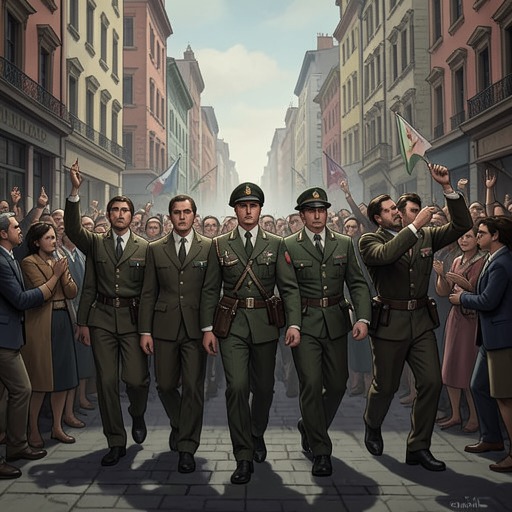
“Vive la France!”
Journey to the End of the Night“Vive la France!” is the patriotic cry Ferdinand Bardamu deploys in a moment of mortal danger aboard the Admiral Bragueton. Its importance lies in the gap between its grand national sentiment and its immediate, practical use: the slogan interrupts a threatened beating and buys Bardamu time to escape the confrontation through performance and flattery.
A cry borrowed for survival
Bardamu’s predicament is perilous. The captain has not decided what to do, while the officers around him have come prepared to beat him; civilians have also gathered, eager for the spectacle. Bardamu admits that he does not know exactly what he is saying and clings instead to a lyrical performance, holding the captain’s hands as the ship presses through fog. At the climax of his speech, he raises one arm and cries, “Gentlemen: Aren’t we all agreed that brave men will always come to an understanding in the end? So damn it all, Vive la France! Vive la France!”
The device is not his own. Bardamu identifies it as Sergeant Branledore’s gimmick, which had worked before. Its success depends less on patriotic conviction than on the social difficulty of striking a man who has just shouted the national slogan. The officers hesitate, and that brief pause saves Bardamu.
From danger to an uneasy armistice
Bardamu immediately turns the hesitation into an invitation: he takes two officers by the arms and proposes that everyone go to the bar to drink to his health and their reconciliation. The men resist for barely a minute before joining him; they drink for two hours. The slogan thus opens a narrow path from imminent violence to temporary conviviality, though the reconciliation is fragile rather than a genuine resolution.
The women watching remain silent and increasingly disappointed. Bardamu sees the schoolteacher-pianist prowling with them through the portholes, and recognizes that they suspect he has talked his way out of the trap and intend to catch him later. For the moment, however, he keeps the officers’ attention by praising their colonial feats of arms and asking for more war stories. The patriotic cry begins a performance that he sustains by giving the soldiers an audience for their vanity.
Meaning and irony
The episode makes the slogan a tool of self-preservation rather than a simple declaration of national loyalty. Bardamu says that this was the only time France saved his life; otherwise, he adds, the opposite had been closer to the truth. The irony rests on the contrast between the elevated language of national solidarity and the immediate threat of bodily violence aboard the ship. Here, patriotism works because it momentarily restrains men who are otherwise prepared to attack him.
The cry does not end the danger so much as alter its timing and shape. Bardamu escapes the immediate assault through borrowed words, a calculated appeal to military pride, and an improvised display of admiration. Its force in the scene is therefore both political and theatrical: a familiar patriotic formula becomes a temporary shield, while the fragile drinking truce leaves the threat of renewed hostility in view.